5 Common Reasons Companies Fail at Hiring Foreign Workers | Key Criteria to Review Before Adoption

With shortages of infrastructure engineers and developers, more companies are hiring foreign talent. But in many cases, work does not run smoothly after they join, increasing the burden on the team. A major reason is using hiring simply as a way to fill labor gaps. This article explains the conditions under which foreign hiring works, the common traits of failed companies, and practical criteria for deciding whether to adopt it.
Contents
※Please be noted that this blog is translated automatically by AI
Why is hiring foreigners difficult?
Foreign hiring is often discussed as a way to broaden recruiting channels, but if it is designed with the same assumptions as domestic hiring, it often fails.
The reason is that it is closer to "organizational design" than to a "hiring method".
Different assumptions from domestic hiring
With Japanese hiring, candidates are already adapted to the Japanese-language and work culture environment, so companies can focus on skills and culture fit.
In foreign hiring, however, variables such as language, understanding of work processes, and expectation gaps arise at once, so the same interview process sharply lowers evaluation accuracy.
For example, if you hire a candidate unfamiliar with Git operations or code-review culture based only on skills, code reviews may fail after joining, increasing senior engineers' workload and lowering team productivity.
This is not a hiring problem, but a lack of upfront design.
The misconception that it solves labor shortages
Many companies fall into the trap of deciding to "fill labor shortages with foreign talent."
However, foreign hiring is not about immediate capacity replacement; it is an investment-style hire based on evaluation and management design.
Tier 1 talent is highly competitive globally, and compensation is often higher than in Japan, so simple labor-cost optimization does not work.
Tier 2 talent, on the other hand, varies widely in skill, and if screening accuracy is low, post-hire training costs balloon.
In other words, foreign hiring does not work simply by "bringing people in because there are not enough." It only works when you clearly define which layer to hire and with what design.
Related articles

Despite stronger IT engineer hiring, offer declines and skill mismatches keep rising, increasing team workload. The core issue is not too few applicants, but flaws in hiring design. This article clarifies common misconceptions about the IT talent shortage and explains practical criteria and redesign methods—including overseas hiring—to prevent recruitment failures.


Common structure of failing companies
Companies that fail to see results from hiring foreign employees have a common structural flaw, not isolated problems.
It comes down to the fact that the hiring process itself moves forward while the design of evaluation and acceptance remains vague.
Vague evaluation criteria
Many companies reuse the vague standards they used for hiring Japanese employees, such as "potential" and "culture fit," for foreign hiring.
However, in situations where language and cultural assumptions differ, these qualitative judgments rarely work.
As a result, each interviewer rates candidates differently, skill definitions are inconsistent, and offers are made without alignment, leading to a gap that appears later as "not meeting expectations."
Especially in technical roles, hiring accuracy cannot be secured unless practical abilities such as design skills and code review response are broken down and evaluated concretely.
Postponing the acceptance setup
Another common issue is putting post-hire design off until later.
Specifically, this includes undeveloped onboarding materials, no rules for English communication, and unadjusted evaluation systems.
If hiring proceeds like this, job instructions become vague after joining, and projects move ahead without aligning expectations.
As a result, the employee feels they do not know what is expected, while the team feels they do not know why the person cannot perform, creating mutual distrust and leading to early resignation or lower performance.
In other words, failure in foreign hiring should be seen not as a hiring problem, but as a design mistake: a lack of evaluation and language clarification.
Typical on-site mistakes
If foreign hiring proceeds without a solid evaluation and onboarding design, problems surface on the floor after hiring.
And they appear not as a simple mismatch, but as a drag on the productivity of the entire organization.
Doesn't Work After Joining
You may hire an engineer who scored highly in the final interview, but once assigned tasks after joining, design reviews keep sending the work back, and senior engineers end up rewriting the code.
At first this is treated as a "catch-up" issue, but in reality the cause is insufficient job understanding and prerequisite skills, so quick improvement is unlikely.
If this continues, the whole team slows down, and training costs balloon beyond expectations.
In other words, the person you hired to add capacity ends up consuming it.
Early Resignations and Offer Declines
Another typical case is an increase in offer declines and early resignations.
In particular, overseas talent from places like India tends to prioritize "salary," "growth opportunities," and "market value"; if the offer or role is vague, they are more likely to move to a better offer.
In practice, there are cases where candidates decline a few days after receiving an offer because of another company's offer, or leave within a short time because the work differs from what they expected after joining.
This is not a candidate problem; it happens because the company has not clearly communicated the role definition and expectations.
If you can't identify at which stage the mismatch occurred, the same failures will repeat. You need to break down the entire hiring process once and redesign the evaluation, offer, and onboarding stages.
5 Criteria for Hiring Foreigners
The failures so far are not isolated incidents; they come from mistakes made before launch.
So the key is not whether to hire, but whether your company is ready to execute.
Accuracy in defining work and skills
First, if the work to be assigned is not broken down, hiring foreign workers will not work.
That is because vague instructions rely on Japanese language and culture, so the results are not repeatable.
OK: Deliverables are defined by task, and review criteria are documented
NG: Only the area of responsibility is set, details are left to the site, and evaluation depends on individuals
If there is a gap like this, even hiring people with the same skills can lead to very different outputs.
Management and onboarding design
Next is the operating design after hiring.
In particular, if onboarding, communication rules, and evaluation methods are not in place, hires will not stay.
OK: Workflows in English or a shared language are established, and 1-on-1s and review processes are designed
NG: Work continues on the assumption of Japanese, and the site is left to handle everything
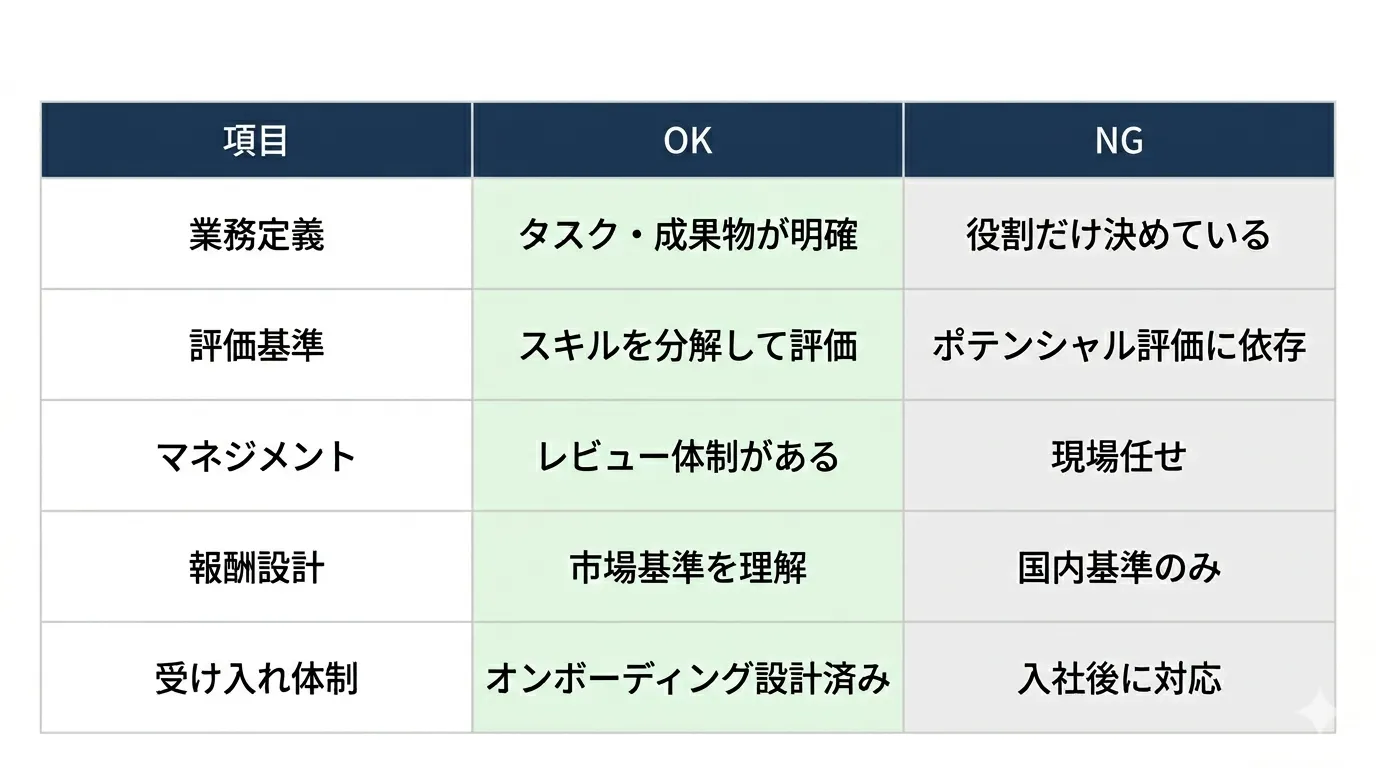
If two or more of these five items are NG, hiring foreign workers is likely to fail.
In other words, whether you can meet these criteria is the practical line for deciding whether to implement it.
Differences and Limitations vs. Domestic Hiring
When considering hiring foreign nationals, the key is to structurally understand why domestic hiring cannot solve the problem.
If this premise remains vague, you only add another hiring channel, and the issue is not solved.
Why Japanese hiring does not fill the gap
First, the real shortage in IT talent is not a lack of people, but a lack of skill levels.
In particular, mid-level and senior talent who can handle design, reviews, and architecture rarely enters the market, and hiring competition is intensifying each year.
As a result, it is now common not to find candidates who meet the requirements, or to lose them to other companies even after extending an offer.
In other words, domestic hiring is increasingly unworkable due to a limited candidate pool.
Global competition and pay reality
On the other hand, overseas talent—especially India’s Tier 1 candidates—faces competition from global companies, and salary levels are often higher than Japanese companies expect.
For example, strong engineers receive multiple offers from foreign firms and startups, making them unlikely to choose a Japanese company based on its initial offer alone.
What matters here is to abandon the assumption that they can be hired cheaply.
In reality, only companies that can offer the right pay and growth opportunities can hire.
Therefore, instead of shifting to foreign hiring because domestic hiring is difficult, you need to redefine which market to compete in, then design compensation and roles accordingly.
India Hiring Option
Among foreign hiring options, Indian talent is increasingly being considered, but it is not right for every company.
The key is to assess whether your hiring challenges match the traits of Indian talent.
Hiring strategy by tier
In Indian hiring, strategies differ greatly between Tier 1 and Tier 2.
Tier 1 can be ready to contribute quickly, but competition is fierce and salaries are high, so role design and appeal are essential.
Tier 2 has a wider candidate pool and is easier to hire from, but skill levels vary widely, so accurate screening through technical tests and assignments decides success.
If you recruit the same way without understanding this difference, expectations will miss the mark.
In other words, the tier you target should be decided not by "hiring difficulty" but by your "assessment accuracy and capacity to train."
When Indian talent is a fit
Indian talent is especially well-suited to work that is structured and can be evaluated by output.
For example, they perform strongly in areas like backend development and data processing platforms, where requirements and outputs are clear.
On the other hand, work with vague requirements or tacit knowledge tends to increase communication costs and makes it harder to deliver the expected results.
So before hiring, it is important to break down the work and judge whether it can be clearly described.
For companies that have this in place, hiring in India is not just an alternative—it becomes a strategic choice that raises organizational productivity.
Summary
Foreign hiring is not just a way to cover labor shortages; it must be treated as an “organizational design” issue, including evaluation criteria, work design, and management structure.
If introduced as only one hiring method, it can lead to lower post-hire performance and early turnover, worsening on-site productivity and management burden.
The conditions for success are clear: first, tasks and deliverables must be broken down; second, skill evaluation must be structured; third, onboarding and management operations must be designed.
Without these, hiring will not produce repeatable results.
However, designing these in-house alone is not easy. Evaluation can become person-dependent, and the hiring process can turn into a black box, making it hard to maintain accuracy over time.
Phinx (Finks), led by members who built global organizations at Rakuten and Mercari, uses university networks in India from Tier 1 to Tier 3 and provides end-to-end support, from technical screening to VISA/COE handling and acceptance design.
Its strength is structuring each hiring step so it can be implemented in a repeatable way at any company.
If you have issues such as unclear evaluation criteria, not knowing which Tier to target, or concerns about post-hire operations, it is important to organize the plan from the design stage.
In that case, please consult Phinx.
【Source】
India Skills Report
https://www.indiaskillsreport.com/

Latest Articles

Stay up-to-date
Related articles

Why AI Agent PoCs Fail and Enterprise Design Essentials

Is FDE Viable for Japanese Firms? SES Differences & Setup

India New Graduate Starting Salary and Annual Income 2026 | CTC Structure and Offer Design

Stricter Visa Rules for Dispatched Engineers in Japan (2026)