Hiring woes aren’t about applicant numbers | Redesign recruiting for the IT talent shortage era

Despite stronger IT engineer hiring, offer declines and skill mismatches keep rising, increasing team workload. The core issue is not too few applicants, but flaws in hiring design. This article clarifies common misconceptions about the IT talent shortage and explains practical criteria and redesign methods—including overseas hiring—to prevent recruitment failures.
Contents
※Please be noted that this blog is translated automatically by AI
The IT talent shortage isn't just a hiring issue.
The IT talent shortage is often discussed as a market-wide issue, but in practice it should be treated as a hiring design issue.
Unless you first break down structurally why hiring fails, every measure will miss.
Not Excess Demand, but a Design Issue
The IT talent shortage is often seen as simple excess demand, but in many cases companies miss hiring opportunities because their hiring design is underdeveloped.
This is because even when required skills do not match available market talent, companies keep recruiting with the same requirements without adjusting the gap.
As a result, applications come in but are rejected at screening or interviews, creating ongoing inefficiency and reinforcing the sense that they "cannot hire."
In short, the issue is not the absolute number of candidates, but that a company’s requirements and evaluation criteria are not connected to the market.
The Misconception of Candidate Pool Shortage
Many companies conclude that the candidate pool is insufficient, but often the real issue is channels or targeting.
For example, if hiring is limited to Japan’s domestic job-change market, the reachable talent segment is inherently very narrow.
Also, relying on the same channels creates a structure where firms compete for exactly the same candidate pool.
In this situation, winning hiring competition tends to depend on "pay or name recognition," which disadvantages smaller firms.
So, a candidate pool shortage is not the core reality; it should be seen as a structural constraint caused by limiting accessible markets.


Why no applicants despite stronger hiring?
Many companies increase hiring spend—adding job boards or expanding agent contracts—yet see little result.
The reason is often not the channel, but a misread of the competitive environment and hiring structure.
Limits of channel-dependent hiring
Many firms rely on job boards and staffing agencies, but these markets are already intensely competitive.
Because multiple companies contact active job seekers at the same time, candidates are always comparing options.
So even if a company tries to grow its candidate pool, it is mostly fighting over the same people, which does not solve hiring difficulty.
With agents, candidates also tend to prioritize higher pay and market value, making condition-based competition more likely.
Structural competition in Japan
In Japan, the IT talent market is structurally supply-constrained.
Job-ready talent is often taken first by large companies and mega ventures, so smaller firms have very low odds even with similar offers.
For example, candidates who reach final interview and receive an offer often decline within days, saying another company offered better terms.
In this environment, stronger recruiting efforts mainly increase workload and team fatigue.
The issue is not lack of effort, but competing while staying confined to the domestic market structure.
The reality of hiring failures
Companies struggling with hiring tend to repeat the same failures.
Most are not accidental; they recur as structural patterns.
Why Offer Declines Keep Happening
Some companies repeatedly lose candidates a few days after making an offer, even after final interviews.
For example, after two months of interviews, an engineer declines, saying "another company offers higher pay" or "they have a more modern tech stack," and the hire is lost.
Behind this is a failure to correctly identify candidate priorities before moving forward.
If you do not assess whether they prioritize pay, growth opportunities, or market value, you are more likely to lose at the final stage.
Skill Mismatch After Hiring
Another common failure is hiring someone who cannot perform on the job.
For example, an engineer hired for potential receives repeated code review corrections, and team development speed drops.
The cause is interviews conducted with unclear skill evaluation standards.
Relying on vague impressions like "seems good" does not ensure real problem-solving and system design ability.
So hiring failure is not a one-off mistake; it is a structural issue caused by missing evaluation criteria and poor selection design.
If it is unclear where screening is failing, break down and review the full hiring process once.
If evaluation criteria are not clearly defined, similar mismatches will likely happen again.
Domestic hiring limits and overseas hiring crossroads
For companies repeatedly failing to hire, it's not enough to improve tactics; they must rethink the hiring scope itself.
Especially when limited to the domestic market, structural constraints leave little room for improvement.
What domestic hiring can solve
Domestic hiring still has areas for improvement, but only under clear conditions.
First, if you can shift to hiring based on developing junior talent, you can secure a certain candidate pool.
Also, easing geographic limits—such as remote-first roles or regional hiring—increases reachable talent.
However, for hiring job-ready engineers, competition with major companies remains unavoidable.
So if you cannot win on pay or brand, completing hiring only domestically has clear limits.
When to switch to overseas hiring
Overseas hiring is one option, but it is not suitable for every company.
The key is judging at what stage you should switch.
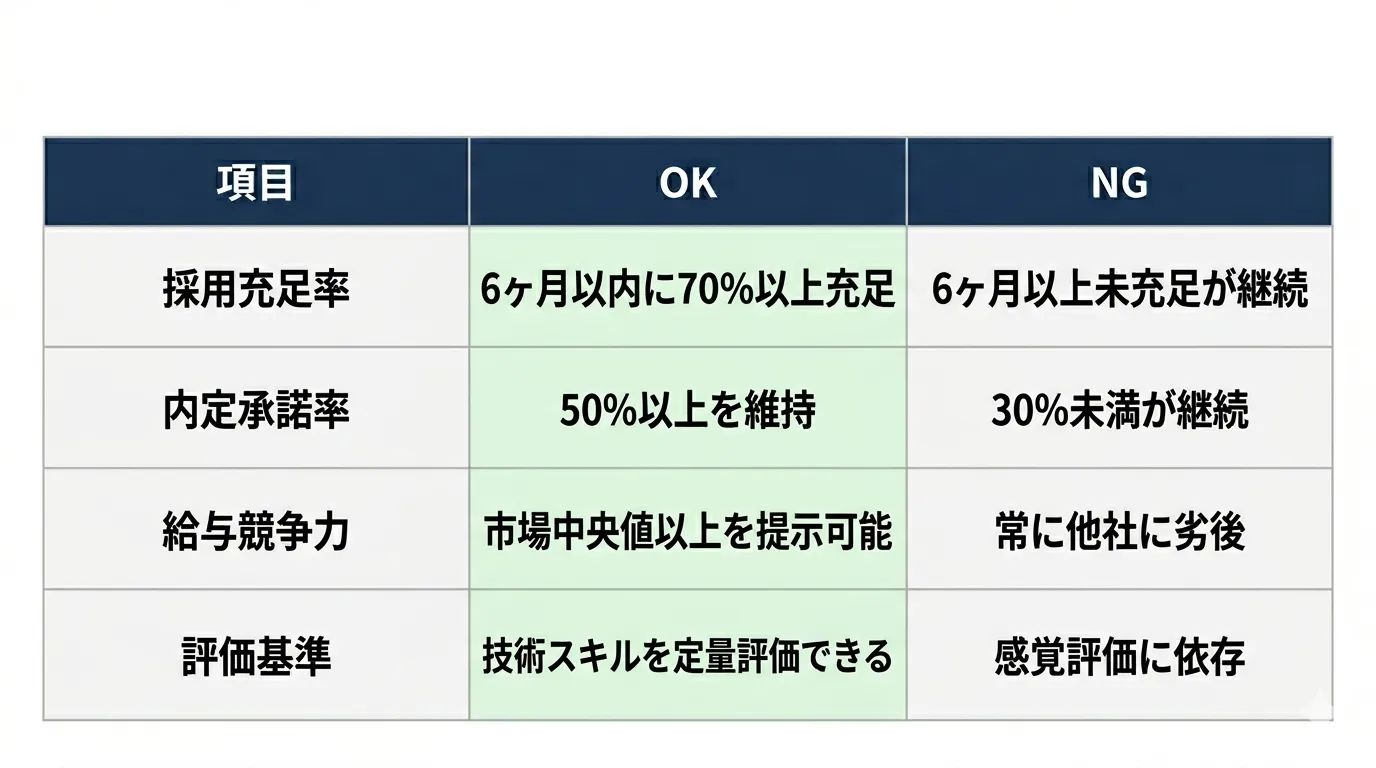
If any of these fall into NG, improving by extending domestic hiring may be difficult.
In that case, considering overseas hiring to expand the hiring market itself is a rational choice.
Related articles

Hiring in India is effective for securing high-level talent, but poor timing can lead to offer rejections and slow onboarding, wasting recruiting investment. The main causes are intense market competition and unclear evaluation standards. This article outlines both “too early” and “too late” entry failures, and presents conditions for when to enter plus practical decision criteria.
Why Indian Talent Makes Sense
Among overseas hiring options, Indian talent is especially practical in IT.
But rather than calling everyone "excellent," you need to decide which tier to hire and how.
Difference Between Tier 1 and Tier 2
Skill levels in India vary greatly by university background.
Tier 1, represented by institutes like the IITs, is the top group: many are strong in algorithms and system design and can contribute quickly, but hiring is difficult due to intense competition with global companies.
Tier 2 has more skill variation, but with proper screening you can secure high-potential candidates.
So the key is not just "which tier to target," but "how to assess each tier."
Reality of Salary and Competition
Competition exists in hiring Indian talent, but the structure differs from Japan's domestic market.
For example, Tier 1 candidates compete with Western and global firms, so salary levels are correspondingly high.
In Tier 2, however, Japanese companies can compete well by offering the right pay design and growth opportunities.
The key is not only annual salary, but a plan that matches candidates' desire to increase their market value.
In short, hiring success depends not just on pay, but on a total offer including tech stack and career path.
Practical steps to redesign hiring methods
To solve hiring shortages, you need to redesign the whole hiring process, not just add tactics.
Especially for global hiring, extending current methods will not work; the structure itself must be revised.
Review channel design
First, revisit which markets you are accessing.
If you rely on domestic job boards and agents, competition stays the same and improvement is limited.
Designing channels to reach overseas talent pools can change the competitive structure itself.
For example, using Indian university networks or local agents lets you directly approach top talent not active in the job-change market.
Changing "where you hire from" creates the biggest impact.
Define evaluation criteria
Next, clearly define evaluation standards.
For overseas talent in particular, education and work history alone cannot assess skills accurately.
So you need a system that quantitatively evaluates technical skill and problem-solving ability.
For technical skill, it is best to confirm through coding tasks whether candidates can produce reliable, repeatable code; judging only by resume or self-report greatly lowers accuracy.
For problem solving, candidates who can break down requirements and explain how they independently reached a solution are likely to adapt well in practice; if they wait for instructions and stop thinking, project-stall risk rises.
For communication, what matters is not English level itself but whether they can organize and explain key points; evaluating only language skill often causes misalignment.
By breaking evaluation axes down to observable behaviors and clearly defining OK vs. NG states, you can reduce interviewer variance and ensure consistent hiring.
Summary
The IT talent shortage is not just hiring difficulty; it is a structural issue caused by poor hiring design.
If this design is wrong, repeated offer declines and skill mismatches reduce on-site productivity, and recruiting itself becomes an organizational burden.
So the key is not the size of the candidate pool, but redesigning who you access and how you evaluate.
The conditions for success are clear.
First, move beyond hiring limited to the domestic market and change the competitive structure.
Second, have standards that can quantitatively assess technical skills and problem-solving ability.
Third, design offers based on candidate preferences.
Without these, hiring consistency cannot be ensured.
However, designing and operating all of this in-house is not easy.
This is because it requires specialized, continuous operations: avoiding evaluator dependency, ensuring screening accuracy in overseas hiring, and handling VISA and COE processes.
Phinx, built by members who formed global organizations at Rakuten and Mercari, uses a university network in India from Tier 1 to Tier 3, and provides end-to-end support from technically grounded screening to VISA/COE handling and onboarding.
It is not just a staffing agency, but a partner that rebuilds hiring design itself.
If you are still hiring with unclear evaluation standards, or are unsure whether to proceed with overseas hiring, please consult Phinx.
By organizing from structure first, hiring consistency and results can improve greatly.
[Source]
• India Skills Report
https://www.indiaskillsreport.com/

Latest Articles
Stay up-to-date
Related articles

Is FDE Viable for Japanese Firms? SES Differences & Setup

India New Graduate Starting Salary and Annual Income 2026 | CTC Structure and Offer Design

Stricter Visa Rules for Dispatched Engineers in Japan (2026)

Limits of Man-Month & AI-Era Estimation: Client's Guide