India vs. Domestic Hiring

Choosing between domestic hiring and sourcing from India based only on cost overlooks selection time and onboarding effort. Instead, compare whether you can hire on time, apply the same standards, and support their success after joining.
Contents
※Please be noted that this blog is translated automatically by AI
Summary
Domestic hiring is easier to start; India hiring expands the candidate pool.
First-time India-to-Japan hiring takes 3–6 months from definition to onboarding.
Compare total hiring costs including agency fees, vacancy periods, and training.
Instead of choosing one, consider parallel hiring using the same evaluation criteria.


Domestic vs. India Hiring
Comparing domestic and India hiring isn't about nationality.
It's about choosing the right channel by comparing the talent pool, screening, onboarding, and support needed.
The IPA DX Trend 2025 report shows 85.1% of Japanese firms face a shortage of DX talent.
While domestic hiring needs work, sourcing from the same market alone may not meet deadlines.
Here is a summary of the key differences.
Aspect | Domestic Engineers | India Engineers |
|---|---|---|
Talent Pool | Japan's mid-career/graduate market | Expanded to Indian universities & job markets |
Process | Mainly screening and notice periods | Includes COE, visas, and relocation logistics |
Language | Mainly Japanese; easy to start | Requires English or Japanese study by role |
Evaluation | Local careers are easy to assess | Focuses on project scope/skills over college tier |
Onboarding | Can use standard existing systems | Requires housing, life, and onboarding support |
Domestic hiring minimizes changes but talent shortage risks remain.
Hiring from India expands your pool but adds steps, demanding proper team prep to avoid heavy workloads.
Compare fill rate and hiring time
Compare the hiring period from job posting to actual start date, not just to the offer stage.
Domestic Hiring Period
Domestic hiring is faster to complete once a candidate is chosen, as no visa or travel prep is needed.
However, issues like poor response, slow screening, or declined offers will extend vacancies.
In such cases, candidate pool size is not the only issue.
Check if requirements, screening speed, salary, tech interviews, or job appeal match the market.
Indian Hiring Period
For a first-time India-to-Japan hire, expect 3 to 6 months from defining requirements to onboarding.
This includes sourcing, screening, plus visa COE, physical visa, travel, and housing prep.
The Immigration Services Agency publishes visa processing averages monthly.
As processing times vary by season and case detail, keep onboarding dates flexible with a buffer.
For urgent hires, the key is not simply "domestic is fast, overseas is slow."
Compare the time spent searching domestically with Indian prep time to see which fits your deadline.
Related articles
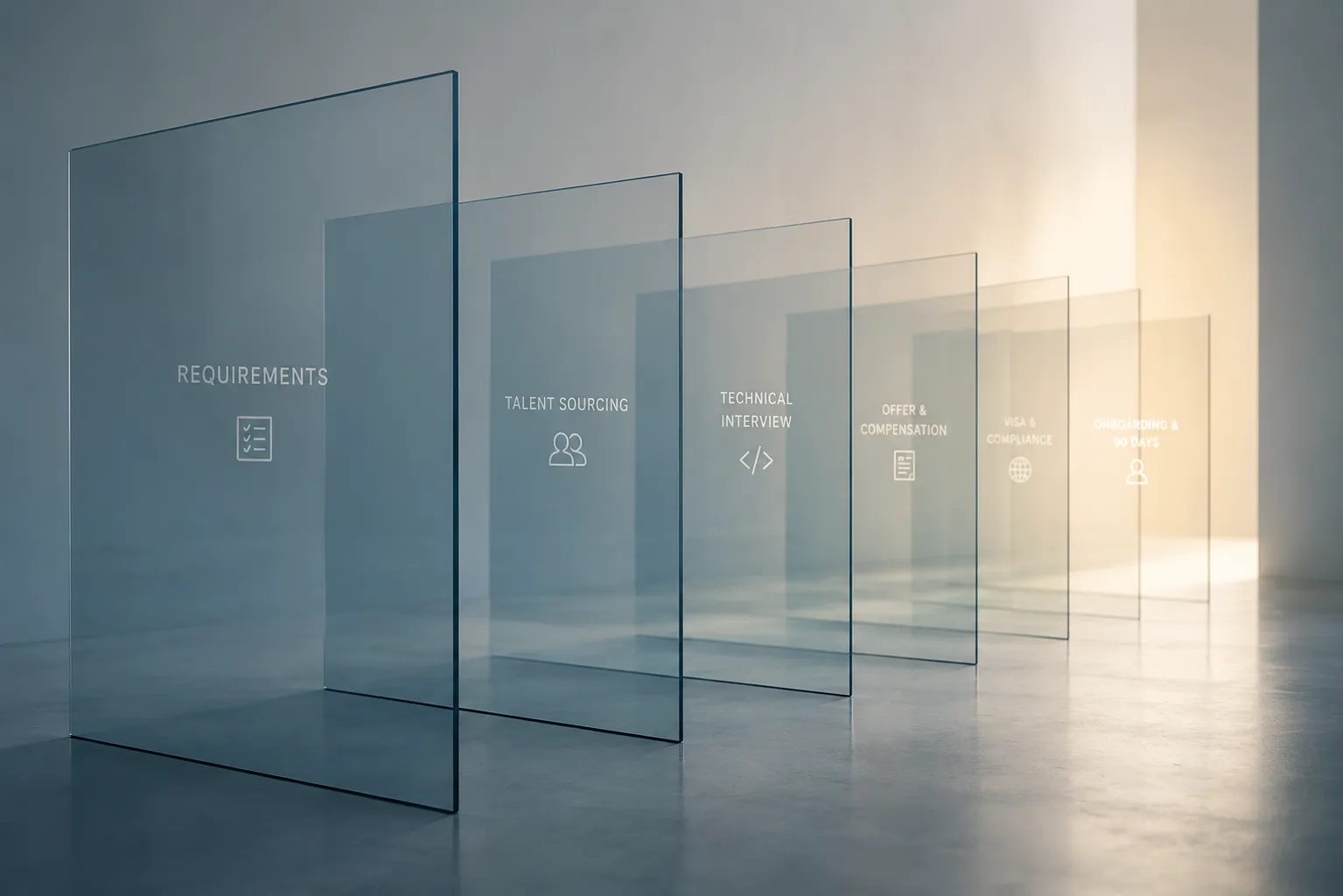
Hiring from India requires more than just posting jobs. You must simultaneously design hiring criteria, local sourcing, tech interviews, offers, visas, and onboarding.
Hiring vs Vacancy Costs
Domestic vs. India hiring cannot be compared by agency fees alone due to different cost items.
Cost & Burden | Domestic | India Hiring |
|---|---|---|
Sourcing | Ads, agent fees, PR | Agent fees, local sourcing |
Onboarding | Standard HR tasks | COE, visa, flight, housing |
Integration | Placement & training | Placement & daily life setup |
Vacancy Cost | Development delay | Planning during visa process |
Attrition Risk | Rejection, early resignation | Rejection, visa issues, early exit |
Phinx estimates the initial cost of hiring an entry-level IIT engineer under a work visa at 1.5M to 3.5M JPY, covering sourcing, visa, travel, housing, and onboarding.
This is a 2026 estimate and varies by salary, hiring method, location, and support scope.
Domestic hiring costs also exceed ads and agent fees.
Opportunity losses, such as product delays, overtime, and HR/interviewer hours, must be included.
The comparison formula can be defined as:
Total Burden = External Cost + Internal Hours + Vacancy Loss + Integration Support
Hiring from India fails if viewed purely as "cheap labor."
It should be judged as an investment for scarce skills or future global development.
Related articles

How much does it actually cost to hire one Indian talent? You cannot get approval without knowing the total cost, not just the introduction fee.
Compare skills and languages
We use the same evaluation criteria for Japan and India. Only background verification and language gap support differ.
Criteria | Common Base | India-specific Check |
|---|---|---|
Tech | Design, code, test, operate | Deep-dive into resume scope |
Collab | Review, change, report | Check English and async sync |
Lang | Required accuracy for job | Check actual speech, not JLPT |
Mindset | Role, growth, pay expectations | Check reason for Japan/plans |
Output | Past improvements and code | GitHub, tests, code reviews |
Don't confuse global-mindset with Japan-mindset. Wishing to work abroad does not mean knowing Japanese corporate culture, pay, or workflows.
Do not judge Japanese from degrees alone. The target level differs between client-facing jobs and English-only roles. Define language for meetings, docs, and clients, and test via mock sessions.
Compare onboarding workload
Domestic hires leverage existing living bases, whereas hiring from India requires setting up both work and life simultaneously.
When bringing talent from India to Japan, companies should prepare the following:
Guide for housing, banking, mobile, and administrative procedures
Onboarding materials available in English
Documented scope of work, evaluation criteria, and contacts
Assignment of a mentor or buddy
Regular 1on1s and expectation alignment up to day 90
Overburdening only the candidate or HR causes gaps with the team.
Define roles for dev leads, managers, HR, and life support before arrival.
Similarly, domestic hiring is not free from onboarding needs.
Treating mid-career hires as instant assets without giving specs or criteria delays their ramp-up.
The key comparison is not whether to support, but if your current onboarding can add language, life, and visa support.
Which to choose?
Decisions depend on role, deadline, language, and support capacity.
Cases to prioritize local hiring
Advanced Japanese is required from day one for client facing.
Immediate onboard (within weeks) is needed with existing candidates.
No capacity to support relocation, visa, or lifestyle for global talent.
Job specs or hiring speed still have room for improvement.
Cases to expand hiring in India
Unable to find tech talent locally even after months of searching.
Development environment uses or is ready to transition to English.
Able to plan for 3 to 6 months before onboarding.
Can assign tech evaluators and 90-day post-onboarding support.
Aiming to build a global product team for the future.
Hiring fails if target countries are changed without fixing the local hiring setup.
Fix job specs, process speed, and offer details first, then expand sourcing to India.
Related articles

Despite stronger IT engineer hiring, offer declines and skill mismatches keep rising, increasing team workload. The core issue is not too few applicants, but flaws in hiring design. This article clarifies common misconceptions about the IT talent shortage and explains practical criteria and redesign methods—including overseas hiring—to prevent recruitment failures.
Steps to parallel recruitment
For most firms, the realistic approach is not replacing local hiring with India hiring, but searching domestic and global candidates in parallel under the same job definitions and evaluation standards.
Step | Action Items | Completion Criteria |
|---|---|---|
1. Job Definition | Define expected outcomes and required skills | Have nationality-neutral job descriptions |
2. Standardize Evaluation | Align technical tasks and interview standards | Minimize rating gaps among interviewers |
3. Language Planning | Decide language for meetings, docs, and clients | Clearly explain required Japanese proficiency |
4. Process Branching | Manage local and global onboarding in parallel | Assign COE and travel logistics owners |
5. Integration Prep | Prepare the first 90 days plan | Clarify roles of managers, HR, and supporters |
This enables evaluating local and Indian candidates against the same hiring goals. Rather than setting separate standards by nationality, it targets business outcomes while bridging language and system gaps.
Summary
Comparing domestic and Indian engineer hiring is not about cheap unit costs, but securing needed talent on time and ensuring performance post-hire.
Success requires: unifying job descriptions/evaluation criteria regardless of nationality; comparing total workload including vacancy periods and onboarding costs; and defining roles for language, visa, and lifestyle support before hiring.
Domestic hiring offers easier institutional setup, while Indian hiring expands the candidate pool.
Instead of choosing one, establish domestic hiring standards first, then expand the search to India using those same criteria for reproducibility.
Handling this in-house often fragments resume screening, English tech evaluation, negotiations, visa processes, and onboarding support.
Phinx leverages global org experience (Rakuten, Mercari), India's Tier 1-3 university network, and technical screening to provide end-to-end support from interviews to visas and arrival.
Evaluating Indian candidates with the same standards as domestic hires expands your channel without dropping quality.
Sources
IPA "DX Trends 2025" https://www.ipa.go.jp/digital/chousa/dx-trend/tbl5kb0000001mn2-att/dx-trend-2025.pdf
Immigration Services Agency "Visa Processing Times" https://www.moj.go.jp/isa/applications/resources/nyuukokukanri07_00140.html
Phinx "Cost of hiring Indian Tech Talents" https://phinx.tech/article/india-talent-hiring-costs
Phinx "Complete Guide to Hiring Indian Tech Talents" https://phinx.tech/article/india-hiring-process-guide

Latest Articles

Stay up-to-date
Related articles

Why AI Agent PoCs Fail and Enterprise Design Essentials

Is FDE Viable for Japanese Firms? SES Differences & Setup

India New Graduate Starting Salary and Annual Income 2026 | CTC Structure and Offer Design

Stricter Visa Rules for Dispatched Engineers in Japan (2026)