AI Implementation Guide 2026: Steps & Pitfalls

For enterprise AI success, you must define tasks, data, access, KPIs, and ownership before choosing tools. This article explains why AI adoptions fail and how to plan before starting a PoC.
Contents
※Please be noted that this blog is translated automatically by AI
Summary
Before choosing AI tools, first decide which business process to transform.
Failures stem from unclear value, lack of data, poor permissions, no KPIs, and loose ownership.
Start with frequent tasks that have clear rules and human-in-the-loop exception handling.
Define KPIs, approvers, logs, and rollback plans before PoC to ease production.
Phinx excels in linking strategy, requirements, data, AI-native dev, and operations.


First AI step
AI adoption is not just installing a tool, but redesigning workflows with AI in mind, defining outcomes, risks, and responsibilities.
Simply giving access to a chat interface won't change your business.
A project truly begins when you decide which tasks AI handles and where humans intervene.
Select the Workflow Before the Tool
The first decision is not which AI to use, but which workflow to transform and what metric (time, quality, volume, or decision speed) to improve.
Tasks like minutes creation, initial inquiry response, or contract review help require different data, permissions, and approvers.
Without this distinction, company-wide rollouts increase usage but fail to measure results.
Employees find it handy, but management cannot prove ROI while IT only inherits risks.
Phasing the Scope of AI Autonomy
AI adoption requires phasing what the AI is allowed to do: read-only access, drafting answers, processing with approval, or fully autonomous execution.
Each phase changes the risks and design requirements.
You do not need to target full autonomy from the start.
Initially, a "human-in-the-loop" model is easier to log, evaluate, and handle exceptions.
Without this phased design, projects fail in production despite successful PoCs.
Why AI projects fail
AI failures aren't just about model performance.
Gartner predicts over 40% of agentic AI projects will be abandoned by 2027 due to rising costs, unclear business value, and poor risk management.
This applies to all AI deployments.
Starting Without Clear Business Value
A common mistake is launching a PoC just because AI "seems useful."
Demos may look good, but without defining which tasks to speed up, which decisions to improve, or which errors to prevent, success cannot be measured.
McKinsey’s 2025 study shows that high-performing AI adopters focus on workflow redesign, AI governance, KPIs, and feedback loops.
Success depends on how you redesign operations, not just how fast you deploy.
Unclear Ownership Between Business and IT
AI deployment requires business units to own operational requirements, while IT manages tech and security.
Often, ownership stops at "business wanted it" or "IT chose the tool."
This creates gaps in responsibility for AI errors, privacy, access controls, and workflow changes.
Deloitte notes that regulatory uncertainty, risk management, data gaps, and talent shortages remain major barriers.
Assigning a tool champion isn't enough; you must define who owns operations, approvals, audits, and ongoing improvements to go live.
Choosing tasks for adoption
Choose your first task based on ease of testing, not flashiness.
Avoid tasks to completely replace, instead choose ones where humans can review AI outputs and compare before/after results.
The table below shows criteria for your initial setup.
Criteria | Ideal | Avoid |
|---|---|---|
Frequency | Weekly or more | Few times a year |
Review | Verify correctness/quality | Relies on intuition |
Data | Clear sources | Scattered/outdated docs |
Risk | Human approves output | AI errors hit clients directly |
Impact | Measurable time/rework | Just "nice to have" |
Crucially, do not search for AI tasks in the abstract.
For example, drafting internal FAQ answers is easy to start, while auto-replying to customers requires complex design for tone, logs, and liability.
Select Small but Impactful Areas
Ideal initial projects are small but show clear business impact.
Examples: searching sales materials, checking internal rules, sorting inquiries, or extracting tasks from minutes.
These allow easy human review and clear measurement of time saved.
Conversely, avoid high-impact areas like management decisions, legal checks, hiring, or credit approval.
If needed, start only with AI gathering information rather than making the actual decision.
Why verify data & access first
A common oversight in AI adoption is what the AI can access.
Generative AI and agents rely on internal docs, customer data, logs, chats, and meeting notes to be useful.
However, access rights do not automatically equal permission for business use.
Hard-to-use data without versions or sources
AI errors aren't just model issues.
If internal docs lack version control, terms vary by department, or old exceptions look like active rules, the AI will use them as facts.
Before adopting AI, verify key docs, data fields, owners, and access rights for the target task.
When building RAG or search, poor document freshness, source tracking, or retirement rules will hinder production use.
Permissions: From viewing to execution
Access design goes beyond viewing rights.
Control requirements change based on whether the AI only reads docs, creates tickets, drafts emails, or runs workflows.
If giving AI operational authority, define approvers, execution logs, and rollback steps.
Delaying this halts production approval due to security, mis-sending, or error risks, despite a successful PoC.
Related articles

Before using AI agents at work, you must first organize your data, docs, and permissions for secure AI access. This article explains the difference between traditional BI/DWH and the data foundations needed for the AI era.
KPIs and Scope of Responsibility before PoC
PoCs are not for building prototypes, but for deciding on production.
Before starting, define KPIs, decision-makers, scope, and next steps for failure.
Otherwise, you will end up with a "useful but useless next step" scenario.
Do Not Limit KPIs to Accuracy
AI success goes beyond accuracy rates.
Combine metrics like task time, rework, wait time, response rate, review effort, and audit logs.
KPI | Focus | Caution |
|---|---|---|
Time Saved | Task, search, and copy time | Plan how to use freed-up time |
Quality | Errors, reworks, and rejects | Do not judge by accuracy alone |
Ops Load | Approvals, exceptions, and queries | Check for increased user burden |
Risk | Unauth access, leaks, and log gaps | Confirm rollback steps before launch |
Treating saved time purely as labor cost cuts discourages user cooperation.
It is better to reallocate freed-up time to customer support, improvement, or quality review.
Clarify Responsibilities
Before PoC, define business owners, tech owners, security reviewers, and final sign-offs.
Document who reviews outputs, who fixes errors, and who maintains prompts.
Vague roles lead to blame on "the AI" or "the users" when things fail.
Production needs clear ownership of tasks, not finger-pointing.
Separate output quality, data quality, rules, and training to ease improvements.
Related articles

Many companies build AI agent PoCs but struggle to move to production due to workflows, data permissions, approvals, audits, and liability. This article explains why PoCs stall and outlines key operational designs needed before launch.
Steps to go live
AI adoption is easier when full-scale rollout isn't the initial goal.
Start small: focus on one task, department, or dataset to verify operations.
Then, expand gradually while checking KPIs and risks.
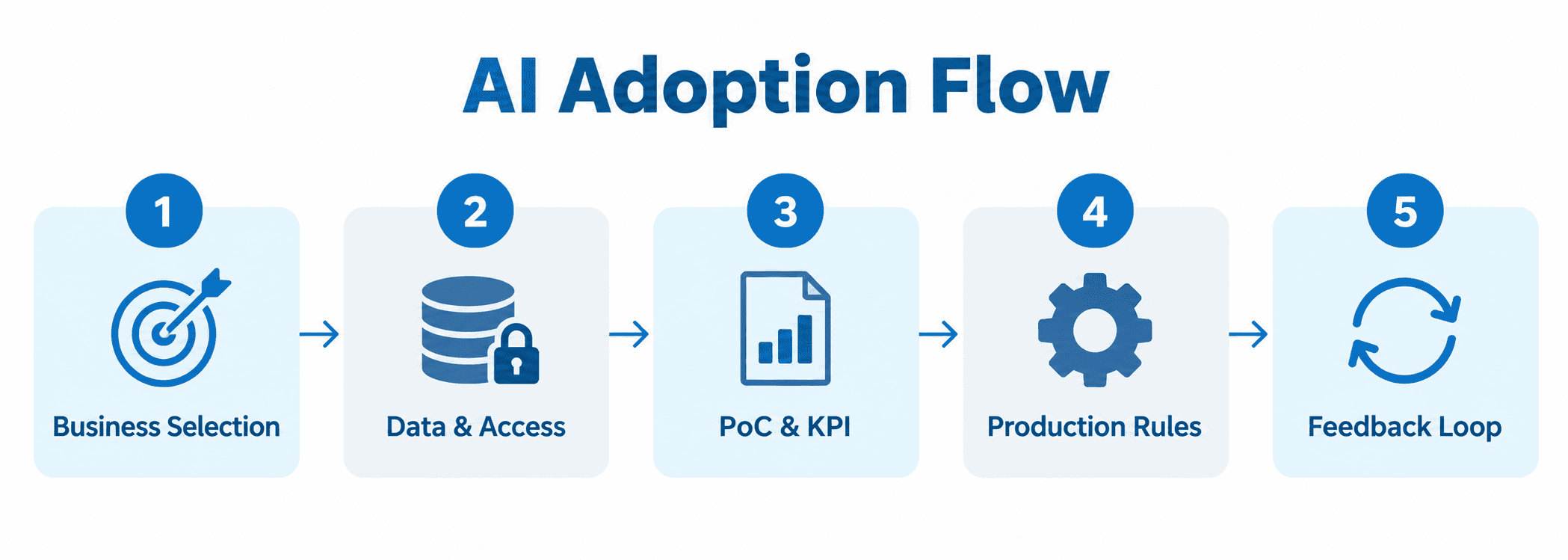
The diagram shows 5 steps from task selection to operation improvement.
Importantly, don't treat PoC as an isolated event; design it to include data verification, KPIs, responsibilities, and continuous improvement.
5-Step Process
Follow this basic order:
Select a task, verify data/permissions, measure KPIs via PoC, define responsibilities for production, and run the improvement cycle.
Skipping steps to install tools first leads to data or permission issues later.
Conversely, you don't need a perfect company-wide AI platform from day one.
Building a "small, production-ready model" in a limited scope minimizes failure risks during expansion.
When to Use External Support
External support is not just for learning how to use AI tools.
Third-party help is valuable when task organization, data verification, permission design, KPIs, system integration, and operation improvements are siloed.
Especially when progress stalls between business and IT departments, AI adoption cannot be solved by technology alone.
First, create a shared decision-making framework for business owners, IT, security, and management.
Summary
AI adoption is not about handing out tools, but redesigning workflows, data, access, KPIs, and roles.
To succeed, start small, phase AI tasks, and define metrics and operational conditions before PoC.
Key success factors are measurable value, clear data lineage, and separate responsibilities between business and IT.
However, doing this in-house often silos tasks: business models workflows, IT picks tools, and legal manages risk.
Phinx offers end-to-end support, covering problem definition, requirements, data infrastructure, AI-native dev, and adoption.
Combining Japanese business understanding with global dev resources, Phinx turns AI ideas into real-world business tools.
Sources
Gartner Predicts Over 40% of Agentic AI Projects Will Be Canceled by End of 2027 https://www.gartner.com/en/newsroom/press-releases/2025-06-25-gartner-predicts-over-40-percent-of-agentic-ai-projects-will-be-canceled-by-end-of-2027
The state of AI: How organizations are rewiring to capture value https://www.mckinsey.com/capabilities/quantumblack/our-insights/the-state-of-ai-how-organizations-are-rewiring-to-capture-value
State of Generative AI Q4 - Press Release https://www2.deloitte.com/us/en/pages/about-deloitte/articles/press-releases/state-of-generative-ai.html
DX Trends 2025 https://www.ipa.go.jp/digital/chousa/dx-trend/dx-trend-2025.html

Latest Articles
Stay up-to-date
Related articles

RAG Data & Access Control Prep Guide
AI Implementation Guide 2026: Steps & Pitfalls

How to Outsource Development with Unclear Requirements: Scope & Contracts

Retaining Indian Talent 2026: Turnover Prevention & Year 1 Guide