When to Start Hiring in India: Criteria & Pitfall Avoidance

Hiring in India is effective for securing high-level talent, but poor timing can lead to offer rejections and slow onboarding, wasting recruiting investment. The main causes are intense market competition and unclear evaluation standards. This article outlines both “too early” and “too late” entry failures, and presents conditions for when to enter plus practical decision criteria.
Contents
※Please be noted that this blog is translated automatically by AI
Why timing hires in India is difficult
Hiring in India is not just expanding the candidate pool; tougher competition and harder evaluation make decisions more difficult.
Especially if judged as an extension of domestic hiring, companies can fall into a pattern of mistiming market entry.
Structural differences from domestic hiring
In domestic hiring, skills, preferences, and market norms are relatively aligned, so interviewer experience can deliver reasonable accuracy.
In India, however, skill distribution differs greatly between Tier1 and Tier2, and even with the same “3 years of engineering experience,” implementation and design ability can vary by multiples, making traditional evaluation criteria ineffective.
So if you enter without well-defined standards, candidate quality after interviews is inconsistent and hiring loses repeatability.
The result is: “we can hire, but they cannot perform on site.”
Global competition distorts decisions
At the same time, global firms like Google and Amazon continuously hire Tier1 talent in India, so Japanese companies compete on the same field.
In this situation, deciding to hire just because someone “seems strong” leads to weaker pay and growth offers, and repeated offer declines.
In short, India hiring should be judged not by “can we hire,” but by “do we meet conditions to win competition”; without this view, entry timing is misjudged.


Causes of poor entry timing
Companies that mistime hiring in India often have issues not with decisions themselves, but with the underlying evaluation framework.
When both "how to assess" and "how to proceed" stay unclear, they cannot judge the right start timing.
Education and Tier Dependence
A common pitfall is judging mainly by Tier1 universities such as IIT.
Tier1 talent is often job-ready, but competition is intense and salaries are high, so using only this standard leads to a persistent "can’t hire" situation.
If companies widen targets to Tier2 and below, skill variation grows, so they must assess by practical skills rather than academic background. But firms that fail to make this shift start hiring without clarity on which segment to target.
As a result, they only build applicant volume without a clear target, and screening efficiency drops sharply.
Undefined Evaluation Criteria
Even more serious is starting interviews without clearly defining evaluation criteria.
For example, if selection is based on the vague standard "self-driven talent," interviewers judge differently and pass/fail consistency is lost.
In practice, candidates who pass coding tests may be repeatedly sent back in post-join reviews, forcing on-site engineers to spend time handling issues.
This gap is not a market-entry timing problem; it comes from starting before evaluation design was complete.
If it is unclear at which step assessment is failing, the whole hiring process should be broken down and reorganized once.
Failures from entering too early
Indian hiring is often seen as "better if started early," but entering without a solid acceptance setup turns hiring itself into an organizational burden.
In the early phase especially, companies often lack key foundations that should be prepared before hiring.
Insufficient onboarding system
A common issue is that post-hire assignment and training do not function.
For example, an engineer hired and brought to Japan is placed on an existing team, but code review standards and task breakdown levels are not shared, causing repeated rework and eventually consuming Japanese lead engineers' time.
In this state, increasing hires only raises frontline workload, creating the paradox: "hiring succeeds, but development slows."
In short, if evaluation criteria and onboarding design are not ready before hiring, market entry is premature.
VISA and ramp-up delays
Another often-missed issue is delays in VISA processing and daily-life setup.
Document errors or procedural delays often push back start dates and disrupt project plans.
For example, even when hiring is timed to project launch, a two-month delay in joining can break the intended team structure, forcing temporary coverage by existing members and causing development delays.
This is not a hiring-timing failure but a preparation failure; entering without an end-to-end plan, including VISA support, is high risk.
Related articles

Assessing technical level is a key challenge in hiring in India. This article covers skill gaps by university tier, proficiency in languages, AI, and cloud based on latest data, and competition with U.S. firms. From a practical view, it presents indicators to identify engineers’ true technical ability.
Failure from entering too late
Meanwhile, many companies that keep deciding "it’s too early" miss the chance to enter.
In India especially, time itself makes hiring harder, so delays directly mean higher costs and tougher recruiting.
Top talent dries up
The clearest issue is harder access to Tier 1 talent.
Global firms like Google and Amazon hire continuously, so top candidates are secured early; by the time Japanese firms start hiring, those people are often no longer options.
As a result, even for the same role, candidate quality drops, and mismatches like "below expected level" become common.
Even if hiring expands to Tier 2 at this stage, without solid evaluation standards, screening accuracy lags and hiring efficiency does not improve.
Rising pay and stronger competition
Another major issue is rising salary levels.
India’s engineer market sees pay increase year by year, and the later you enter, the higher the offers required.
For example, even with the same skills, annual salary ranges can shift greatly in 1–2 years, and late entrants can face "not chosen even after raising offers."
This is not just about money; firms also fall behind in overall competition, including growth opportunities and project appeal, so slow decisions directly reduce competitiveness.
Definition of target company criteria
For hiring in India, decide not by "should we" but by "are we ready."
If this readiness is vague, early failure is likely.
Define requirements clearly
First, confirm hiring requirements are written concretely.
Here, requirements mean not just skills, but clear standards: "what level can perform on the job."
For example, "3 years of backend experience" is not enough; you need specifics like "can independently design APIs with async processing" and "can merge code without review issues."
Without this detail, interview evaluations and on-site expectations will diverge.
Evaluation and assignment design
Next is post-hire assignment and evaluation design.
Indian talent is often expected to contribute immediately, but differences in development process and review culture can cause early friction.
For example, if tasks are handed over at too coarse a level, output may miss expectations, rework costs rise, and team productivity drops.
To prevent this, design not only evaluation criteria but also "which team" and "what task granularity" to assign work.
Only when these two are in place can India hiring start and still function organizationally.
3 indicators needed for decisions
Deciding when to hire in India should be based on data and structure, not intuition.
The three key factors are salary, lead time, and competition; without measuring them, decisions become unstable.
Acceptable Salary Range
First, confirm the salary range your company can offer.
If you target Tier 1 talent, you need compensation at or near global-company levels; if your range is far from market, you cannot compete.
Even when targeting Tier 2, hiring is not simply cheap; it matters whether you can offset with growth opportunities and tech stack.
So salary must be judged as part of the full offer package.
Time from Hiring to Start
Next is lead time from hiring to actual start.
In India hiring, including screening, offer, visa, relocation, and onboarding, it usually takes about 3–6 months.
If you ignore this and start when you "need people now," team expectations and hiring speed will mismatch, lowering perceived results.
So when considering hiring, a key criterion is whether it aligns with an organizational plan six months ahead.
Position in Global Competition
Finally, clarify which competitive segment you are in.
Whether you aim for Tier 1 or hire Tier 2 with screening assumptions greatly changes required evaluation accuracy and hiring strategy.
Entering without this clarity creates a "halfway position that appeals to no tier," making even candidate-pool building difficult.
Therefore, being able to define target talent and competitive environment together is the basis for deciding whether to enter.
Practical decision criteria
Based on this, India hiring should be judged not by "whether to do it" but by "when conditions are ready."
In practice, clearly separating OK and NG conditions improves timing decisions.
Conditions to Enter
Below are practical checklist items for decisions.
Check whether your company meets all OK conditions.
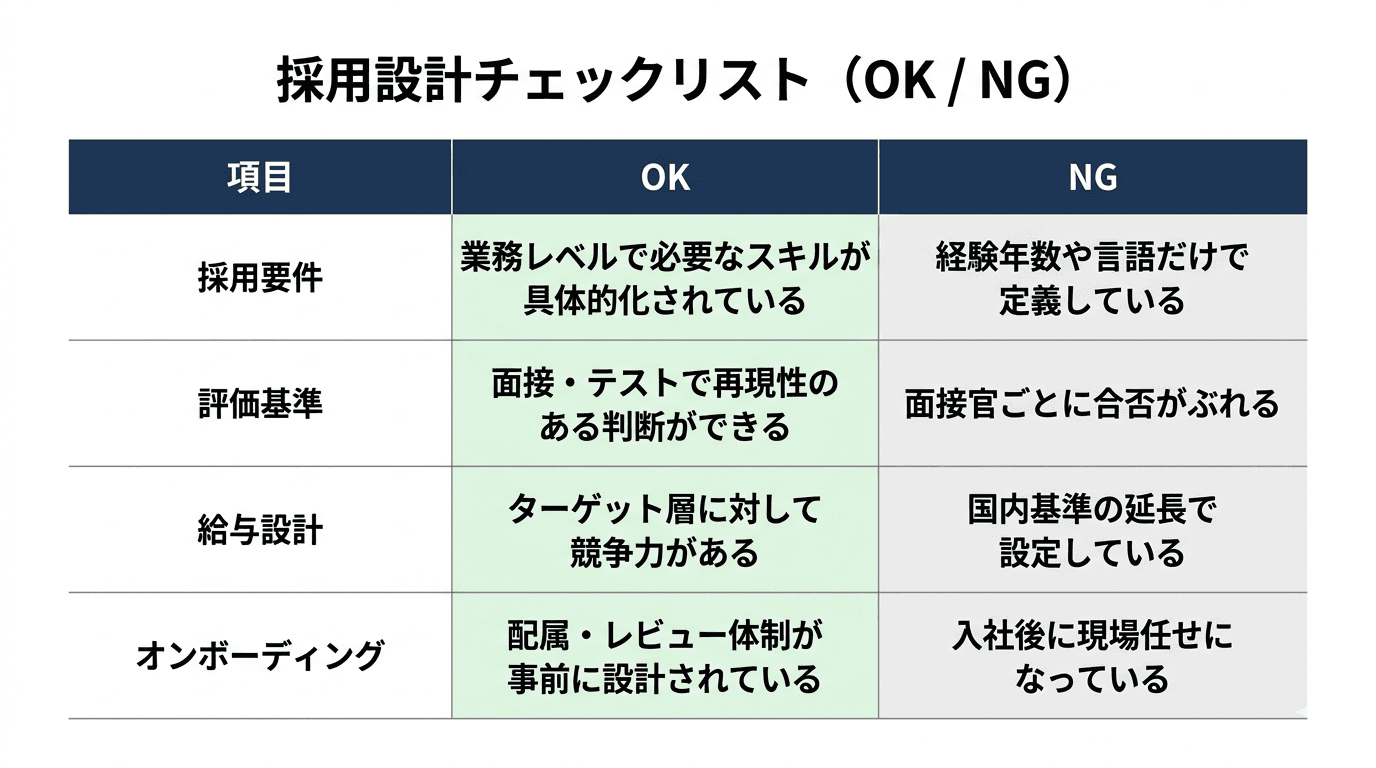
If these are met, you can minimize post-hire mismatch and onboarding delays.
Conditions Not to Enter
On the other hand, if any of the following apply, postponing entry is reasonable.
- Hiring target (Tier1 or Tier2) is not decided
- Evaluation criteria are vague and interviews lack consistency
- Not linked to a six-month workforce plan
- VISA and onboarding systems are not ready
If you enter in this state, hiring may move forward, but offer declines and early turnover can occur, often leading to the view that "we should not have done it."
Success in India hiring is determined mostly by readiness, not timing.
Summary
Hiring in India is not just filling roles; it is an investment in rebuilding your talent portfolio for global competition.
Success depends on three points: clearly define target talent layers, translate evaluation criteria into practical job-level terms, and design with hiring-to-onboarding lead time in mind.
However, if done only in-house, you must simultaneously assess skill gaps by Tier, track market salaries, and build operations including VISA support, which creates heavy workload.
In particular, without external expertise, evaluation accuracy and screening consistency are hard to stabilize, making hiring outcomes more variable.
If you have direct ties with Indian universities and a system that can screen consistently from Tier1 to Tier2, you can design hiring by target profile.
Also, the ability to run end-to-end operations with AI/DX technical understanding and VISA support strongly affects practical success rates.
If in-house design is difficult, one option is to review the full hiring process from its structure and decide while using external expertise.
[Source]
• India Skills Report 2024
https://wheebox.com/india-skills-report/

Latest Articles
Stay up-to-date
Related articles

Is FDE Viable for Japanese Firms? SES Differences & Setup

India New Graduate Starting Salary and Annual Income 2026 | CTC Structure and Offer Design

Stricter Visa Rules for Dispatched Engineers in Japan (2026)

Limits of Man-Month & AI-Era Estimation: Client's Guide