Why AI Agent PoCs Fail and Enterprise Design Essentials

Many companies build AI agent PoCs but struggle to move to production due to workflows, data permissions, approvals, audits, and liability. This article explains why PoCs stall and outlines key operational designs needed before launch.
Contents
※Please be noted that this blog is translated automatically by AI
Summary
AI agent PoCs fail to go live not due to model performance, but because workflows, permissions, and operational roles are left undecided.
Before launch, separate tasks for AI suggestion vs. execution, and define approvers, logs, and rollback methods.
Governance should not be uniform, but layered by stage: reading, suggesting, approved execution, and autonomous execution.
Evaluate PoCs not just on accuracy, but on exception handling, system integration, adoption, and auditability.
Successful companies define roles for business owners, IT, legal, and users before starting extra PoCs.


Productionizing AI Agent PoCs
Productionizing AI agent PoCs means moving agents from experimental environments to real workflows, connecting them to internal data, systems, approvals, and audit logs for continuous use.
It goes beyond simply answering via chat, searching documents, or calling a single API.
PoC vs. Production
In a PoC, a few users test with limited data where failure has minimal impact.
If an answer is slightly wrong, a human can easily catch it.
In production, agents might read docs, create tickets, draft emails, and write to CRM/ERP systems.
This requires more than accuracy: you must define data access permissions, execution conditions, logs, and rollback procedures.
The 2026 Landscape
By 2026, development frameworks for AI agents are highly advanced.
For example, OpenAI Agents SDK provides production-ready features like agents, handoffs, guardrails, tracing, and human-in-the-loop.
However, having a platform is different from practical business use.
Anthropic also advises starting simple with agentic systems, adding complexity only when proven.
Companies must first decide which workflows to delegate to AI, rather than which tool to use.
Why PoCs fail in production
AI agent PoCs easily look successful.
Themes like sales FAQs, internal rules search, query classification, meeting summaries, and code generation show results quickly.
However, companies stuck before production only confirm that it "works" in PoC, ignoring operational "sustainability."
Workflow validation is missing
A PoC works just by uploading a document and answering sample questions.
In production, you need document updaters, approvers, retention rules, access rights, and help desks.
For example, a sales AI agent writing proposals with outdated pricing feels convenient.
But without clear rules on who replaces documents or stops the AI from referencing old versions, staff will fear using it.
KPIs are limited to accuracy
Focusing only on accuracy, usability, or speed in PoC leads to wrong production decisions.
AI agents may shorten task times but increase review efforts and exception handling.
Production evaluation requires broader perspectives.
The table below separates typical PoC metrics from necessary pre-production metrics.
Target | Typical PoC Metrics | Pre-Production Metrics |
|---|---|---|
Quality | Accuracy, naturalness | Error detection, source verification |
Impact | Task time reduction | Rework, approval effort, exceptions |
Ops Load | User satisfaction | Update roles, audit logs, support |
Risk | Banned words, PII | Access leaks, misruns, rollbacks |
Running PoCs without checking these gaps yields more demos but no actual services.
Inside the company, only the AI team stays excited while business units remain bystanders.
Roles & Duties Before Go-Live
The first step in production is choosing which tasks the AI agent handles.
Broad goals like "automate sales" or "handle support" cause failure.
Categorize tasks into: Reference, Proposal, Exec with Approval, or Autonomous Exec.
Tasks for AI Proposal
The easiest starting point is where AI suggests and humans execute.
Examples: email drafts, support categorization, task generation from minutes, and code review comments.
Here, humans catch errors.
However, even with human review, sources, edit history, and decision logs are required.
Simple human sign-off won't explain why a decision was made when issues arise later.
Tasks for AI Execution
Tasks like CRM updates, ticketing, inventory allocation, billing, and user access changes require execution rights.
Here, treating AI as just a "handy input helper" is not enough.
Define in advance: auto-run rules, approval triggers, and rollback procedures.
If approvers cannot easily understand the context, the approval flow fails to protect.
It becomes a rubber-stamp ritual, blurring accountability.
Metrics & Test Cases
When deploying AI agents to production, avoid creating test cases solely from a Q&A list.
Real-world tasks always involve ambiguous requests, outdated docs, unauthorized data, exceptions, and mid-stream changes.
Ignoring these in PoC leads to production failures.
Build Test Cases from Failure Conditions
Prioritize failure scenarios over success paths in pre-production tests.
For sales support, test "outdated price lists," "missing discount rules," or "unauthorized inquiries."
For policy search, test "conflicting active policies," "separate exception files," or "unanswerable queries."
An AI failing to answer is not a failure itself.
The issue is when it hallucinates instead of stopping.
Include stop conditions, escalation paths, and human-handoff triggers in your test cases.
Separate Logs for Improvement and Audit
AI agents require distinct logs for improvement and auditing.
Improvement logs identify weak queries, missing documents, and failed prompts or tool calls.
Audit logs track who accessed what data, with which permissions, and when.
The OpenAI Agents SDK tracing handles events like LLM generation, tool calls, handoff, and guardrails.
Regardless of the tools used, production principles remain the same.
An untraceable AI agent cannot be trusted as an enterprise system.
Adapt governance by autonomy
Uniform control of AI agents makes them impractical.
However, unrestricted trust increases security and business risks.
Gartner points out that by May 2026, managing AI agents without separating autonomy and access levels leads to either over- or under-restriction.
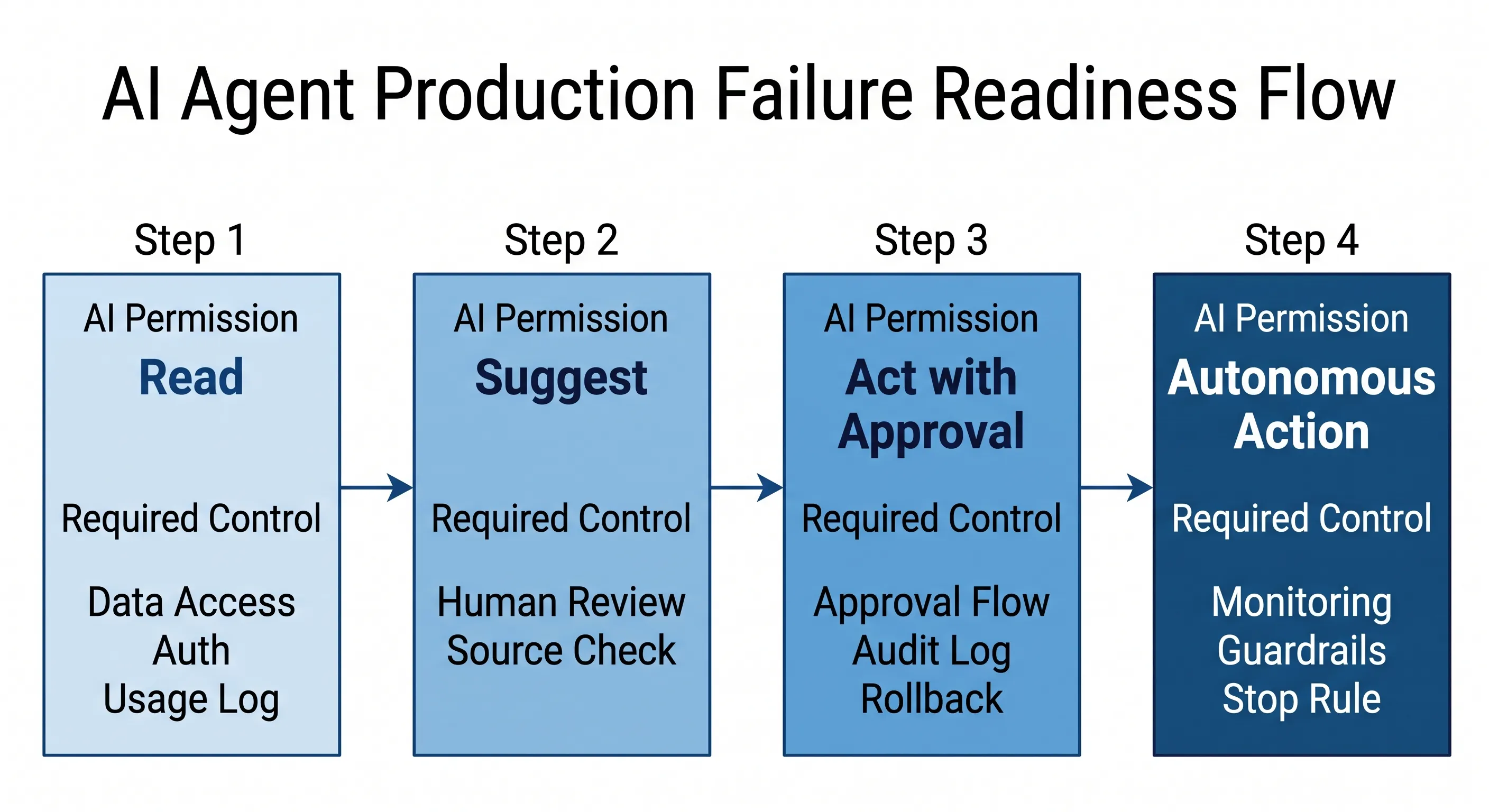
Four Levels of Authorization
In practice, classifying AI agents into four levels simplifies decision-making,
preventing read-only and write-access AIs from being governed by the same rules.
Level | Permitted Actions | Required Controls |
|---|---|---|
Read | Search, Summarization | Data scope, Auth, Logs |
Suggest | Drafts, Recommendations | Sources, Quality, Human check |
Approved Run | Create/Update tickets | Approval flow, Audit logs, Rollback |
Autonomous | Auto-run within limits | Monitoring, Kill switch, Owner |
These levels also serve as an adoption roadmap.
Instead of jumping to full autonomy, start with Read and Suggest, assess operations with Approved Run, and finally consider limited Autonomous execution.
Don't Overrely on Human Approval
Assuming human approval guarantees safety is a risk.
It works only if approvers thoroughly check the AI's data and impact each time.
Too many requests lead to blind approval.
Therefore, approval flows must be split by volume, priority, and impact.
Automate low-risk tasks and keep humans in the loop for high-risk ones.
Without this separation, AI agents will either stall completely or cause high anxiety.
Go-Live Plan
Production AI is not a PoC extension, but a system launch.
Decide on tasks, data, access, evaluation, and operations before models/tools to avoid rework.
Focus on One Task
Target a single task first.
Choose tasks with clear inputs and outputs, like "pre-meeting research", "ticket triage", or "spec review & draft testing".
Narrowing focus clarifies data, users, approvers, and exceptions.
Broad, company-wide assistants are easy to start but lack ownership and accountability.
Align Data & Process Design
AI agents give convincing answers even with messy company data.
This is a major risk.
Without clear updates, owners, permissions, and sources, agents fail in production.
Existing BI/DWH or RAG may not suffice.
AI needs clear access rules for proposals, contracts, FAQs, specs, and chats.
This is covered in our "data infra for AI" post, which is worth reviewing before launch.
Related articles

Before using AI agents at work, you must first organize your data, docs, and permissions for secure AI access. This article explains the difference between traditional BI/DWH and the data foundations needed for the AI era.
Phinx Evaluation
When Phinx evaluates AI agent implementation, we do not start with "what to build with AI."
We first identify which tasks, what decisions, and under whose responsibility will change.
Reversing this order often stalls production despite progress in PoC.
What Clients Must Prepare
Before consulting developers or AI vendors, clients should confirm these five key points.
A perfect spec sheet is unnecessary, but decision-making roles must be clear.
Key Checkpoints | Decisions to Make | Key Roles |
|---|---|---|
Target Task | Start & end conditions | Task Owner |
Data Scope | Sources, updates, permissions | IT Dept, Data Lead |
Execution Authority | Suggestions only or execution | Task Owner, IT Dept |
Evaluation Metrics | Accuracy, time, rework, audit | DX Team, Operations |
Ops Responsibility | Inquiries, updates, halt decisions | IT Dept, Main Dept |
If you cannot fill this table, you should organize workflows, data, and permissions first.
Adding more PoCs will likely stall at the same point.
When to Use External Partners
External partners add value when setup alone cannot solve the challenge.
When designing integrations, permissions, workflows, metrics, and operations, AI implementation sits between system development and process improvement.
As discussed in our articles on FDE support and AI development cost estimation, clients do not need to finalize all requirements before outsourcing.
However, outsourcing without involving decision-makers, task owners, and operations will prevent the AI agent from being adopted.
Summary
Moving AI agent PoCs to production is more than just tuning AI models.
It is a design challenge of integrating workflows, data permissions, approvals, audit logs, error handling, and operational ownership.
Even with good PoC results, users cannot adopt them without clear rules on document management, AI autonomy, and error recovery.
Key success factors include narrowing the scope, adjusting governance by AI autonomy, and evaluating rollback costs and auditability.
However, keeping this in-house can lead to siloed decisions among AI, IT, business units, and legal teams.
Repeatable production requires a framework that unifies business understanding and system design.
Phinx excels by combining AI-native development, ETL/DWH data pipeline building, global team coordination, and tech-driven problem-solving.
Our value lies in helping you design AI agents to function as reliable business operations, avoiding the "PoC-only" trap.
Sources
Gartner, Gartner Predicts Over 40% of Agentic AI Projects Will Be Canceled by End of 2027 https://www.gartner.com/en/newsroom/press-releases/2025-06-25-gartner-predicts-over-40-percent-of-agentic-ai-projects-will-be-canceled-by-end-of-2027
Gartner, Gartner Says Applying Uniform Governance Across AI Agents Will Lead to Enterprise AI Agent Failure https://www.gartner.com/en/newsroom/press-releases/2026-05-26-gartner-says-applying-uniform-governance-across-ai-agents-will-lead-to-enterprise-ai-agent-failure
McKinsey, The state of AI: How organizations are rewiring to capture value https://www.mckinsey.com/mx/our-insights/the-state-of-ai-how-organizations-are-rewiring-to-capture-value
OpenAI Agents SDK https://openai.github.io/openai-agents-python/
OpenAI Agents SDK Guardrails https://openai.github.io/openai-agents-python/guardrails/
OpenAI Agents SDK Tracing https://openai.github.io/openai-agents-python/tracing/
Anthropic, Building effective agents https://www.anthropic.com/engineering/building-effective-agents

Latest Articles

Stay up-to-date
Related articles
Why AI Agent PoCs Fail and Enterprise Design Essentials

Is FDE Viable for Japanese Firms? SES Differences & Setup

India New Graduate Starting Salary and Annual Income 2026 | CTC Structure and Offer Design

Stricter Visa Rules for Dispatched Engineers in Japan (2026)