Is FDE Viable for Japanese Firms? SES Differences & Setup

Simply building AI or business systems to specs often fails to deliver results today. This article contrasts FDE with SES, contract development, and consulting, explaining from a client's perspective how Japanese firms can successfully adopt an FDE-style model.
Contents
※Please be noted that this blog is translated automatically by AI
Summary
When considering FDE, focus on responsibilities, not job titles.
Understanding these key points clarifies the difference from SES and traditional outsourcing.
FDE is an engineering role bridging business understanding, tech design, development, deployment, and improvement.
The difference from SES lies in scope, ownership, and change management, not just on-site work.
FDE pricing focuses on software usage, onboarding, outcomes, and continuous updates rather than selling man-months.
In Japan, budgets and approvals favor man-months; clarify contracts and responsibilities before starting FDE.
Running FDE in Japan requires active client leadership, decision-makers, data access, and field cooperation.
For AI, FDE must detail workflows and metrics; otherwise, the project stalls in production after PoC.
When using global teams, separate tasks requiring Japanese from those managed via specs and code.


What is FDE?
FDE (Forward Deployed Engineer) is an engineering role that works closely with clients to understand business challenges, define tech scope, implement, deploy, and improve operations.
They integrate deeper into client business than typical devs and stay closer to implementation than standard consultants.
OpenAI defines FDEs as leads for complex production rollouts, handling discovery, technical scoping, system design, build, and production rollout.
Anthropic also notes that FDEs build production AI apps within client systems.
With AWS investing in FDE teams in 2026, FDE is drawing attention as a key model for putting AI into production.
What to look for beyond job titles
The name FDE may seem like a new engineering role.
However, what matters to clients is who clarifies challenges, makes tech decisions, and takes ownership until production.
If an FDE only codes after requirement definition, it is no different from traditional outsourcing.
When Japanese firms consider FDE support, verify the actual scope, not the title.
Results vary greatly depending on whether it covers business interviews, requirement breakdown, prototyping, evaluation design, integration, security, and user rollout.
FDE vs. SES, Contract Dev & Consulting
To understand FDEs, compare them with SES, contract dev, and consulting based on scope of responsibility, not tasks.
Each model has its place.
The issue lies in tackling high-uncertainty projects like AI adoption using only man-hour supply or proposal writing.
Model | Key Value | Key Check for Clients |
|---|---|---|
SES | Secures technical headcount | Who defines problems and owns results? |
Contract Dev | Delivers agreed specs | How to handle changes and acceptance? |
Consulting | Helps clarify issues and strategy | Does it link to implementation and use? |
FDE Support | Links biz understanding to launch | Is client decision-making ready? |
FDE is not a direct upgrade to SES.
For projects with fixed specs needing quick coding, SES or contract dev may fit better.
Conversely, for vague requests needing AI or data planning, FDE support is more effective.
On-site presence is not the differentiator
In Japan, FDE is often confused with SES.
Both work close to clients and join meetings or interviews.
However, being on-site but just executing assigned tasks is not FDE.
FDEs do not just turn vague client requests into tickets.
They check goals, limits, systems, data, and rollbacks to split tasks into codable parts.
Without this role, any "FDE" setup is just selling man-hours.
Billing Models
FDE billing has no legal definition.
Depending on terms, it includes flat monthly fees, quasi-mandate, success fees, or software fees.
Thus, it is inaccurate to say FDE never uses time-and-materials billing.
However, major US FDE models rarely sell just engineer hours.
Palantir's annual report states revenue comes from software subs, O&M, and professional services.
AWS describes FDE around shared goals and business outcomes, not billable hours.
Clients should check invoice line items.
If built only on hourly rates and headcount, the "FDE" might just be labor provision.
If it includes platform fees, setup, process design, KPIs, handoffs, and feedback cycles, expect real FDE value.
Related articles
As AI coding agents rise, system development estimates are harder to judge by man-months alone. This article explains how clients should interpret the man-month model and verify AI scope, review duties, change management, and knowledge transfer before signing contracts.
When Japanese firms need FDE
An FDE-style setup is not for projects with clear requirements from the start.
It is needed when the business, IT, and external vendors lack alignment on what to build.
This gap often happens in AI rollouts, data platforms, system revamps, and multi-vendor projects.
Why FDE Spread in the US
The rise of FDEs in the US stems from shifts in how enterprise software is sold.
Just selling licenses fails to integrate deeply into a client's workflows or data structures.
Especially for AI and data, real-world deployment requires embedding inside client operations to co-create actual data, access rights, workflows, and evaluation methods.
Another driver is that feedback from client sites fuels product improvement for SaaS and AI firms.
Indeed, OpenAI and Anthropic FDE job postings explicitly highlight this loop back to product and engineering.
FDEs do not just solve one-off client issues; they find reusable features, deployment patterns, and operational designs.
This is why US tech and platform giants highly value FDEs.
When this loop runs well, vendors improve their products while deeply integrating into client operations.
For clients, the vendor is no longer just a contractor, but a partner linking their workflow upgrades with product updates.
While highly convenient, it increases lock-in.
Before signing, clarify the ownership and handoff terms for data, settings, rules, docs, and custom tools.
Where Japanese Business Practices Often Clash
Japanese firms typically manage vendor contracts via man-months, quasi-delegation, deliverables, or maintenance agreements.
Internal approvals and procurement processes heavily rely on upfront estimates, rates, deliverables, and acceptance criteria.
While this framework works, applying FDE-style support directly makes it unclear what constitutes a deliverable.
For example, if the first 4 weeks cover workflow audits, data checks, prototyping, and KPI design, is that requirements definition, development, or consulting?
If internal budgets or acceptance rules cannot handle this flexibility, these crucial tasks become hard to justify contractually.
Clients should clarify these points internally before engaging FDEs:
What deliverables are included? (e.g., specs, code, workflow charts, KPIs, SOPs)
Who prioritizes tasks if the project scope changes mid-contract?
Which committee decides on moving a PoC prototype to production?
How is intellectual property split between the vendor's product feedback and the client's internal IP?
Rather than importing the US FDE model as-is, it is more practical to map out responsibilities first to fit Japanese approval and procurement workflows.
Without this clarity, FDEs end up being treated as standard IT outsourcing, losing their unique value.
AI Projects Stuck in PoC
While AI agent or generative AI PoCs can be built quickly with a small team, production deployment is a different story.
It requires access rights, answer validation, approval loops, edge-case handling, audit logs, and legacy system integration.
A mere PoC demo screen cannot resolve these operational hurdles.
An FDE approach works best by reverse-engineering production requirements before building the PoC.
For instance, to generate quotes via AI, you must first define accessible contracts, price lists, past proposals, approvers, and validation methods.
Skipping this step leads to working prototypes that cannot be used in actual operations.
Development Projects with Vague Requirements
The same applies to enterprise software development.
Projects stall when clients cannot write a detailed RFP and vendors reply, "We will quote once requirements are finalized."
The fix is not to draft a perfect spec sheet instantly, but to isolate uncertainties and test them in small steps.
FDE-style support separates business decisions, technical validations, and executive approvals.
Spending the first 1-2 months just categorizing requirements, prototypes, data checks, and legacy system audits vastly improves later quotes.
Deciding which uncertainties to defer is crucial before comparing man-month estimates.
Conditions for FDE-like system
FDE is not just about bringing in skilled external engineers.
Clients must prepare for decision-making and on-site cooperation.
Without this, FDEs become mere handymen, ending up as standard development support.
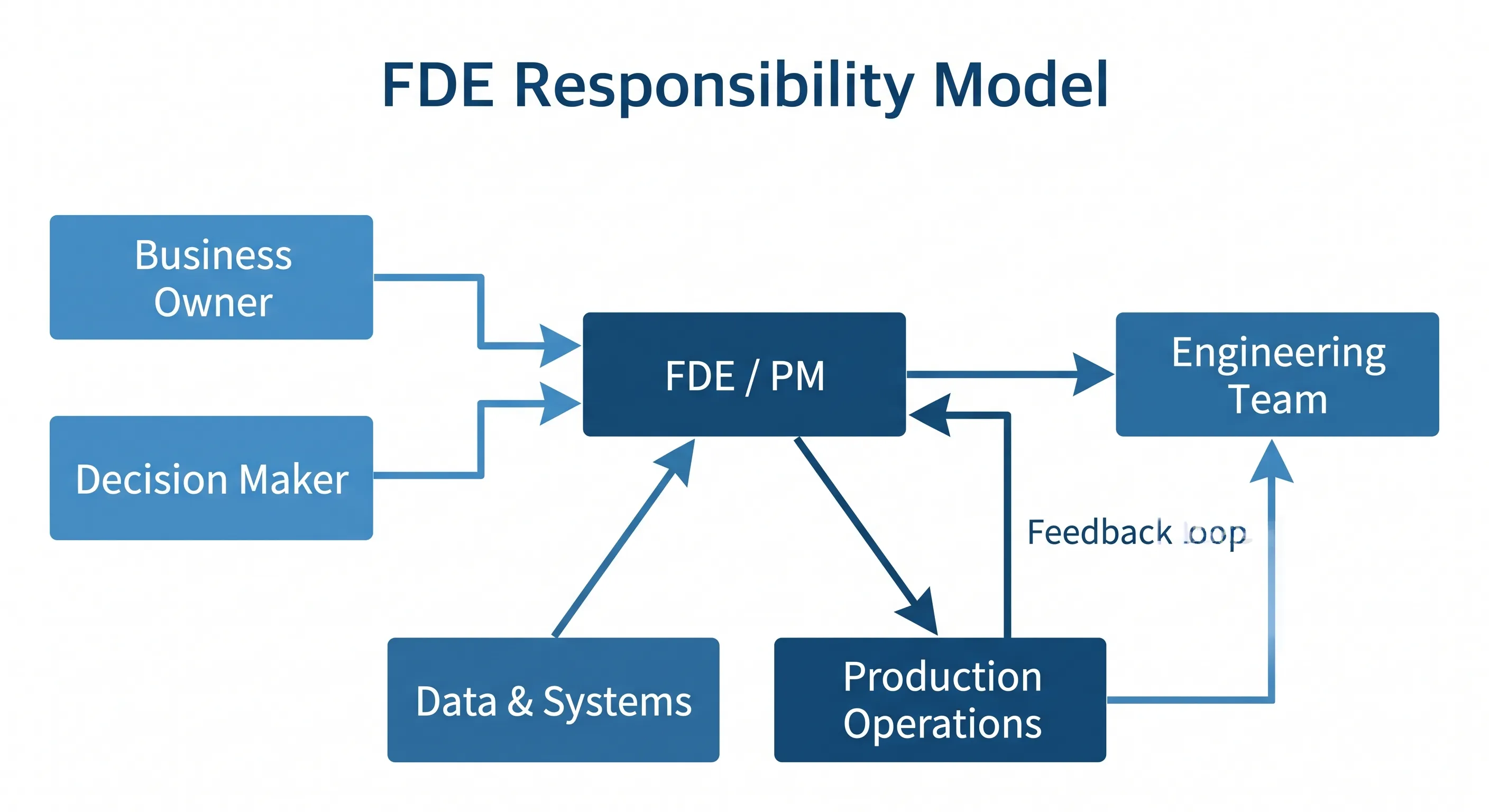
The diagram shows the FDE bridging business units, IT, developers, and operations.
However, FDEs do not do everything.
Responsibilities must be shared: clients make decisions, FDEs and developers design/implement, and both ensure operational adoption.
The Role of the FDE
FDEs do not just turn client requests into specs.
They understand business goals, break them into tasks, test high-risk parts first, and make them actionable for developers.
For AI, they define the business decision to support before choosing models.
For data platforms, they identify users, permissions, and frequency before building DWH or RAG.
Following this order defines FDE quality.
Requirements for FDE Providers
Not every developer can provide FDE services.
Providers must meet at least three conditions.
First, they must feed project insights back into their products, templates, and assets.
Those handling projects as isolated cases are just standard system integrators.
Second, sales, consultants, engineers, and ops must share the same standards.
FDE support fails if sales promises outcomes while tech only tracks man-months.
Third, they must build operational capacity within the client, not just create dependency.
AWS's focus on client self-reliance is a key reference.
Clients should evaluate not just what to outsource, but what capabilities they retain post-contract.
Required tasks, data, and permissions
Clients do not need complete requirements before FDE support.
However, external partners must have access to decision-making materials.
Prep Item | Key Verification | Risk if Missing |
|---|---|---|
Business Owner | Who makes business decisions? | Scope creeps; priorities remain unset. |
Data Access | Accessible docs, DBs, and logs. | Usable info differs between PoC & production. |
Metrics | How success is measured. | Stalls with unmeasurable outcomes. |
Ops Lead | Who uses and maintains it post-launch? | System fails to gain adoption. |
An FDE approach is not magic; it cannot fix a client's lack of preparation.
Assign a business owner if missing; separate PoC/production data if access is unclear.
Delaying these decisions only wastes development budget.
Questions to Ask Before Contracting
When choosing an FDE partner, resumes and tech stacks are not enough.
These questions help distinguish simple implementers from true business-tech bridges:
What do you verify in the first 4 weeks when requirements are fluid?
Is billing based on man-months, flat monthly fees, performance, or software licensing?
What design aspects do you separate between PoC and production?
Who decides on AI evaluation, auditing, and fallback procedures?
What docs, ops procedures, and decision logs should remain with the client?
Who owns the created business rules, configs, templates, code, and eval data?
If responses focus solely on implementation hours, they are likely just providing dev resources.
Conversely, if they ask about owners, data access, metrics, and adoption, you can expect true FDE support.
Related articles

Before using AI agents at work, you must first organize your data, docs, and permissions for secure AI access. This article explains the difference between traditional BI/DWH and the data foundations needed for the AI era.
Why FDE's value rises in the AI era
AI speeds up coding.
Yet, AI cannot decide what to build, what data to use, who approves results, or what quality to release.
With these decisions remaining, an FDE's value shifts from coding volume to breaking down problems into testable forms.
Fast Processes vs. Remaining Tasks
AI agents speed up drafts, tests, research, and documentation.
However, system integration, security reviews, business alignment, edge cases, and training still remain.
Using AI makes these remaining tasks the bottleneck if overlooked.
An FDE's role is not just fast coding, but making the output production-ready.
What output requires human review?
What logs are kept?
When should automation stop?
Without these designs, AI implementation stalls before use.
Feedback to the Product
According to OpenAI and Anthropic, FDEs must feed client feedback back into the product or model.
FDEs are not just deliverers; they bridge client constraints and product improvement.
While not easily replicated in every Japanese company, custom projects can still document decisions, failures, and reusable designs.
FDE value lies in transforming individual project insights into shared assets for future development.
For clients, this is a double-edged sword.
Product improvements speed up future proposals, but relying too heavily on external products for business logic increases switching costs.
Foreign engineers & offshore teams
An FDE-style structure does not need to be built solely with Japanese engineers.
However, when mixing foreign engineers or offshore teams, assigning roles based only on Japanese proficiency leads to failure.
It is necessary to split the required language, decision authority, and deliverables by process.
Processes Requiring Japanese
Strong Japanese skills are needed for business department interviews, management briefings, approval documents, handling on-site exceptions, and post-launch support.
This requires not just language accuracy, but the ability to read what worries the other party.
Meanwhile, API specs, data models, test cases, code reviews, and log investigations can proceed using English or structured specs.
Rather than having everyone attend Japanese meetings, it is more effective for Japanese FDEs/PMs to organize decisions, letting offshore engineers focus on implementation and verification.
Connecting with Global Delivery
Phinx does not view offshore teams merely as cheap labor for implementation.
The key is for the Japanese side to handle customer understanding, issue definition, and quality judgment, while integrating offshore engineering resources (mainly in India) into the right processes.
In the AI era, teams that only take specs and implement in bulk lose value.
Conversely, offshore teams that autonomously run design, reviews, testing, and knowledge management using AI gain more value.
The FDE role serves as the crucial link connecting Japanese business decisions with offshore implementation power.
Related articles

Rising local costs and AI coding agents are rendering the idea of cheap offshore teams obsolete. This article explores AI's impact on offshore development and outlines a new division of labor between Japanese PMs and AI-native overseas teams.
FDE: Pros and Cons
While FDE-style support sounds useful, it's not needed for every project.
Evaluate based on project uncertainty, business involvement, system complexity, and AI/data usage.
Project State | FDE Fit | Key Decision Points |
|---|---|---|
Requirements and scope are clear | Low | Outsource or SES might fit better |
Business issues exist, solution undecided | High | Clarify issues while running POCs |
Want to productionize AI POC | High | Design data, permissions, and ops |
No internal decision-maker | Low | Assign a responsible leader first |
Want to use offshore dev teams | Mid-High | Separate Japanese and dev phases |
FDE fits projects with many decisions, rather than just vague requirements.
However, without a decision-maker, user cooperation, or data access, even FDE fails.
Companies That Should Prepare First
Some companies must organize internally before bringing in FDE.
For example, if business units won't help, IT blocks data, or management lacks clear goals.
Otherwise, partners spend time on alignments without developing, wasting budget.
First, select one small target process and define the owner, users, data, KPIs, and operators.
Then, bring in FDE support so they can design based on real constraints, not guesses.
Getting this order right is the first step to successful FDE adoption.
Summary
FDE is not just another name for resident engineers or AI consultants.
It is about system design connecting business understanding, tech scoping, coding, deployment, and operation.
To succeed in Japanese companies, it requires not only the partner's skills but also the client's decision-making, data access, and team support.
The key to success is not to outsource everything to FDEs.
The client holds the business answers; FDEs break them down into buildable parts for development and testing.
This division of labor keeps development moving even without fixed specs.
Otherwise, leaving decisions in limbo while relying on outsiders only swells coordination costs.
AI and data integration add metrics, permissions, legacy systems, and post-launch improvements to the mix.
Trying to handle this internally often siloes decisions among business, IT, and vendors, leaving no shared knowledge.
Phinx excels in linking problem solving, scoping, AI, dev, and global team setup.
When considering FDE-style development, Phinx's value lies not in engineer hours, but in connecting business logic, tech decisions, and delivery.
References
OpenAI Forward Deployed Engineer https://openai.com/careers/forward-deployed-engineer-%28fde%29-sf-san-francisco/
Anthropic Forward Deployed Engineer https://job-boards.greenhouse.io/anthropic/jobs/5302966008
AWS APN Blog - Introducing Forward Deployed Engineering for Partners https://aws.amazon.com/blogs/apn/introducing-forward-deployed-engineering-for-partners-winning-the-future-of-enterprise-ai/
Amazon News - AWS invests $1 billion to embed AI forward deployed engineers with customers https://www.aboutamazon.com/news/aws/aws-1-billion-forward-deployed-ai-engineers
Palantir Technologies Inc. 2025 Form 10-K https://www.sec.gov/Archives/edgar/data/1321655/000132165526000011/pltr-20251231.htm

Latest Articles
Stay up-to-date
Related articles
Is FDE Viable for Japanese Firms? SES Differences & Setup

India New Graduate Starting Salary and Annual Income 2026 | CTC Structure and Offer Design

Stricter Visa Rules for Dispatched Engineers in Japan (2026)

Limits of Man-Month & AI-Era Estimation: Client's Guide