Limits of Man-Month & AI-Era Estimation: Client's Guide

As AI coding agents rise, system development estimates are harder to judge by man-months alone. This article explains how clients should interpret the man-month model and verify AI scope, review duties, change management, and knowledge transfer before signing contracts.
Contents
※Please be noted that this blog is translated automatically by AI
Summary
The man-month model won't vanish instantly. In the AI era, estimates must focus on uncertainty, responsibility scope, and review structures, not just workload.
AI speeds up initial drafts, research, and test creation, but requirement decisions, system adjustments, quality ownership, and internal consensus remain.
Clients should check if estimates cover requirements, reviews, change management, knowledge bases, and AI rules, not just headcount and unit rates.
Before choosing a contract type, clarify deliverables, acceptance criteria, change handling, and responsibility for reviewing AI-generated outputs.
In multi-vendor projects, AI can scatter info, causing failures. Keeping shared records of minutes, specs, decisions, and issues is essential.


Man-Month Model vs AI-Era Estimation
The person-month model calculates costs based on man-hours (people multiplied by period).
For example, 2 people for 3 months equals 6 person-months.
It is clear for clients, but fails to capture vague requirements, legacy constraints, or rework overhead.
Where It Still Works
The model is still useful for maintenance, small updates, or testing where scope is clear.
It simplifies budgeting, internal approvals, and vendor comparison.
The problem is using only person-months to measure development difficulty.
AI speeds up coding, but understanding business logic and integration still takes time.
Modern estimates must look beyond person-months to processes, responsibilities, and assumptions.
Shift Focus from Headcount to Risk
Clients must ask more than "how many people for how long."
Who handles undefined requirements?
Who reviews AI-generated code?
How are spec changes funded?
Vague estimates look cheap initially but lead to high costs later.
In the AI era, person-months are just part of the price.
Clients must separate labor estimates from risk management estimates.
AI's impact on processes
The IPA notes AI is used in software development for requirements, minutes, code generation, reviews, and testing.
In real projects, AI is highly effective for drafting, research, and generating ideas.
However, time savings vary significantly across different phases.
Tasks Easily Shortened
Tasks with clear inputs and expected outputs are easily shortened by AI.
This includes CRUD drafts, API templates, code modifications, test cases, minutes summarization, and spec diffs.
A GitHub Copilot study showed developers completed specific JavaScript tasks much faster with Copilot.
However, these metrics cannot be applied to all projects blindly.
Real business development involves data, permissions, stakeholders, and release liabilities that simple tasks do not.
Clients should check estimates to see which specific tasks are assumed to be shortened by AI, rather than just asking for a flat discount rate.
Tasks Requiring Human Effort
Tasks involving judgment and consensus-building are hard to shorten.
Confirming specs, deciding exception handling, investigating system constraints, security reviews, liability, and release decisions still require human approval.
DORA's 2024 report indicates that while AI boosts individual productivity, its impact on overall software delivery is different.
Overlooking this leads to projects where coding is fast, but acceptance testing never ends.
A vendor using AI is fine.
The issue is whether they budgeted enough time for review, fixes, explanation, and approval after the AI-accelerated phase.
Related articles

Rising local costs and AI coding agents are rendering the idea of cheap offshore teams obsolete. This article explores AI's impact on offshore development and outlines a new division of labor between Japanese PMs and AI-native overseas teams.
Hidden costs in man-month estimates
The weakness of man-month estimation is that neat lines on a quote falsely reassure clients.
However, actual costs depend on more than just coding.
Excluding system research, vendor coordination, spec changes, testing, and handovers causes internal overload later.
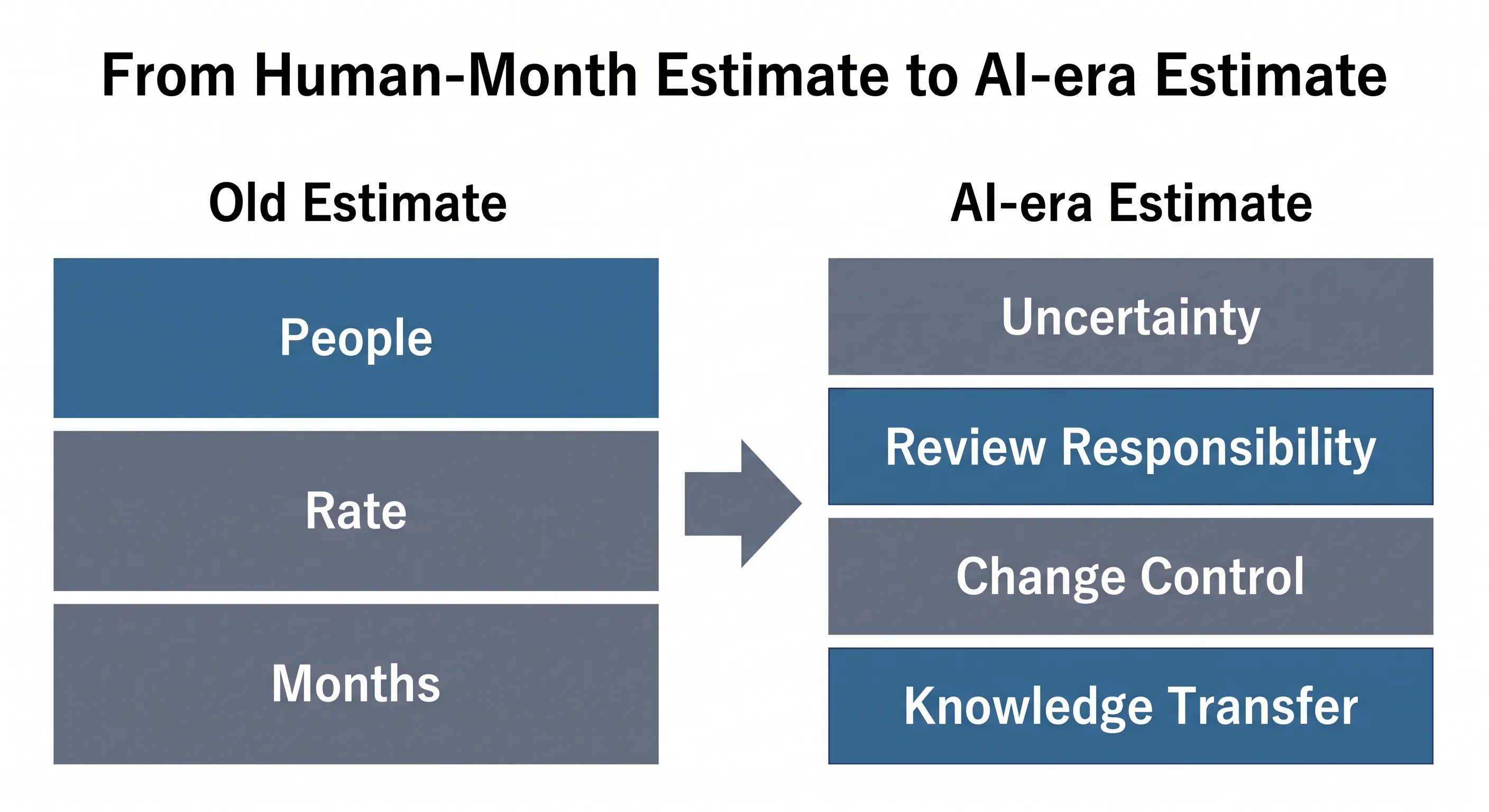
The diagram expands a simple "staff, rate, period" quote into one including "uncertainty, review, change management, and knowledge transfer."
Crucially, while AI speeds up coding, it does not reduce the client's decision-making time.
Hidden Coordination Costs
In multi-department projects, alignment on decisions is required before building features.
Sales wants more input fields, Accounting wants ledger integration, and IT wants access control.
These alignments are often hidden under PM or requirements definition fees.
AI helps organize minutes and specs but cannot resolve stakeholder conflicts.
Clients must verify if PM and requirements fees include stakeholder coordination, decision support, issue tracking, and history logging.
Review and Acceptance Costs
AI-generated code and docs must be reviewed by humans to be accepted.
If review hours are underbudgeted, vendors may code quickly but shift quality assurance to the client.
Cheap quotes often result in clients working late to verify specifications.
Acceptance criteria follow the same pattern.
A working screen, passed tests, and business readiness are different milestones.
Clients must clarify acceptance items, revision limits, bug-fix scopes, and post-launch support during estimation.
Key Estimate Items
In the AI era, comparing estimates means checking item breakdown rather than finding the lowest unit rate.
Even for the same total, load on the client varies if the estimate covers design/testing/transition or just development.
Key Items to Verify
The table below shows key items to check.
Looking for missing items helps identify potential trouble spots.
Estimate Item | What to Check | Decision Point |
|---|---|---|
Req. Definition | Open issues & deciders | Clarify who decides |
AI Usage | Steps & review method | Ensure human review |
QA | Test scope & acceptance | Cover operational use |
Change Control | Handling extra requests | Set pricing conditions |
Knowledge Transfer | Specs & ops handover | Keep info internal |
Missing items don't always mean a bad estimate.
However, the client must shoulder that workload.
Companies lacking PMs or tech leads need wider-scope estimates.
Reading Cheap Estimates
Cheap estimates have reasons.
It could be client-led reqs, AI-driven drafting, limited testing, or no ops handoff.
If the reason is clear, choosing it can be a valid option.
Avoid cheapness without clear reasons.
Even with low unit rates, costs don't drop if you must handle specs, reviews, and UAT.
Adding a "Client Tasks" column next to the total makes comparison easier.
Related articles

More firms outsource to fix IT labor shortages, but relying solely on it often hurts speed and quality. This article explains the pitfalls of outsourcing and how to balance in-house and external development.
AI use and liability before contracting
AI-driven development increases pre-contract checks.
No need to ban AI use.
Instead, vendors clarifying how they use AI, who reviews it, and who is responsible for deliverables are easier to manage.
Contract Type Differences
In service contracts, deliverables and acceptance criteria are crucial.
Regardless of AI use, check if deliverables meet requirements and how bugs are handled.
In quasi-mandate contracts, hours, scope, reporting, and decision-making matter most.
Neither is superior.
Service contracts suit fixed requirements and clear deliverables.
Quasi-mandate suits exploratory projects.
But always check review duties, tools, input data, and IP rights regardless of contract type.
Pre-Ordering Questions
Ask vendors specific questions to clarify their estimates.
Just asking "Do you use AI?" is too vague.
In which phases is AI used: research, coding, testing, review, or documentation?
Who reviews AI-generated code/specs, and by what criteria?
Are there rules for inputting customer data, source code, or business data into AI?
What conditions trigger extra fees for specification changes?
What docs remain for our team to maintain the system after delivery?
If they cannot answer specifically, they might not be bad vendors,
but they likely lack processes for AI-driven workflows.
Compare vendors based on answer details, not just estimates.
Multi-Vendor Knowledge Management
In the AI era, knowledge management dictates estimate success.
Multi-vendor projects often scatter requirements, minutes, decisions, APIs, and issues.
As AI relies more on past context, scattered data leads to implementation errors based on wrong assumptions.
Units of Knowledge Retention
Clients must define how to track decisions, not just deliverables.
Why this spec?
Which options were rejected?
What API limits were assumed?
Who approved it?
Without this, maintenance and future updates will face constant re-verification.
Japan's METI report on legacy systems notes that old systems block digital transformation.
Similarly, fast AI-driven builds will fail at connection and migration if existing systems are ignored.
The AI era demands knowledge management that bridges old specs and new code.
Organizing Data Before AI Reading
Before feeding data to AI, define the single source of truth and edit rights.
Where are the latest specs, tasks, minutes, designs, and tests, and who updates them?
Without this, AI search and summaries will include outdated information.
Phinx prioritizes this clarity in multi-vendor projects.
AI-driven management and knowledge bases require more than just tools.
Aligning the client, PM, and dev teams on the same page first ensures stable AI utilization.
Related articles

Before using AI agents at work, you must first organize your data, docs, and permissions for secure AI access. This article explains the difference between traditional BI/DWH and the data foundations needed for the AI era.
Common Pitfalls
A common mistake in AI-era dev estimation is choosing vendors solely by price.
To firms lacking tech experts, cheap quotes look attractive.
However, omitted tasks return to the client as meetings, reworks, and maintenance loads.
Assuming AI Just Lowers Costs
The riskiest move is budgeting on the sole assumption that faster AI coding slashes total costs.
Even with faster drafts, total costs won't drop if data prep, role design, and testing remain.
Worse, boosting AI output with weak review systems causes reworks.
In bids, ask to separate AI-shortened steps from non-shortened ones.
Quotes claiming just "AI efficiency" are hard to justify internally.
Ask which step shrinks by how much and what reviews are needed instead to justify your budget.
Ordering Deliverables Only
Another failure is buying deliverables without defining post-launch operations.
Even with APIs and admin tools, you remain vendor-dependent if your team cannot understand them.
AI speeds up code growth, so delaying docs and maintenance plans piles up tech debt.
Ensure bids include manuals, role lists, design choices, test views, and known limits.
These aren't flashy but prove vital for additions six months later.
Summary
AI-era estimation isn't about abandoning the man-month model, but breaking down what man-months can't measure.
While AI speeds up initial drafts, research, and testing, humans still handle requirements, integration, reviews, and handovers.
Clients must look beyond team size and rates.
Key factors are: who manages which risks, who owns deliverables, and how changes are handled.
Success requires detailing estimates by phase, clarifying AI use and review duties upfront, and retaining decision logs.
Without these, cheaper estimates often shift more validation work to your team.
Tech-savvy firms manage vendors well.
However, lacking PMs, tech leads, or business architects makes comparing estimates highly subjective.
Phinx supports everything from organizing issues and defining requirements to AI-driven development and global team design.
By combining local client understanding with AI-native development and Global Delivery, we ensure clear, early validation of estimates.
Sources
IPA "Software Development Using AI" https://www.ipa.go.jp/digital/ai/software-engineering.html
METI "Legacy System Modernization Committee Summary Report" https://www.meti.go.jp/press/2025/05/20250528003/20250528003.html
DORA "Accelerate State of DevOps Report 2024" https://dora.dev/research/2024/dora-report/
GitHub Blog "Research: quantifying GitHub Copilot’s impact on developer productivity and happiness" https://github.blog/news-insights/research/research-quantifying-github-copilots-impact-on-developer-productivity-and-happiness/

Latest Articles

Stay up-to-date
Related articles

India University Tiers & Hiring: Salary Data & Candidate Assessment

AI Subsidies: What to Outsource vs. In-house or SaaS

AI Security for SMBs: Data Breach Lessons

Stricter Visa Rules for Dispatched Engineers in Japan (2026)