Can EOR and offshore be used together? Common pitfalls explained
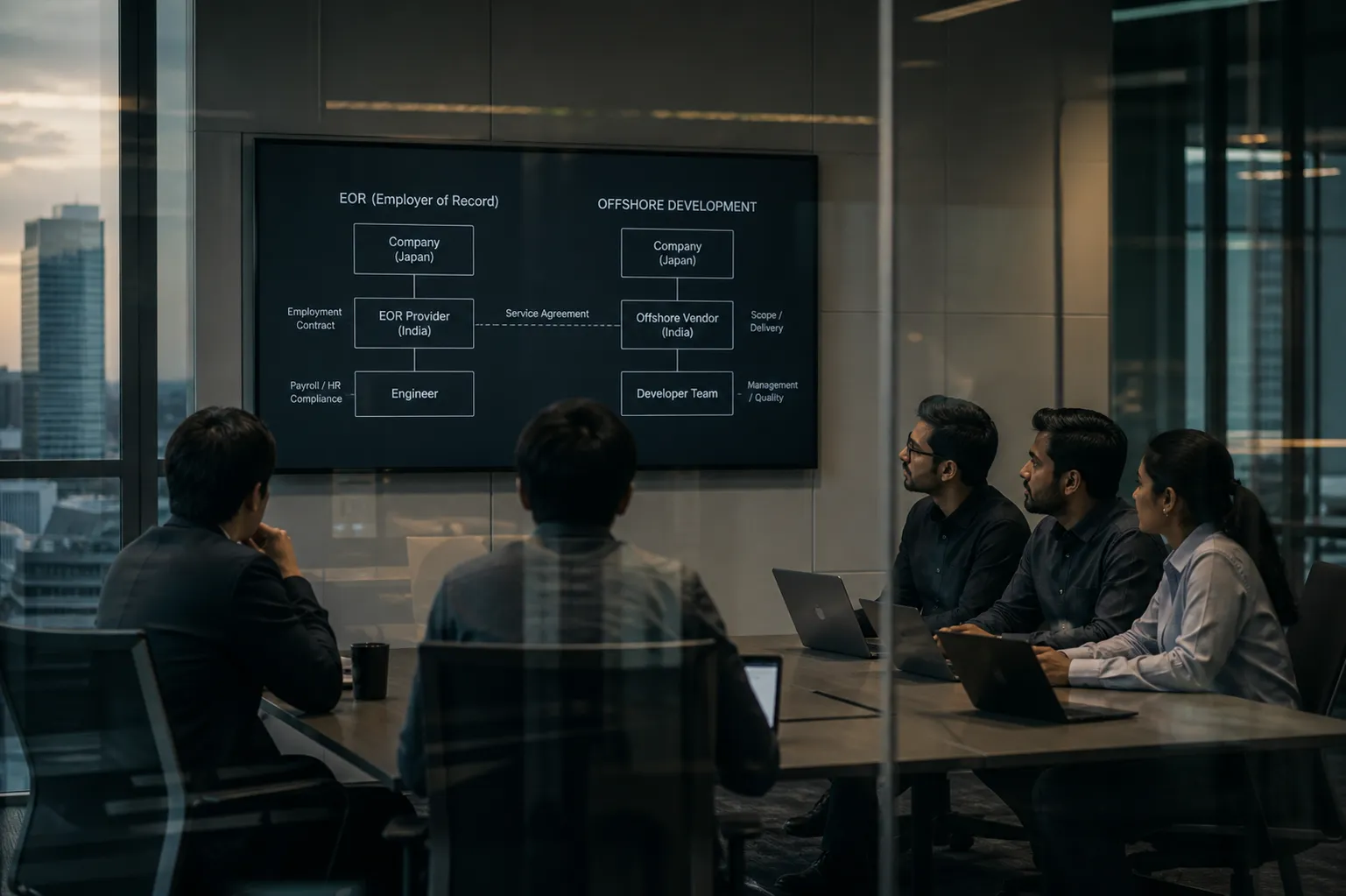
More companies are combining EOR and offshore, but if roles and responsibilities are not clearly defined, it often leads to lower quality and a heavier management burden. This article explains the structural differences between EOR and offshore, plus common pitfalls and practical design methods when using both.
Contents
※Please be noted that this blog is translated automatically by AI
Clarifying the differences between EOR and offshore
Both EOR and offshoring are ways to use overseas talent.
However, their contract structures and scope of responsibility differ greatly.
If you use them together without understanding this difference, it becomes unclear who owns results and who manages the work, and operations can easily fall apart.
First, you need to clarify the structural differences.
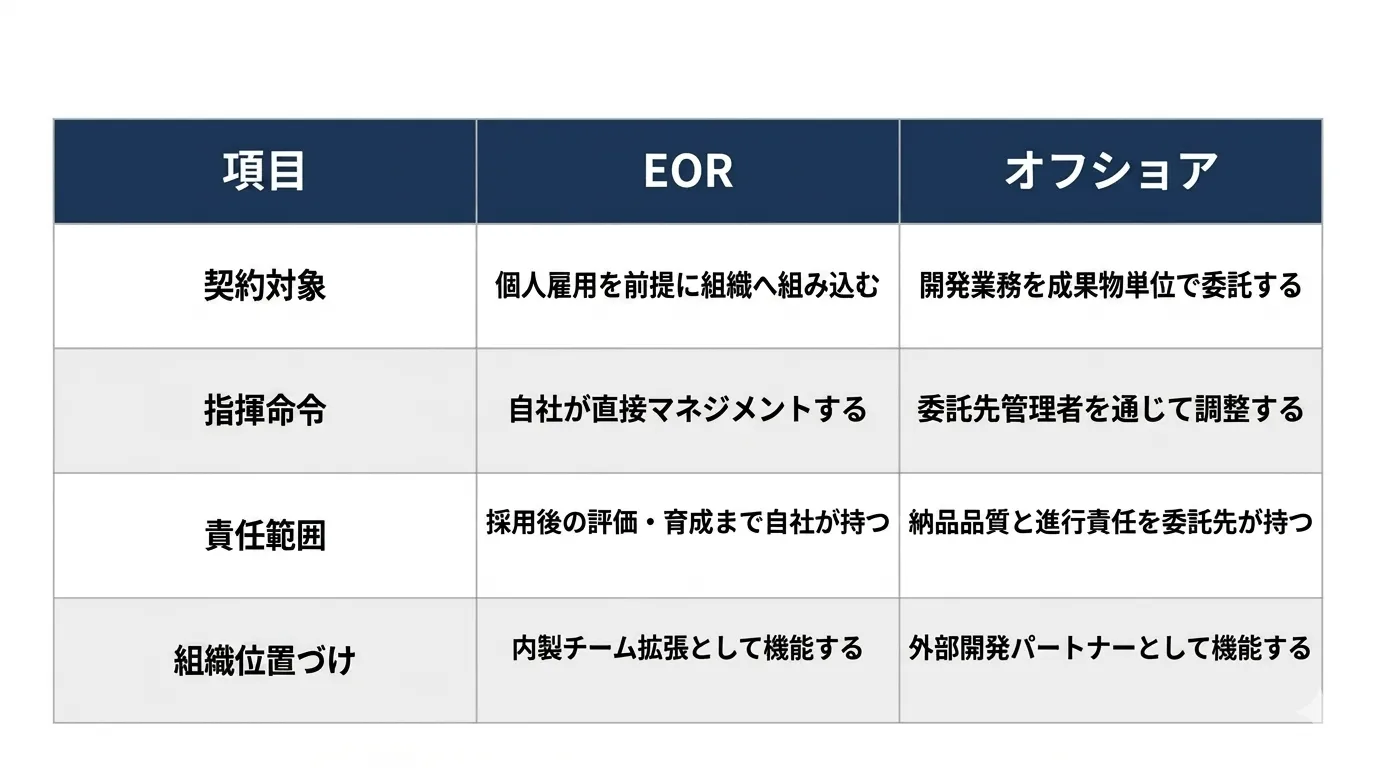
Differences in the contracting party
EOR is an employment support scheme that embeds overseas talent into your organization as in-house members.
Even without a local entity, the EOR provider becomes the legal employer, so the company can directly give instructions to overseas staff.
Offshoring, by contrast, outsources the development work itself to an outside company.
The contract is for the deliverables, not the people, and the vendor handles project and quality management.
If you use both without understanding this difference, it becomes mixed up internally whether the person is a hired employee or an external contractor.
In engineering teams especially, frequent scrum operations and spec changes mean inconsistent command lines directly cause delays.
For example, a PdM may give tasks directly to EOR staff, while offshore members on the same team can only be asked through a PM.
In that state, priority changes are not shared in real time, and sprint plans can break down.
Even if management thinks it has "in-sourced" the overseas team, the front line is often still managing vendors.
If you scale the organization without sorting out the contract model differences, only management costs tend to rise.
Differences in result responsibility
One reason EOR and offshoring are easily confused is that both look like systems for using overseas talent.
But in practice, the location of result responsibility is completely different.
In EOR, result responsibility stays with your company.
You own operational responsibility, including how you assign, evaluate, and onboard the overseas talent you hired.
That is why design ability at the manager level matters in EOR use.
Even if you just increase headcount without clear requirements, you will not get the expected results.
In offshoring, by contrast, you can transfer part of the result responsibility to the vendor.
Having the vendor PM handle deadlines and development progress reduces your management load.
However, many companies treat EOR staff as if they were offshore resources.
Work instructions become fragmented, and review processes are weak, so quality problems occur repeatedly.
In one SaaS company, engineers hired through EOR were developed by simply handing the work over to the existing offshore team without first defining requirements.
As a result, it became unclear who owned design responsibility, and many spec mismatches surfaced just before release.
On the ground, the Japan-side PM had to keep confirming specs late at night, making the whole development team unstable.
EOR is "recruitment support," while offshoring is "development outsourcing."
If you combine them without organizing this role difference, the management structure itself becomes more complex.
Related articles

More Japanese companies want to tap top talent in India, but varied contract options can make decisions difficult. This article compares EOR with other contract models and clearly explains their pros and cons.


Why Using EOR and Offshore Together Fails
EOR and offshore are effective on their own.
But if used together without defining roles, management structures tend to duplicate.
Especially in engineering organizations, spec changes and priority shifts happen daily.
So if both are used with unclear responsibility, decision-making slows fast.
The problem is not "using overseas resources" itself, but combining them without a design.
Responsibility boundaries become unclear
The most common issue when using EOR and offshore together is the loss of clear responsibility boundaries.
The most common case is when it is unclear who is responsible for quality.
EOR staff work under in-house management, while offshore staff work under the vendor's management.
In other words, different management structures coexist within the same development team.
When incidents or delays happen, blame is easily pushed around.
The offshore side claims that "the spec was vague," while the in-house side says there is a development quality issue.
Meanwhile, EOR staff do not fully belong to either side's scope and can become worn down as coordinators.
Especially dangerous is when managers themselves do not understand the contract structure.
Even if executives see them as one "overseas team," the actual instruction route differs by contract.
As a result, review requests, incident response, and priority changes flow through multiple routes, slowing development.
In addition, decision history gets scattered across Slack and Jira, making it hard to trace who changed the spec.
EOR and offshore are similar in that they both use overseas talent.
But in reality, they are different operating models with different responsibility structures.
If you combine them without clarifying this premise, management burden only grows.
The command chain splits
Another serious failure in combined use is the split command chain.
Especially in product development, quick response to spec changes is crucial.
EOR staff can communicate directly as in-house members.
On the other hand, offshore teams usually go through the vendor PM or bridge engineer.
This difference creates a gap in decision speed.
For example, if a Japanese PdM changes priorities, EOR staff can respond the same day.
However, offshore teams need internal checks at the vendor, so there is a delay before the change is reflected.
If this continues, an "information gap" forms within the team.
It is not uncommon for only the EOR side to understand the latest spec, while the offshore side keeps developing based on the old one.
Actually, at an e-commerce startup, a backend engineer hired through EOR and an offshore development company were working at the same time.
However, spec-change notices were not shared properly with the offshore side, and the API specs ended up being managed twice.
As a result, many integration mismatches occurred right before production, forcing a release delay.
This cannot be solved by individual skill.
The cause is that "who should lead development operations" has not been defined.
EOR is suited to expanding an in-house organization.
Offshore, on the other hand, is suited to work that can be split into deliverable units.
If these roles are mixed without being organized, the organizational structure itself becomes unstable.
If evaluation criteria and scope of responsibility are not clearly stated, the same confusion may repeat.
Burden caused by failed combined use
Failed use of EOR and offshore together is not just a contractual issue.
In the end, the burden falls on on-site engineers and managers.
The biggest problem is not knowing who to ask.
When responsibilities are unclear, coordination costs rise with every spec change or incident response.
As a result, time meant for development gets spent organizing information and checking details.
When Spec Changes Stop Being Passed On
One of the most common problems in a combined setup is spec changes not being passed on.
Especially in agile development, requirement changes happen repeatedly in short cycles.
However, EOR and offshore use different communication paths.
EOR staff are shared updates directly via Slack or Notion, while offshore teams usually go through the vendor PM.
This gap creates differences in how quickly information reaches each side.
The dangerous part is thinking something has been communicated when it has not.
It is not uncommon for a Japan-side PdM to share a spec change with EOR engineers and assume it has reached everyone.
However, in reality, it may not have been formally shared with the offshore side, and development continues based on the old spec.
In this state, rework costs spike later.
Spec gaps may be found during testing, requiring changes on both frontend and backend.
Worse, the team shifts into a "wait for confirmation" culture.
No one can make decisions with confidence, so even small changes trigger more approval steps.
As a result, the organization slows down.
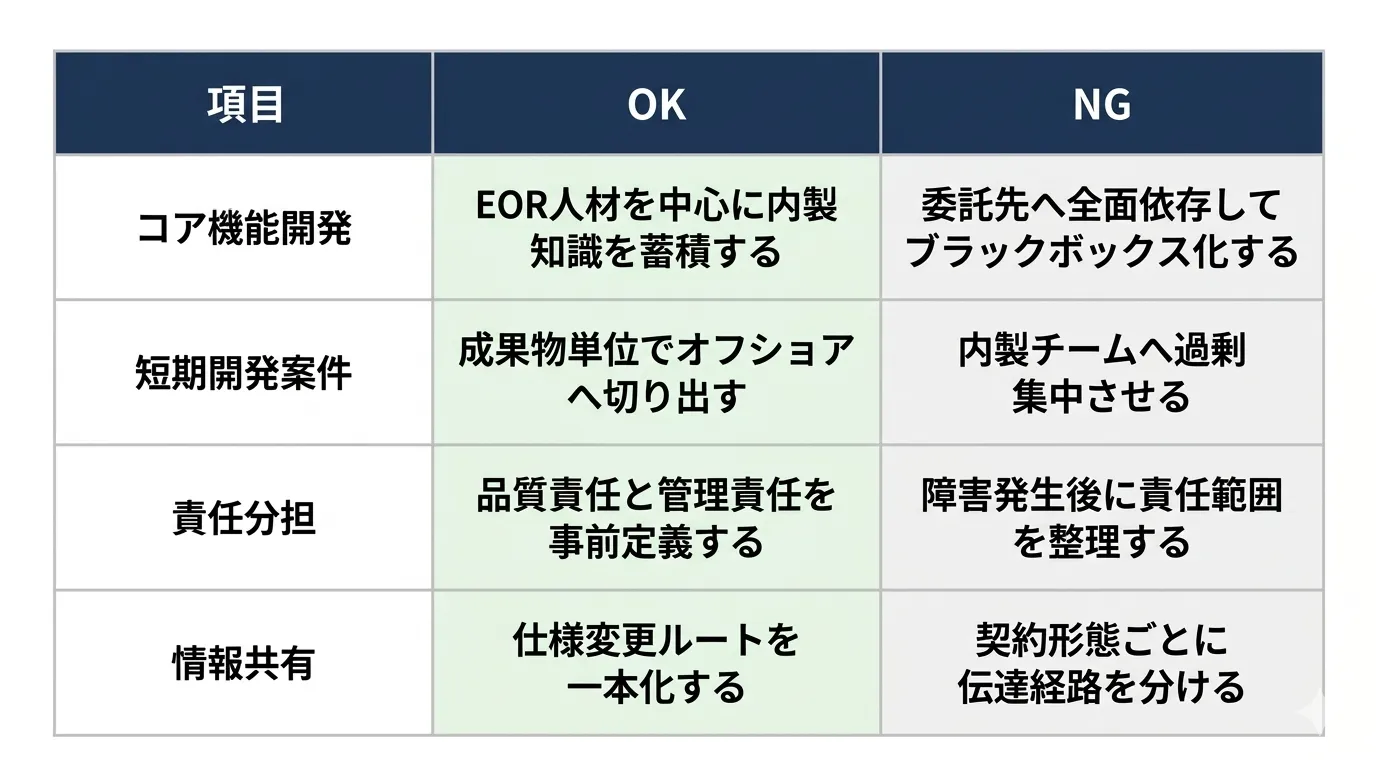
When using EOR and offshore together, the communication route must be unified.
In particular, if you do not clearly define who has authority over spec changes, management costs will rise rapidly.
Responsibility for Quality Issues Disappears
Another serious problem is that the responsible party becomes unclear when quality issues occur.
This becomes especially visible during incidents.
In offshore development, the vendor usually bears quality responsibility within a certain scope.
With EOR, your own company handles reviews and quality control.
But in a combined setup, this boundary blurs.
For example, if EOR staff design a feature and the offshore side implements it, it becomes harder to pinpoint the cause of a bug.
It becomes unclear whether the issue came from design, implementation, or review.
As a result, more time is spent assigning responsibility than analyzing the incident.
At one FinTech company, an authentication platform upgrade was jointly developed by EOR staff and an offshore team.
However, after a production incident, no one could identify the review owner, and the fix was stalled for over half a day.
On site, the Japan-side EM, EOR engineer, and offshore PM kept checking logs until late at night, and normal development came to a complete stop.
The core issue is that the organization has not defined who owns development responsibility.
The more you expand overseas use, the more important responsibility design becomes.
Put another way, if you combine them without this design, confusion grows in proportion to the size of the organization.
Success overseas depends on role sharing
Using EOR and offshore together is not the problem.
In fact, companies that clearly define roles run overseas operations more stably.
What matters is defining first which work to keep in-house and which to outsource.
Without this design, expanding overseas teams can easily make the structure more complex.
In engineering teams, it is especially important to set responsibility and evaluation criteria in advance.
Separate Hiring and Development
Companies that run EOR and offshore smoothly treat hiring and development outsourcing as separate issues.
In other words, they do not mix staffing and deliverable management.
EOR is suited to expanding an in-house team.
It works well when you want to build product knowledge over the long term and absorb it into your culture.
Offshore, on the other hand, is good when you need to scale development resources quickly.
It is especially effective for fixed-spec feature work and maintenance.
Problems arise when these roles are reversed.
If core features that need in-house knowledge are left entirely to offshore teams, understanding of the specs can become dependent on specific people.
If even short-term projects are run mainly with EOR staff, management overhead grows too much.
So in practice, you must first define which areas to keep as in-house knowledge.
More companies are using EOR to internalize areas tied directly to competitiveness, such as authentication, payment logic, and data platforms.
By contrast, offshore is better for areas that are easy to split into deliverables, such as testing and routine development.
In other words, roles should be decided by responsibility structure, not cost.
Set Evaluation Criteria First
Companies that use overseas teams successfully define evaluation criteria before hiring.
Companies that fail tend to assume they can adjust after hiring.
In EOR especially, your own management ability directly affects results.
So if review standards, design ownership, and communication scope are not set in advance, operations become person-dependent.
For example, if you hire without clearly defining what counts as self-driven work, expectations will diverge.
Japan side may expect proactive proposals, while the overseas team may be working on the assumption that they should wait for instructions.
This gap is not an ability issue.
It comes from unclear evaluation criteria.
The same applies to offshore.
If you contract without clear output definitions, there will be no shared view of the completion criteria.
As a result, extra fixes and rework repeat.
When using multiple countries or contract types, it is important to standardize evaluation criteria.
If review quality, response speed, and documentation standards are not unified, the whole organization loses consistency.
Overseas use is not just labor-cost optimization.
It is organizational design: deciding who owns which responsibilities.
In high-level talent recruitment, market selection is also part of the design.
When expanding overseas, many companies focus on “which method to use.”
In practice, however, difficulty changes greatly depending on which market you hire from.
Especially in advanced IT talent, differences in supply and hiring competition directly affect organizational scaling speed.
So you must treat the hiring market itself as something to design, not just EOR or offshore selection.
For advanced talent such as engineers, design difficulty changes greatly by country or market, so decisions must include which market to choose.
Hiring Markets Change the Difficulty
Hiring difficulty for advanced IT talent differs greatly by a country’s supply structure.
For example, even for software engineer hiring, the size of the ready-to-work talent pool varies widely.
In the domestic market, engineer demand is concentrated in growth areas like SaaS, AI, and FinTech.
As a result, competition has intensified not only for senior talent but also for mid-level talent.
If you rely only on domestic hiring, not only costs rise, but your scaling speed is limited.
Especially for startups and new businesses, cases where development stops because hiring fails are increasing.
So more companies are designing organizations with overseas markets in mind.
But the key is not to choose a market based only on low labor costs.
In markets with low supply, hiring competition eventually becomes intense.
Also, if there are few people with experience in a specific technical area, training costs rise.
In short, even with EOR or offshore, an organization won’t be stable if the hiring market itself has a shortage.
In practice, you need to design with the available supply of engineers by country and level in mind.
Organizational Growth Depends on Supply
When scaling an engineering organization, it matters not only whether you can hire, but whether you can keep hiring.
In other words, you need repeatable supply, not just one successful hire.
For example, in a market with too few people skilled in a specific tech stack, even if the first hire succeeds, additional hiring won’t continue.
As a result, development tends to become person-dependent.
Also, in highly competitive markets, turnover becomes a problem.
Poaching through high-salary offers increases, making it harder to retain organizational knowledge.
So in global hiring, you need to look not only at headcount but also at supply sustainability.
Especially when building an in-house team with EOR, the ability to keep hiring is critical.
Companies with stable supply in the hiring market can design long-term roadmaps more easily.
Conversely, depending on a shortage market makes hiring difficulty a constraint on growth.
Overseas expansion is not just a hiring-method issue.
It is a management-level design challenge: which market to use and what responsibility structure to build around it.
Using Indian talent changes design difficulty
Phinx supports cross-border hiring of Indian talent, and here we summarize the practical insights.
In hiring senior IT talent, where you recruit from directly affects org design.
Especially when scaling an in-house team with EOR, differences in supply and skill level greatly affect hiring repeatability.
Among these markets, India is a representative one where global companies continuously hire engineers.
The key point is not just labor cost, but the presence of a supply structure that can keep scaling the organization.
Supply Volume Shapes Organizational Growth
One reason India attracts attention is the volume of senior IT talent.
In software development, AI, data infrastructure, and cloud, a large engineering talent pool exists.
This supply is not just about hiring numbers.
The key is whether you can keep hiring more.
For example, if you keep hiring senior engineers only in Japan, competition becomes extremely intense.
In a market with larger supply, it is easier to adjust hiring scale as the organization grows.
With EOR, overseas engineers can join your organization directly without a local entity, making insourcing easier.
This differs greatly from offshore setups, which tend to center on outsourcing development.
India also has many engineers with experience working with global companies, and some are used to English-based specs and Scrum development.
If a Japanese company can clarify review standards and responsibilities, it becomes easier to expand an in-house team through EOR.
However, the larger the supply, the more likely it is to hire without a proper design.
Being able to hire is not the same as being able to run the organization.
That is why role definitions and evaluation criteria must be fixed first.
Using EOR to Build In-House Capability
When using Indian talent, more companies are choosing not to outsource offshore, but to build in-house through EOR.
The background is a desire to keep product knowledge inside the company.
In SaaS and AI in particular, specs change quickly, and external outsourcing alone can slow decision-making.
That is why more companies are using EOR to directly embed overseas engineers into their teams and maintain development speed.
But this model has prerequisites.
Without clear review culture, documentation standards, and responsibility boundaries, insourcing will not work.
A common failure is treating EOR like offshore outsourcing.
If onboarding after hiring and technical decisions are left to vendors, responsibility becomes unclear.
In practice, when using EOR, the design skills of the Japan-side EM and Tech Lead matter even more.
Who decides the specs?
Who owns review responsibility?
How far should self-sufficiency extend?
Companies that can put these into words are the ones successfully integrating overseas talent into stable in-house teams.
India has an advantage in supply volume.
But the real issue is not which market to use; it is defining the responsibility structure for running the organization.
Summary
Using EOR and offshore together is not just a combination of hiring methods.
In practice, it is an organizational design issue: who is responsible, and how much should stay in-house?
If offshore use moves forward without this design being clear, handoff breakdowns, unclear quality ownership, and higher management load are likely.
As a result, not only development speed but overall organizational productivity declines.
The key is to clearly separate the roles: EOR as hiring support, offshore as development outsourcing.
You also need to define in advance how much core capability to keep as in-house knowledge, who owns review responsibility, and how to unify evaluation criteria.
Using overseas talent should be seen not as cost optimization, but as a management issue of designing responsibility structure.
On the other hand, designing this kind of operation entirely in-house is not easy.
When you include market-specific hiring traits, defining evaluation criteria, EOR operations, VISA・COE handling, and onboarding design, operations tend to become person-dependent.
Especially for companies hiring overseas for the first time, unclear responsibility boundaries often emerge after hiring.
Phinx is made up of members with experience building global organizations at Rakuten and Mercari, and supports advanced IT talent hiring using a network of Indian Tier 1 to Tier 3 universities.
In addition to technical screening, we provide end-to-end support from selection to onboarding, including EOR use and VISA・COE handling, helping prevent the black-box issues unique to overseas hiring.
If you are unsure how to divide roles between EOR and offshore, or worried whether overseas engineers can be integrated into an in-house organization, please contact Phinx.
[Sources]
・Remote|What is an Employer of Record (EOR)?
https://remote.com/blog/what-is-an-employer-of-record
・Deel|EOR vs Outsourcing: What’s the Difference?
https://www.deel.com/blog/eor-vs-outsourcing/
・NASSCOM Strategic Review
https://nasscom.in/knowledge-center/publications
・India Skills Report
https://www.indiaskillsreport.com/
・Ministry of Economy, Trade and Industry: Survey on IT Talent Supply and Demand
https://www.meti.go.jp/policy/it_policy/jinzai/

Latest Articles

Stay up-to-date
Related articles

How to Outsource Development with Unclear Requirements: Scope & Contracts

Retaining Indian Talent 2026: Turnover Prevention & Year 1 Guide

Why AI Agent PoCs Fail and Enterprise Design Essentials

Is FDE Viable for Japanese Firms? SES Differences & Setup