When should you start global hiring? Practical criteria for adoption decisions

Global hiring is gaining attention as a solution to talent shortages, but if introduced at the wrong time, it can cause hiring mismatches and early turnover, increasing the burden on the organization. This article outlines the common decision-making pitfalls Japanese companies face and explains practical criteria and design points for determining whether to adopt it.
Contents
※Please be noted that this blog is translated automatically by AI
Why is global hiring such a difficult decision?
When deciding whether to introduce it, many companies fall into the simplistic decision of "we're short on people, so go overseas."
However, because the structure differs from domestic hiring, proceeding on the same assumptions often fails.
It Cannot Be Designed as an Extension of Domestic Hiring
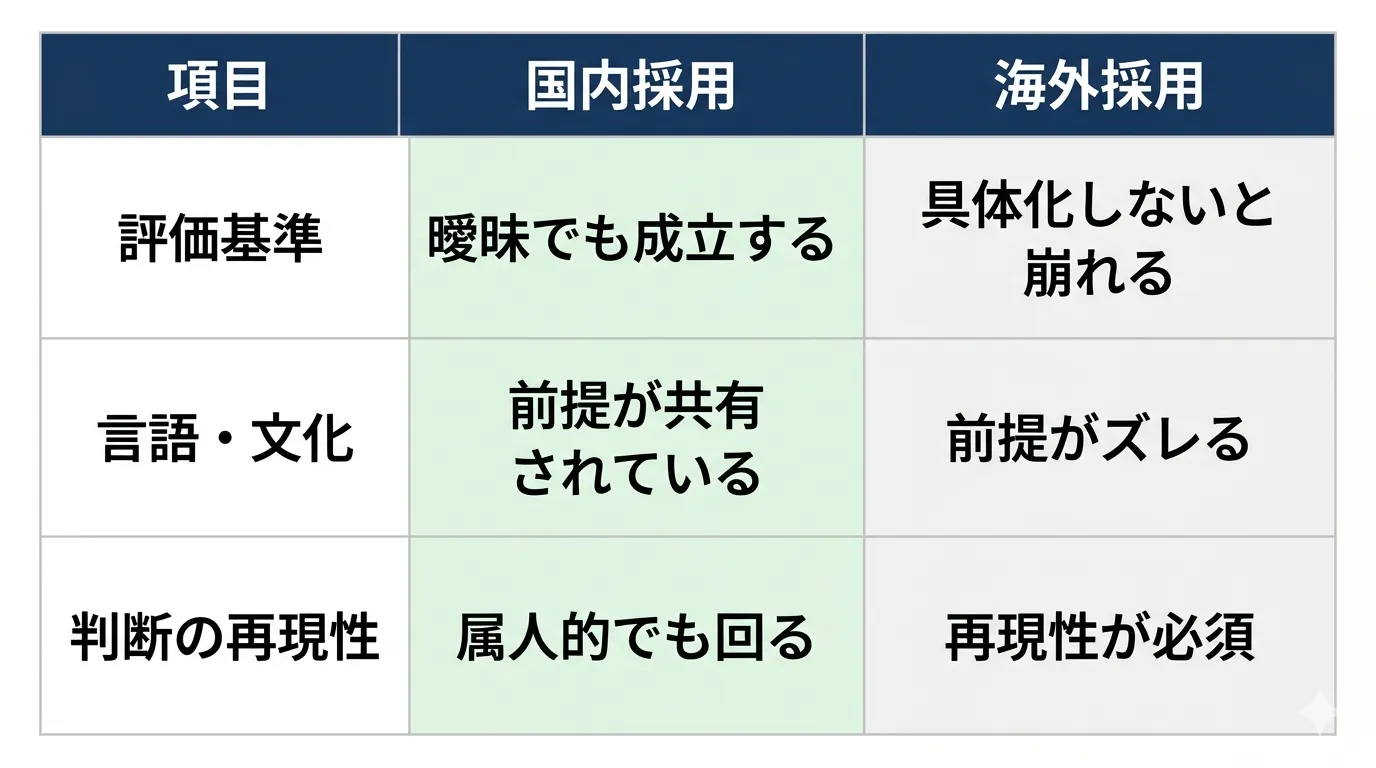
The biggest reason global hiring is hard is that the "assumptions behind the hiring process" differ fundamentally from domestic hiring.
In domestic hiring, culture, language, and expectations are somewhat aligned, so hiring can work even if evaluation criteria are vague, but that assumption breaks down overseas.
For example, even if interviewers judge differently at home, adjustments can be made in the end. But in global hiring, if selection proceeds with unclear evaluation axes, gaps arise in skill recognition and role expectations, and the mismatch becomes obvious.
As a result, after hiring, problems such as "they can't do the work we expected" or "their role is different from what we assumed" occur, driving up retraining costs on site.
Whether you can break down and articulate the criteria at the skill, role, and outcome levels is what determines whether hiring can be repeated reliably.
A Structure That Mistakes the Timing
Another challenge is that "when to start" is not clearly defined.
Many companies consider global hiring when hiring gets harder, but by then it is often already too late.
Because global hiring is not a way to fill shortages; it is a decision to change the hiring structure itself.
You need to redesign everything, including requirements, evaluation criteria, and onboarding, and it is difficult to launch quickly.
As a result, the more rushed the rollout, the more the design falls behind, causing mismatches and early turnover.
If you judge not by when to introduce it, but by whether the design is in place, you can avoid repeating the same mistakes.


Growth stages Japanese companies misunderstand
One reason global hiring decisions go wrong is a mismatch in understanding of the company’s growth stage.
In particular, judging by revenue or company size creates a gap with hiring difficulty.
Revenue growth and hiring difficulty do not move together
Many companies strengthen hiring when revenue or fundraising progresses, and then consider global hiring as an extension of that.
But in practice, revenue scale and hiring difficulty do not always rise in proportion.
For example, if a product gains traction in a certain market and demand for engineers surges, the domestic talent pool for ready-to-work hires can dry up, making hiring impossible even with higher salaries.
On the other hand, even at the same revenue scale, if hiring needs are centered on junior talent, domestic hiring may be enough.
In other words, decisions should not be based on revenue, but on the gap between required talent level and volume, and market supply.
The risk of going overseas before the organization is ready
Another common mistake is moving into overseas hiring before the organization is in place.
Especially in startups and growing companies, there is a tendency to postpone design and implement hiring first because of staffing shortages.
In real operations, people are assigned to projects after hiring without clear roles, and no one knows who makes the decisions.
As a result, candidates feel a gap between the role they expected and the actual work, and many leave within a short time.
It is not unusual to hire a candidate with high expectations after they reach the final interview, only for tasks to be assigned after joining with unclear job definitions, and for them to resign a month later saying, "The role is unclear and there is no room to grow."
If roles, evaluation, and reporting lines are not clearly defined before hiring, trying to fix them through on-site adjustments after hiring will not close the expectation gap, and it will show up as turnover and lower productivity.
Global hiring is not a measure that "solves things by adding people"; it must be understood as a measure that assumes the organization has already been designed properly.
Common Traits of Companies That Fail Prematurely
Global hiring is an effective move, but if introduced at the wrong time, it places a heavy burden on the organization.
The common issue is proceeding without enough design.
Lack of evaluation criteria causes frequent mismatches
The most common failure is moving forward with hiring while evaluation criteria remain vague.
In domestic hiring, interviewers could rely on experience and instinct, but that assumption does not hold in global hiring, making it hard to assess candidates' skills and role fit accurately.
In practice, technical interviews are conducted without unified evaluation points: one interviewer rates a candidate as "strong problem-solving ability," while another judges there is "insufficient hands-on experience," creating split evaluations.
As a result, people are hired based on unclear pass/fail decisions, and skill gaps emerge after joining.
If the evaluation items are not broken down to "what they can do" and "at what level," this mismatch is likely to recur.
Poor onboarding design leads to early turnover
Another typical failure is insufficient post-hire onboarding design.
In global hiring especially, unclear expectation-setting and job definition after joining can quickly lead to resignation.
For example, an engineer is hired, but their specific scope is not decided after joining, so they are repeatedly assigned to support existing members; eventually they conclude they cannot leverage their expertise and leave within weeks.
This situation is caused not by the candidate, but by the hiring side's lack of design.
If role definition, evaluation methods, and the onboarding process are not designed in advance, hiring will not lead to performance, and only re-hiring costs will keep piling up.
If you cannot identify which step is missing design, the same failures may repeat.
Related articles

With shortages of infrastructure engineers and developers, more companies are hiring foreign talent. But in many cases, work does not run smoothly after they join, increasing the burden on the team. A major reason is using hiring simply as a way to fill labor gaps. This article explains the conditions under which foreign hiring works, the common traits of failed companies, and practical criteria for deciding whether to adopt it.
Difference between domestic and global hiring
The success of global hiring depends on how deeply you understand its structural differences from domestic hiring.
It is not just that the target pool is overseas; the assumptions behind sourcing and decision-making change significantly.
Structural Differences in Candidate Sourcing
In domestic hiring, job boards and agencies can secure a certain candidate pool, but in global hiring, the same methods often do not work.
Especially for specialized talent, candidates are often moving through processes with companies in multiple countries at the same time, and Japanese companies are not even on their shortlist.
For that reason, passive recruiting cannot build a pool; proactive outreach is essential.
In addition, the way university rankings and career histories are read differs from Japan. Without understanding categories like Tier 1 and Tier 2, and how project experience is judged, you cannot screen properly.
If you miss this stage, the quality of candidates reaching selection is not assured.
Hiring Speed and Competition
In global hiring, decision speed directly affects competitiveness.
If you run selection with the same process as domestic hiring, candidates are often taken by overseas companies.
In practice, many processes from resume screening to offer can be completed within two weeks, and while Japanese companies go through multiple interviews and internal coordination, candidates accept other offers.
It is not rare to offer a candidate who reached the final interview, only to receive a message three days later saying they will take another company's offer and withdraw.
In this environment, you need a design that balances evaluation accuracy and decision speed.
If you prioritize speed and loosen evaluation, mismatches increase; if you prioritize accuracy and slow down, you lose hiring opportunities. This balance is the hardest part in practice.
Adoption criteria
Whether to start global hiring should be judged not by whether you lack people, but by whether your design is ready.
If you get this wrong, it is not the hiring itself that fails; the organization after hiring will stop functioning.
Specificity of Requirements
The key criterion is how concretely you can define the hiring requirements.
Abstract definitions like “we need engineers” or “we want people who can hit the ground running” make it hard to evaluate overseas talent properly.
In practice, you need to break this down to the technologies used, phase owned, expected outcomes, and evaluation criteria.
For example, “backend engineer” is not enough; selection and evaluation only work when you define a level such as “has Go API development experience and can independently handle load-balancing design.”
If you cannot put requirements into words at this level, hiring will not be repeatable, and you will stay dependent on subjective judgment.
Onboarding Setup and Role Division
Another important criterion is the post-hire onboarding setup.
In global hiring, the goal is not the moment of hiring; you need a design for how the person will get up to speed after joining.
Specifically, it must be clear who gives work instructions, what unit is used to evaluate results, and what is expected during onboarding; otherwise the team will not function.
If you proceed with hiring while these are unclear, the field team will have to make decisions case by case, leading to inconsistent instructions and mismatched evaluations.
If that continues, the person hired cannot show their full performance, and overall productivity drops.
How much you can articulate in the pre-hire design is the dividing line for whether implementation is feasible.
Hiring Strategy Split | Domestic Continuation or Overseas-First?
Given the assumptions so far, global hiring is no longer a question of whether to do it, but of how to design it.
In other words, the choice is whether to extend domestic hiring or switch to a structure built on overseas hiring.
Companies that should continue domestic hiring
Companies that should keep hiring domestically are still in a state where the balance between hiring requirements and market supply has not yet broken down.
Specifically, this applies when junior to mid-level hiring can meet demand, and a sufficient candidate pool can be secured by adjusting hiring speed and compensation range.
Companies whose organizational design is still unsettled, with fluid roles and evaluation criteria, should also avoid moving to overseas hiring at this stage.
If overseas hiring is pursued before the premise is set, post-hire adjustment costs rise, and organizational instability increases as a result.
At this phase, the priority is to first establish hiring processes and evaluation criteria domestically, and ensure repeatability.
Companies that should move to overseas hiring
On the other hand, companies that should move to overseas hiring are those where securing people who meet the requirements in the domestic market has become structurally difficult.
This is especially true for senior engineers and highly specialized roles, where the candidate pool itself is too small and hiring fails even if compensation is raised.
In addition, companies that have already clarified their hiring requirements and evaluation criteria, and know exactly what level of talent they need, are less likely to see their design break down when shifting to overseas hiring.
At this stage, it is more rational to broaden the target market than to continue hiring domestically, and the hiring strategy itself needs to be redesigned.
Especially in highly skilled fields such as engineering, the difficulty of the hiring design changes greatly depending on the country or market targeted, so the decision must include which market to choose.
Practical Hiring for Top Talent | India as an Option
Even if you decide to move into overseas hiring, not every market is suitable for every company; the best option changes with hiring requirements and market structure.
Especially in highly skilled fields, when you cannot build a candidate pool through domestic hiring, you need a design based on a specific overseas market.
Why are Indian candidates targeted?
Phinx supports cross-border hiring of Indian talent, and here we summarize based on our hands-on experience.
Indian talent becomes an option not because it is foreign hiring, but because of the supply structure for advanced IT talent.
In Japan's engineer market, the pool of senior and highly specialized talent is limited, and even higher salaries often do not lead to successful hires.
In India, meanwhile, a large number of science and engineering graduates are produced every year, and Tier 1 and Tier 2 universities in particular provide education on par with global companies.
As a result, it becomes possible to build a candidate pool on the premise that hiring is not possible domestically, but can work with a certain evaluation framework.
In short, Indian talent is not a general-purpose option, but a target to consider only when securing highly skilled talent in the domestic market has become difficult.
Difficulty of hiring design and success conditions
On the other hand, because the pool is large, the precision of the hiring design directly affects results.
In particular, you need evaluation criteria different from domestic hiring, such as how to interpret university rank (Tier 1 to Tier 3), project experience, and coding test design.
For example, even with the same "3 years of practical experience," skill levels vary greatly depending on project difficulty and role, so you cannot judge from a superficial work history alone.
If you proceed with selection while the evaluation design remains vague, skill gaps that were not detected at the hiring stage will surface after joining.
Furthermore, because you need a consistent process that includes VISA/COE acquisition and onboarding after joining, you need a design that covers not only hiring but also acceptance.
Thus, Indian hiring is a market where "precision of evaluation design" is tested in exchange for the advantage of a large candidate pool, and if you proceed without sufficient design, you won't get results.
Conversely, for companies that can consistently design everything from requirements definition and evaluation to onboarding, it becomes a practical option for steadily hiring highly skilled talent unavailable domestically.
Summary
Global hiring is not just a way to secure talent; it is a design task that reshapes the hiring structure itself. If the decision is wrong, it can cause poor fits and early turnover, damaging frontline productivity and organizational stability.
The two prerequisites for success are being able to define hiring requirements in terms of skills, roles, and outcomes, and having evaluation criteria and an onboarding system designed for repeatability. If either is missing when hiring overseas, the same failures will repeat.
On the other hand, if these designs are built in-house, subjectivity in evaluation and limited market understanding can prevent repeatability, leading to unstable hiring quality.
Phinx is led by members with global organization-building experience at Rakuten and Mercari, and provides end-to-end support: sourcing through Tier 1 to Tier 3 university networks, tech-based screening, VISA and COE support, and post-hire onboarding.
If you are struggling to design evaluation criteria or rebuild your hiring process, or are unsure whether your company should move into global hiring, using outside expertise can be a useful way to clarify the decision.
[Sources]
・India Skills Report
https://wheebox.com/india-skills-report/
・Ministry of Economy, Trade and Industry survey on IT talent supply and demand
https://www.meti.go.jp/press/2019/03/20190326005/20190326005.html

Latest Articles

Stay up-to-date
Related articles

Why AI Agent PoCs Fail and Enterprise Design Essentials

Is FDE Viable for Japanese Firms? SES Differences & Setup

India New Graduate Starting Salary and Annual Income 2026 | CTC Structure and Offer Design

Stricter Visa Rules for Dispatched Engineers in Japan (2026)