Why does foreign hiring fail? Post-hire design blind spots explained

Even when foreign hires successfully accept an offer, many leave early or take longer to become productive because onboarding and acceptance planning after joining is insufficient when handed over to the front line. This article explains the structural causes of post-hire problems and common failure patterns, and outlines the specific items and decision criteria that should be redesigned with retention in mind.
Contents
※Please be noted that this blog is translated automatically by AI
Hiring foreign employees breaks down after they join.
Hiring failures for foreign workers often do not show up during screening and only surface later on the job.
Especially when companies think “hired = success,” no post-hire design exists, increasing the burden on the organization.
The workplace can break down even after a successful hire
In many companies, the project is considered complete once the offer is accepted. But in foreign hiring, that is the starting point. If onboarding design is not in place, handoff to the team causes dysfunction.
For example, someone is hired as an engineer, but the team is not prepared to receive them and the work scope is vague, so they are left to OJT. Two weeks later, the person says, “I don’t know what is expected of me,” and performance does not improve; evaluation stays vague and declines.
In cases like this, the cause is not the person but a lack of design. Yet the wrong belief that “foreign workers are not ready to contribute right away” spreads within the organization.
Hiring success and on-site operations should be considered separately, and whether onboarding is complete at the time of hiring is a key criterion.
Limits of hiring-complete thinking
A common mindset in Japanese companies is “hiring equals the goal.” If foreign hiring proceeds on that premise, post-hire design is completely overlooked.
What was absorbed through tacit knowledge and support from existing staff in domestic hiring does not work with foreign hires, so design flaws surface as problems.
In particular, if the detail level of work instructions and evaluation criteria is not made explicit, gaps in expectations directly lead to turnover risk.
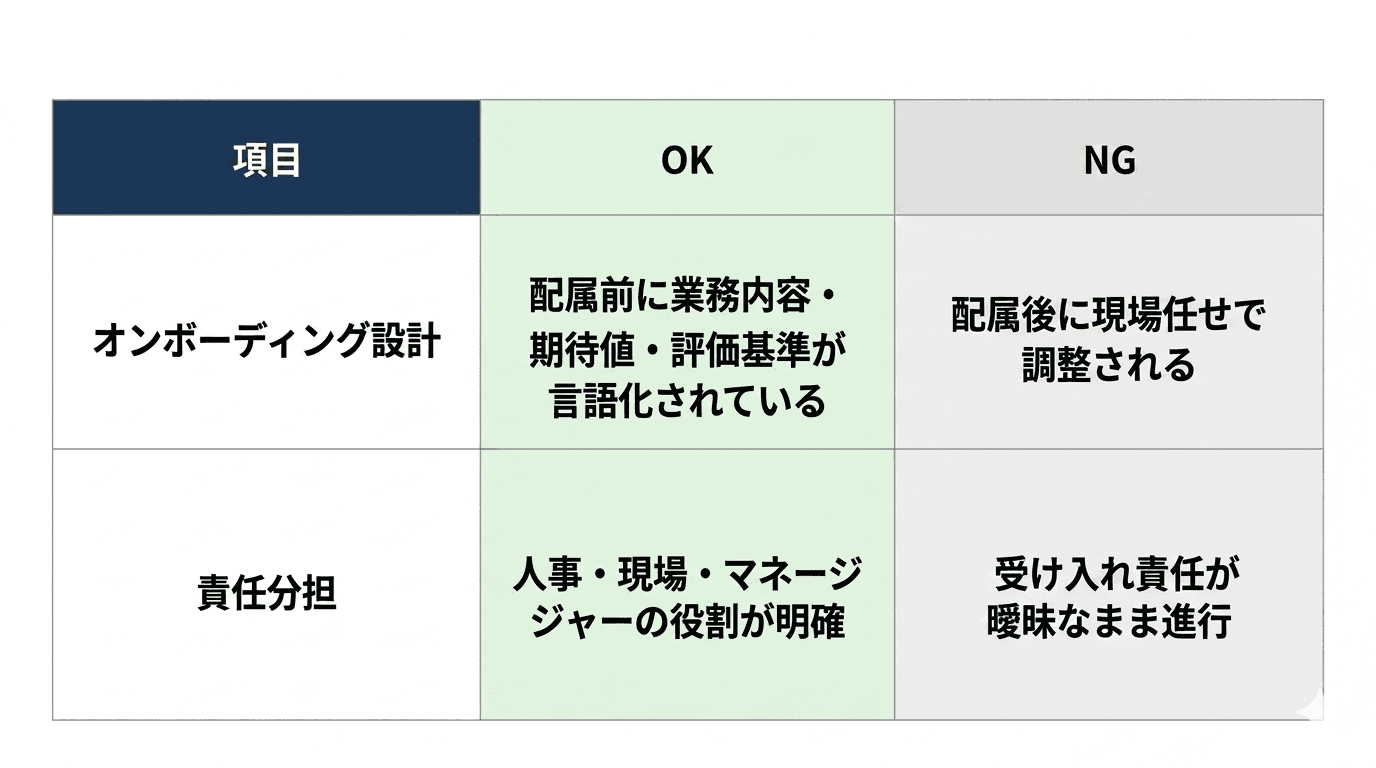
If the design is unclear at this stage, adding more follow-up later will not solve the root cause, and the same failures will repeat.


No acceptance design exists
Many companies that struggle with hiring foreign workers do not have any process for “onboarding design,” and leave post-hire operations to the frontline team.
This structure directly causes onboarding failure and early turnover.
Why onboarding design is often omitted
In Japanese companies, foreign hiring is often treated as an extension of domestic hiring, with the unspoken assumption that people will naturally adapt on the job after joining.
However, in foreign hiring, this assumption does not hold unless language, task understanding, and evaluation criteria are all clearly documented.
For example, if work is assigned while task priorities and completion standards are vague, the person may think they are following instructions, yet be sent back at review with “this is not what we expected.”
Repeated gaps like this leave them unsure of the right answer, which lowers performance.
The practical standard is whether expectations and evaluation criteria are stated in advance.
Specifically, operations are stable when task completion rules, priorities, and review points are all documented; if left to on-site judgment, the same gaps will recur.
Onboarding design is not about the work itself, but about translating expectations and decision standards; without it, consistency cannot be guaranteed.
Responsibilities remain unclear
Another structural issue is the lack of clear responsibility in onboarding.
HR handles hiring, and the frontline team handles operations after joining, but because the handoff is not designed, a situation arises in which effectively no one is accountable.
For example, if a PC or account is not ready on day one and the person spends the first week unable to do much, motivation drops and they may become passive.
This is not a one-off trouble; it comes from not defining who owns each step.
The key criterion is whether there is one responsible person managing the process from pre-joining through initial assignment.
If one person oversees pre-boarding, day-one start-up, and initial task design, problems are less likely; if HR and the frontline are split, gaps will inevitably appear at the handoff.
Also, in early preparation, a key check is whether everything is ready to start work from day one.
If PCs and accounts are prepared later, the chance to begin early is lost and the delay in ramp-up becomes fixed.
If this structure is left untouched, the problem will not be solved by case-by-case fixes, and the same trouble will keep repeating.
Common on-site failures
Failures in hiring foreign workers tend to fall into specific patterns, and many happen early in onboarding.
Mistakes in setup here have long-term effects on later evaluation and retention.
Broken by Poor Initial Placement
The most common early onboarding mistake is assigning work that doesn't match the person's skills.
In particular, with foreign engineers, even when the role and specialty are clear, Japanese companies may assume they can handle a broad range and assign unexpected tasks.
For example, someone hired for backend work is also asked to handle frontend and infrastructure. As a result, they need more time to respond, and others judge them as "low performance."
At this point, evaluation and reality diverge, affecting trust later.
In practice, design around whether the specialty defined at hiring matches the post-assignment scope.
If the area of responsibility, level of involvement, and expected results all align, problems are less likely. But if you operate with vague expectations like "be flexible as needed," a mismatch is almost certain.
Assignment design is not just about skill fit; success depends on defining in advance how much responsibility to give.
Communication Breakdown
Another common pattern is isolation caused by poor communication design.
If foreign employees are left to rely only on Japanese ability or cultural adaptation, their access to information is limited and they fail to understand the work.
In some cases, they barely speak in meetings during the first month, and reviews remain one-way. Then, at the two-month review, they are told they lack initiative; motivation drops and they resign.
The key question is whether it is designed when, what, and how information is shared.
Weekly 1:1s, consistent feedback language during reviews, and clear async communication rules can work. If you leave it to each person's adaptability, information gaps will certainly appear.
Communication is a design issue, not an ability issue. If left alone, isolation and lower evaluations will cascade.
If you cannot identify where the mismatch occurs, break down the process from hiring to placement and clarify the criteria and responsibilities at each step.
Key difference from domestic hiring
Failure in onboarding foreign hires is not just an operational mistake; it stems from designing it without understanding the differences in assumptions from domestic hiring.
If this premise is wrong, problems that cannot be reproduced in the same way will inevitably occur.
Implicit knowledge does not apply
In domestic hiring, how work is done and the rules within the organization are shared as implicit knowledge, and new employees gradually adapt by watching those around them.
However, in foreign hiring, this implicit knowledge is not shared, so the idea of “learn by watching” does not work.
For example, if during a review someone only says, “This is written wrong,” a Japanese employee may infer the intent from past context and team customs, but a foreign employee cannot tell what the evaluation criteria are and ends up receiving the same feedback repeatedly.
The key criterion here is whether work processes and evaluation points are written down.
Specifically, if standards for code reviews, task completion, and priority-setting are clearly documented, operations stay stable; if they rely on implicit knowledge, they are not reproducible.
Operations that depend on implicit knowledge may work domestically, but in foreign hiring they directly lead to dysfunction.
Evaluation criteria must be verbalized
Another critical difference is how evaluation criteria are handled.
In domestic hiring, evaluation may be supplemented by a manager’s subjectivity or team atmosphere, but in foreign hiring, that ambiguity leads directly to distrust.
For example, if someone is told, “I’d like you to be a bit more proactive,” a Japanese employee may infer the expected behavior from context, but a foreign employee won’t know what specific actions will be evaluated, so it won’t lead to improvement.
In practice, the criterion should be whether the evaluation standards are broken down to the behavioral level.
For example, if standards are clear in both quantitative and qualitative terms—such as lead time to task completion, number of review fixes, and communication frequency—it works; if they remain abstract, it does not feel fair or convincing.
Verbalizing evaluation criteria is not just system design; it only works when it is carried through to the level of day-to-day operations.
If you continue running things the same way as domestic hiring without understanding this premise, unclear evaluations will pile up and eventually surface as resignations.
Items to design with adoption in mind
To succeed in hiring foreign talent, design must assume not just hiring, but retention and making them productive.
If this view is missing, more hires will not build up in the organization.
Role Definition and Expectation Design
First, clarify roles and expectations.
Many companies prepare job descriptions, but because actual duties and expected outcomes are not made concrete, a mismatch occurs after joining.
For example, if you hire someone as a backend engineer but the actual work includes a lot of operations and other areas, a gap forms with their expertise, leading to lower performance.
In practice, design should be based on whether these three points match: "scope of responsibility", "range of involvement", and "definition of outcomes".
Specifically, if you articulate which functions they handle, how far they take part in decisions, and what state counts as success, mismatches are less likely.
Conversely, if you run things with vague expectations like "respond flexibly depending on the situation," a mismatch will definitely occur.
Role definition should be treated not as a hiring requirement, but as the core of onboarding design.
Breakdown Design for Onboarding
Next, it is important to break down and design the onboarding process.
Many companies rely on vague operations like "they'll get used to it through OJT," but this does not ensure repeatability.
For example, if you do not define what should be achieved in the first week, first month, and third month after joining, evaluation of ramp-up becomes vague and proper feedback cannot be given.
In practice, it is important to break down and design the three points of "goals by period", "tasks to perform", and "evaluation method".
For example, define it step by step: in the first week, understand the environment and complete simple tasks; after one month, perform tasks independently; after three months, establish responsibility for feature-level work.
By structuring onboarding this way, you can visualize progress during ramp-up and identify which step has problems when issues arise.
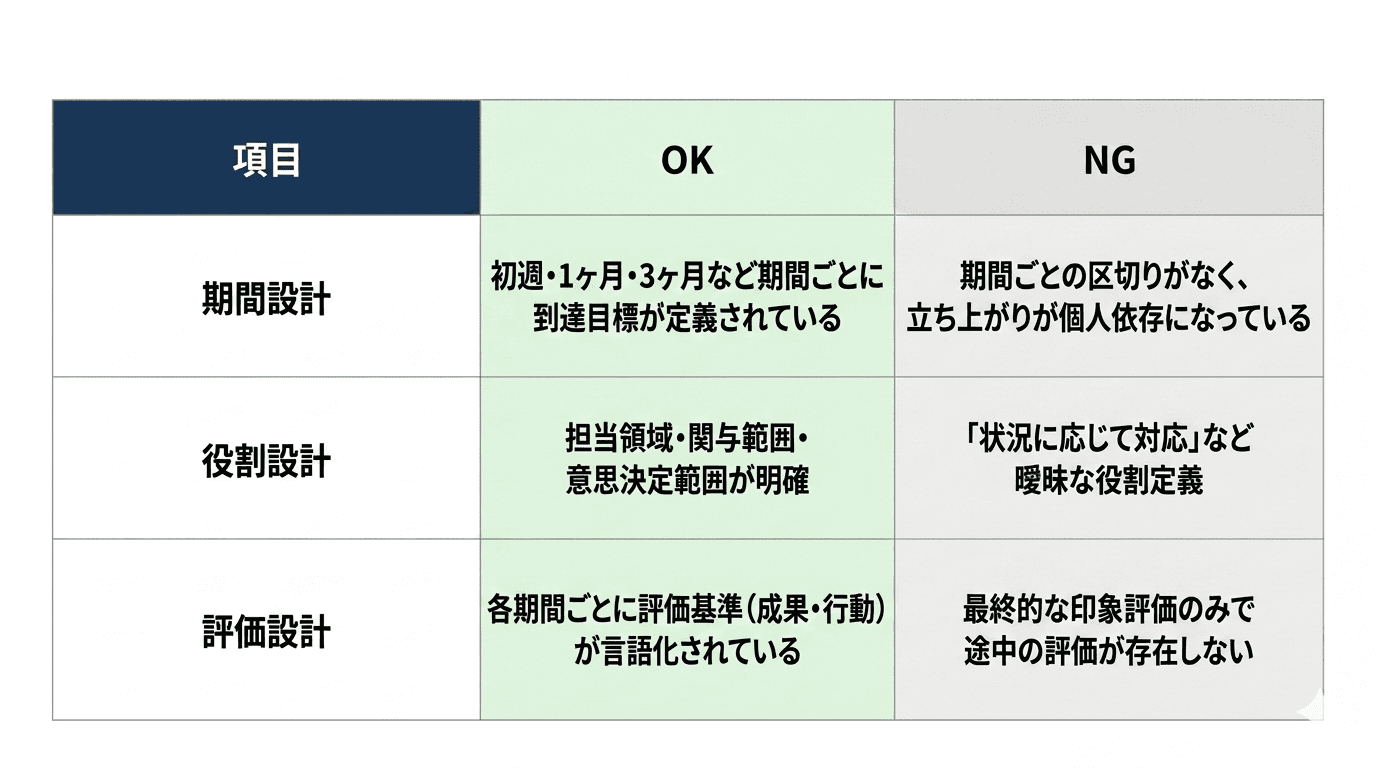
Foreign Hiring Design Branch
From the above, foreign hiring is not a matter of hiring methods, but one where success depends on differences in design assumptions.
In other words, unless you clarify which assumptions you use to hire, the same mistakes will repeat.
Limits of Extending Domestic Hiring
Many companies introduce foreign hiring as an extension of existing domestic hiring, but this assumption has structural limits.
In domestic hiring, operations worked through tacit knowledge and support from current members, but these do not function in foreign hiring, so design gaps surface as problems.
For example, even if evaluation criteria were vague, domestic hiring could still work as people were "somehow" evaluated. But in foreign hiring, that ambiguity creates distrust and leads to early turnover.
The practical test is whether your current hiring, evaluation, and onboarding design is clearly written out.
If not, adding foreign hiring will not improve success; it will amplify problems.
When proceeding as an extension of domestic hiring, the bottleneck is how much of the existing design can be put into words.
Redesign with Overseas Hiring in Mind
On the other hand, if you redesign the entire hiring process with overseas hiring in mind, the odds of success change significantly.
Here, hiring, onboarding, and evaluation must be treated as one consistent design.
For example, clearly define roles and expectations at the hiring stage, connect them to onboarding design, and then use them as evaluation criteria to structurally prevent mismatches after joining.
The key test is whether hiring requirements, onboarding, and evaluation are designed consistently.
If they are split apart, misalignment will inevitably occur somewhere; if they are integrated, repeatability is secured.
Foreign hiring should be seen not as simply expanding the candidate pool, but as a chance to rethink the hiring design itself.
Especially for advanced talent such as engineers, design difficulty changes greatly depending on the countries and markets you target, so you must decide which market to choose.
Related articles

In hiring Indian engineers, it is risky to judge university tiers only by academic scores. This article uses local data to explain Tier 1 (led by IIT), the talent-rich reality of Tiers 2/3, and which talent segments Japanese companies should target and how they view careers.
Why design becomes more difficult with Indian talent
Phinx supports cross-border hiring of Indian talent. Based on practical know-how, this section summarizes the key points.
In foreign hiring, especially for advanced IT talent such as engineers, the required level of hiring design precision differs greatly by market.
Expectation gaps in advanced IT hiring
India has a large supply of advanced IT talent and is a market where many professionals have clearly defined specialties and job scopes.
As a result, if Japanese companies move forward with vague role definitions or expectations, gaps in understanding often surface after hiring.
For example, if someone was hired for backend development but the role also included infrastructure or operations work, they may see it as “work different from the contract,” which lowers engagement.
If this continues, people may leave not because of poor performance, but because of a role mismatch.
The practical standard is whether the role and expectations are defined by job.
Specifically, if the scope of responsibility, deliverables, and level of involvement match, problems are unlikely. But if the job is run with vague expectations like “be flexible,” a mismatch is almost certain.
The more senior the talent, the less tolerance there is for this kind of gap; poor design directly leads to turnover risk.
The link between hiring competition and retention design
Another important factor is competition in hiring.
The Indian engineering market is highly competitive with global companies, and top talent often compares multiple offers before deciding.
As a result, expectations for the post-hire environment and growth opportunities are also high, and if onboarding or evaluation systems are weak, people are more likely to move to another company quickly.
For example, if they do not receive enough feedback after joining and continue to feel no growth, they may start job hunting within three months and eventually leave.
The standard here is whether post-hire growth opportunities and evaluation are built into the design.
Specifically, retention improves when regular feedback, career paths, and technical growth opportunities are clearly provided. If these are vague, it becomes hard to stay competitive and keep being chosen.
Hiring Indian talent is not just difficult; it is a market where “post-hire design precision” directly affects retention, so it must be understood as an area where weak design is not tolerated.
Summary
The failure of hiring foreign talent is a structural issue caused not by recruitment methods or candidate quality, but by a lack of post-hire design.
In particular, if onboarding and evaluation are left vague, it affects overall productivity through slower ramp-up, heavier team workload, and early turnover.
The conditions for success are clear. The key is whether these are designed consistently: "articulation of roles and expectations," "breaking down the onboarding process," and "clarifying evaluation standards at the operational level."
If these are disconnected, gaps will occur somewhere, and non-repeatable hiring will continue.
If you build these systems in-house, operations tend to depend on individuals at each site, making it hard to ensure the accuracy of evaluation standards and acceptance processes.
Especially in foreign hiring, differences in culture, language, and evaluation perspectives overlap, making the design structurally more difficult.
Phinx is made up of members with experience in engineer hiring and organizational building at global companies such as Rakuten and Mercari, and its strengths are a university network from Tier 1 to Tier 3, including IIT, and screening based on technical understanding.
It supports the entire process from hiring requirement design and selection flow to VISA/COE handling and onboarding design after joining, making cross-border hiring visible.
If you are hiring with vague criteria or have not yet translated it into onboarding design, you need to review it from the design stage.
If you have such issues, please consult Phinx.
[Sources]
・India Skills Report
https://wheebox.com/india-skills-report/
・JETRO survey on the use of foreign talent
https://www.jetro.go.jp/
・METI survey on IT talent supply and demand
https://www.meti.go.jp/

Latest Articles

Stay up-to-date
Related articles

Why AI Agent PoCs Fail and Enterprise Design Essentials

Is FDE Viable for Japanese Firms? SES Differences & Setup

India New Graduate Starting Salary and Annual Income 2026 | CTC Structure and Offer Design

Stricter Visa Rules for Dispatched Engineers in Japan (2026)