What Is Engineer Recruitment Candidate Pool Building? Causes of Few Applicants and How to Improve

Hiring engineers, including talent from India, can be an effective move. But when you cannot build a strong candidate pool, offer standards may be lowered, leading to cases where new hires fail code reviews after joining. In this article, we sort out the structural reasons candidates do not gather and explain, from a practical perspective, how to set a candidate-pool strategy and redesign it, including overseas hiring.
Contents
※Please be noted that this blog is translated automatically by AI
The real reason the audience isn't gathering
There are often claims in engineering hiring that "there are no people," but in reality, talent does exist in the market.
The problem is that the candidate pool we can reach is extremely skewed.
Channel dependence narrows the pool
Many companies hire through scout platforms and agencies, but this creates repeated outreach to the same candidates.
That is because these channels mainly reach the "active" group—people already considering a move—and barely reach the passive group.
As a result, selection advances without the pool widening, and improvements in document pass rates and offer acceptance rates stall.
In the engineering market especially, top talent is less likely to appear on the job market, so channel dependence directly raises hiring difficulty.
Misreading the job market structure
Many Japanese companies design hiring on the assumption that if they post a job, applicants will come, but that premise is already out of step with today's engineering market.
In reality, strong engineers often receive offers from multiple companies at once, and only a limited number actively apply on their own.
Moreover, decisions are driven not only by salary and technical environment but also by factors like growth opportunities and market value, so simple condition offers do not build a candidate pool.
If hiring continues without understanding this structure, companies will keep mistaking "no applicants" for "no people."
Related articles

In hiring Indian talent, document screening pass rates are often high, yet many hires fail post-joining reviews and increase team workload. The root cause is a mismatch between CV reading and evaluation criteria. This article explains India-specific resume conventions and structural gaps in screening, then presents practical decision criteria and improvement design.


Limits of Scout Agent Dependence
Many companies that struggle to build a talent pool try to fix it by strengthening scouting and agencies, but this approach has structural limits.
That is because the channels themselves are not suited to expanding the pool.
A structure that only reaches passive candidates
Scouting and agencies may look proactive, but in practice they rely on a "registered candidate database," so they can only reach people already considering a job change.
In other words, even if a company increases the number of scouts, the pool’s "quality and breadth" hardly changes.
In particular, Tier 1 talent often does not enter the job market at all, or receives direct offers from overseas companies, and tends not to respond to Japanese-company scouting.
As a result, response rates keep falling, and only the workload increases.
Why referrals do not increase
Hiring through agencies also has a limit on candidate supply.
Because agencies introduce the same candidates to multiple companies, they are not structured to send candidates steadily to only your company.
Furthermore, when a company’s requirements are vague, agencies prioritize "easy-to-pass candidates" as a safe option, which leads to a mismatch in skills and fit.
In this state, both the volume and quality of the pool are not secured, leading to lower selection pass rates and more declines.
In any case, unless you design not just more channels but "which segment to reach, and by what method," the same problems will repeat.
On-site hiring failures
Poor population design affects not only hiring numbers, but also post-hire performance and frontline workload.
Especially when hiring with a narrow candidate pool, decision criteria become skewed and decision quality drops.
Compromising on offers lowers quality
When few candidates pass document screening and interviews, teams fall into, “We have to hire even at this level.”
For example, after two months of recruiting, if only one candidate reaches the final interview, an offer may be made despite concerns about skills, leading to a hire.
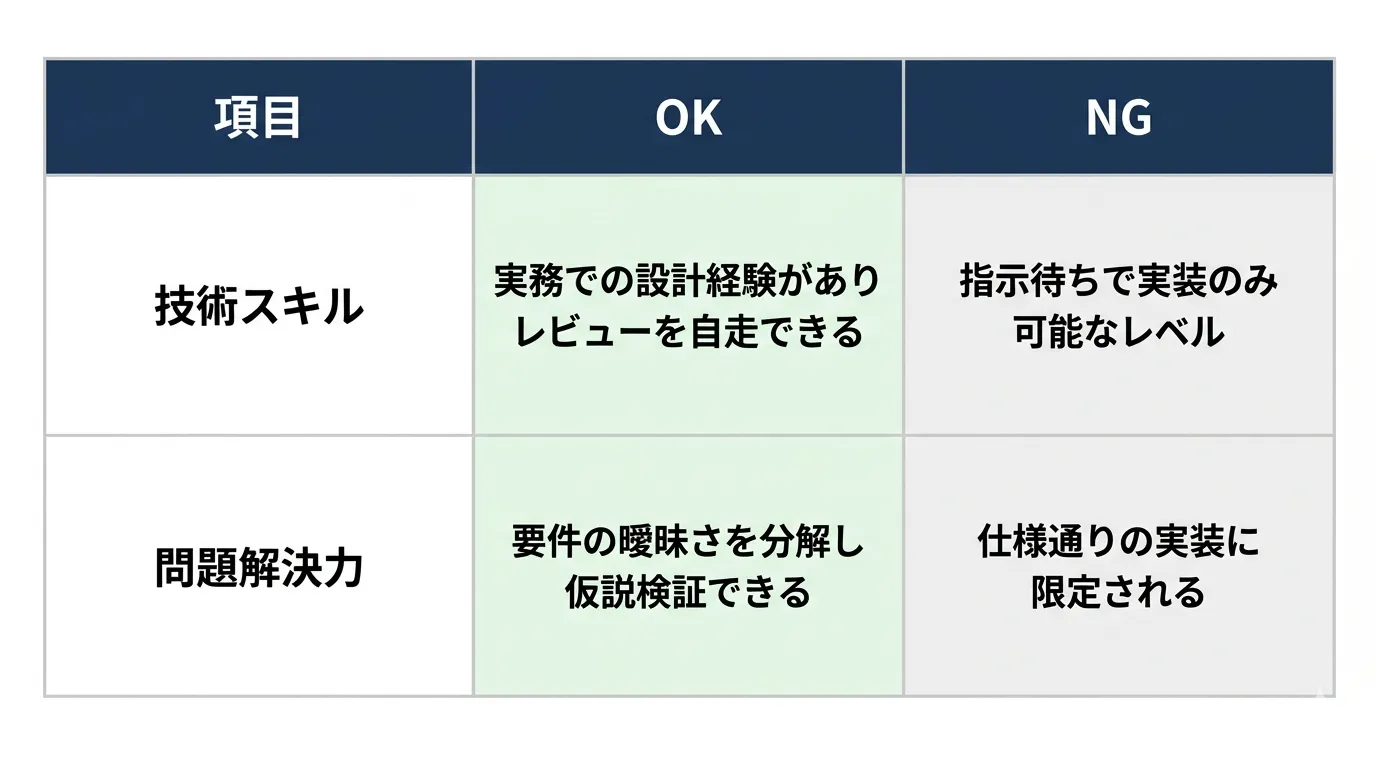
After joining, weak understanding of basic design may show up in code reviews, and fixing it takes the team lead’s time, delaying the whole project.
In this way, a shortage of candidates leads to compromises in hiring, and the impact builds as long-term burden on the team.
How mismatches cascade
Another issue is that mismatches do not end as one-offs.
If hiring standards stay unclear, each interviewer starts judging “what level passes,” and evaluation consistency breaks down.
As a result, candidates who should fail pass through, while suitable talent is overlooked.
Then gaps against expectations surface after hiring, causing early turnover or role readjustment within the team, forcing a redesign of the hiring process itself.
If it is unclear which step failed to identify the issue, you need to break down the entire hiring process and review it.
Criteria for Population Design
The challenge of building a candidate pool is not about “increasing numbers,” but about designing which segment to approach and by what method.
Therefore, it is essential to clearly define the mix of hiring targets and channels.
Segmenting Targets with Tier Design
First, the engineering market differs greatly in hiring difficulty and strategy by tier.
Tier 1 is a highly competitive group of immediate contributors, and because it competes with foreign firms and startups, clear advantages in salary and technical environment are required.
Tier 2, on the other hand, has wide skill variation. If screened properly, you can secure promising talent, but vague evaluation standards lead to missed judgments.
In other words, unless you define the pass line for each tier, expanding the pool will not improve hiring accuracy.
Criteria for Using Channels
Next, the key is how to assign roles to each channel.
For example, scouting is effective for reaching active candidates, but it has limits when it comes to expanding the pool.
Referrals and overseas hiring, however, work as ways to reach passive candidates, broadening both the quality and the range of the pool.
Therefore, you need to design the approach by combining “which tier to target” and “which channel to use.”
Without this design, you cannot properly evaluate results by channel, and inefficient hiring will continue.
Domestic hiring vs. overseas hiring
The difficulty of building a candidate pool changes greatly depending on whether you limit it to the domestic market.
Especially in engineering hiring, structural constraints in the Japanese market set the upper limit of the pool.
Limits of the Japanese Market
In Japan, the number of engineers is limited, and many top candidates are already locked in with high compensation.
As a result, multiple companies competing for the same candidates has become normal, and the candidate pool is effectively a tug-of-war.
In addition, because salary ranges have certain ceilings, companies often lose on conditions when competing with overseas firms.
As a result, even if you try to expand the pool using only the domestic market, there is a clear limit to the number of candidates you can reach.
How Overseas Hiring Changes the Pool Structure
Looking overseas changes the premise of the candidate pool dramatically.
For example, in India, large numbers of engineers enter the market every year, and companies can access a wide range of talent from Tier 1 to Tier 3.
Especially in Tier 1 and Tier 2, many candidates are open to overseas opportunities, and some will consider Japanese companies if growth opportunities and the technical environment are attractive.
Also, salary levels differ from Japan, so with the right design, competitive offers are possible.
In other words, a pool that was a "fight over" in domestic hiring becomes something you can "create anew" overseas, so the hiring strategy itself needs to be redesigned.
How to redesign the population
To improve the candidate pool, rather than simply increasing channels, you need to break down the entire hiring process and structurally identify where the pool is getting stuck.
Then, it is important to redesign it with both domestic and overseas options in mind.
Deconstructing and Rebuilding Channels
The first step is to break down your current hiring channels and visualize which audience each one reaches.
For example, clearly organize their roles, such as scouts reaching active candidates, agencies reaching candidates strongly motivated to change jobs, and referrals reaching people with values close to your company.
Without designing new channels for the missing segments, the imbalance in the candidate pool will not be solved.
Especially important is creating touchpoints with passive candidates and overseas talent; unless this is designed, the pool will not expand.
The Option of Hiring in India
Among overseas hiring options, India is a highly effective choice for building a candidate pool.
The reason is not only the large supply of engineers, but also the fact that clear tier-based segmentation is possible, making it easy to turn into a hiring plan.
For example, it is realistic to design Tier 1 as immediate contributors for projects, and Tier 2 as potential hires for development and training.
Also, because many candidates are highly interested in working abroad, even Japanese companies can be competitive with the right conditions.
In this way, redesigning the candidate pool to include overseas talent, not just domestic candidates, greatly changes both hiring options and the likelihood of success.
Related articles

As Japanese firms speed up DX, using India’s advanced IT talent is now essential. Yet many companies mischoose between direct hiring, EOR, and offshore development, leading to higher costs and IP leakage. This article explains the best entry model for your company, based on India’s labor practices and legal regulations.
Summary
Building a candidate pool for engineering hiring is not just a matter of attracting applicants; it is a core hiring-design issue.
If you proceed with hiring when the pool is too small, offer standards tend to drop and mismatches occur, directly leading to lower team productivity and greater organizational burden.
To succeed, first define hiring targets by tier and clearly articulate evaluation criteria such as technical skills and problem-solving ability.
Then, instead of relying only on existing channels like scouts and agencies, design how to reach each segment and control both the quality and breadth of the candidate pool.
However, if this is done only in-house, criteria can become person-dependent and channel selection can go wrong, making it difficult to build a repeatable hiring process.
In particular, rebuilding the pool for overseas hiring requires expertise in multiple areas, including understanding local markets, screening accuracy, and visa support.
Phinx is led by members with hiring and development experience in global organizations such as Rakuten and Mercari. Using networks from Tier 1 to Tier 3 universities in India, we provide end-to-end support from technically grounded screening to visa and COE handling, and onboarding.
We do more than introduce talent; we help rebuild the candidate-pool design itself.
If you are facing issues such as an inability to build a candidate pool, unclear evaluation criteria, or concerns about designing overseas hiring, it is important to review the entire hiring process from the ground up.
If you face such challenges, please contact Phinx.
[Source]
India Skills Report
https://www.indiaskillsreport.com/

Latest Articles

Stay up-to-date
Related articles

Why AI Agent PoCs Fail and Enterprise Design Essentials

Is FDE Viable for Japanese Firms? SES Differences & Setup

India New Graduate Starting Salary and Annual Income 2026 | CTC Structure and Offer Design

Stricter Visa Rules for Dispatched Engineers in Japan (2026)