Will AI Replace Offshore Dev? Lost vs. Value-Added Phases

Rising local costs and AI coding agents are rendering the idea of cheap offshore teams obsolete. This article explores AI's impact on offshore development and outlines a new division of labor between Japanese PMs and AI-native overseas teams.
Contents
※Please be noted that this blog is translated automatically by AI
Summary
AI won't replace offshore development, but will lower the value of bulk coding based on specs.
Value shifts to requirement breakdown, AI prompting, reviews, testing, knowledge-base ops, and business understanding.
Offshore selection will focus on AI-native capability, Japanese proficiency, and local project experience over low rates.
The practical division of labor: Japan manages issues/quality, while offshore handles AI-driven coding, validation, and improvement.
Phinx leverages AI with Japanese-fluent engineers in Vietnam and India to strengthen PM and Techlead roles.
Before contracting, it is essential to define AI rules, review standards, access controls, and deliverables.


Offshore vs AI-driven Development
Offshore development means outsourcing system development to overseas teams.
AI-driven development integrates AI coding agents and generative AI tools to assist in coding, design, testing, and review alongside human judgment.
The question is relocation, not replacement
"Is offshore obsolete with AI?" is too simplistic.
We must divide tasks into AI strengths, human decisions, and offshore team advantages.
While GitHub Copilot significantly cuts development time for specific tasks, McKinsey notes limited benefits for complex tasks or junior developers.
AI does not speed up all development steps equally.
It accelerates routine coding but leaves business requirements, system integration, security, and quality control to humans.
Success in AI-era offshore development depends on who manages these remaining tasks.
Why unit price differences matter less now
Traditional offshore development was mainly seen as a way to secure cheap labor.
However, as AI coding agents reduce development volume, cost differences in simple coding no longer justify offshoring.
By 2026, discussion in Japan has shifted from price comparison to team design.
Offshore value is no longer about team size, but building strong development processes with AI.
With shared specifications, acceptance criteria, and knowledge bases, overseas teams become partners that extend development capacity, not just subcontractors.
AI-replaceable tasks
AI easily replaces task-heavy steps rather than judgment.
This doesn't mean replacing humans entirely.
Instead, AI drafts the initial work for humans to review and finalize.
Standard Coding & Drafts
AI excels at CRUD screens, API templates, minor edits, test cases, and document drafts.
GitHub Copilot and AI coding agents quickly generate drafts using repository context.
This reduces the value of traditional offshore setups that rely heavily on junior developers.
However, AI drafts may not meet business needs.
A working screen or passing test does not mean it fits actual operations.
Clients using AI must prioritize review and acceptance design over coding speed.
Research & Migration
AI simplifies code explanation, library migration, test planning, and config conversion.
For example, using AI to pre-read and plan old framework upgrades is faster than manual analysis.
Still, migration requires separate quality control.
Blindly adopting AI plans can overlook licensing, performance, security, and monitoring.
When outsourcing, specify targets, downtime limits, validation methods, and rollback plans.
Valuable processes in the AI era
As AI speeds up implementation, the key value shifts to deciding "what to build" and "how to validate."
With less coding time, bottlenecks move to requirements, reviews, testing, and decisions.
Skipping these steps leads to more rework when using AI and offshore teams.
Deconstruction and Acceptance Criteria
Neither AI nor offshore teams can interpret vague requirements within your business context.
Instead of "Improve customer management screen," specify fields, update rights, speed, logs, and completion criteria.
This breakdown helps AI execute tasks and offshore teams verify deliverables.
Acceptance criteria must be set before starting, not after development.
Define who judges compliance and how before outsourcing.
In the AI era, documenting test cases, review points, and authority matters more than raw specifications.
Review and Quality Assurance
The Stack Overflow Developer Survey 2025 shows AI tools boost productivity, though AI agents are not yet mainstream.
This indicates that while AI benefits are expanding, organizational adoption is still maturing.
The more AI is used, the more reviewers and QA systems limit overall development capacity.
Reviews must check business logic, permissions, security, and operations, not just code correctness.
When offshore teams use AI, how they filter output matters more than prompt engineering.
QA is not the final test phase, but rather a process to define review standards during requirements definition.
New Japan-overseas role sharing
In AI-era offshore dev, standard task division—Japan managing and offshore executing—is not enough.
Japan must handle business and decisions, while offshore drives AI-based implementation and improvement autonomously.
The table below shows the key roles to define before ordering.
Phase | Lead | Key Decision |
|---|---|---|
Issues | Japan | Define business impact and priority |
Reqs | Japan + Offshore Lead | Break down for AI-ready tasks |
Drafting | Offshore + AI | Align with rules and tests |
Review | Japan + Offshore Lead | Check business, tech, and quality |
Ops/Imprv | Joint | Share knowledge for next project |
This division does not make things easier for the Japanese side.
In fact, Japan retains heavy roles: sorting issues, deciding, and designing acceptance criteria.
Yet, with this setup, the offshore team can use AI to boost coding and speed up verification.
Role of Japanese Language Skills
Even with better AI translation, Japanese language skills remain vital.
This is because project communications include business terms, internal context, and nuances.
Having an offshore lead who understands Japanese business culture, approvals, and quality standards reduces delay.
The goal is not for all offshore members to speak high-level Japanese.
It is about having key leads who convert Japanese context into clear tasks, specs, and tests for AI and devs.
Securing this role determines if the team performs on par with local developers.
Related articles

Offshore outsourcing to India has shifted from simple cost cutting to securing advanced talent in AI and data science. Yet projects still stall due to spec misalignment and cultural expectation gaps. This article explains practical instruction methods to understand Indian engineers and maximize success.
Phinx strengthens PM and Techlead layers
AI has closed the document-level comprehension gap between local and overseas teams.
With AI, non-native speakers can easily read and summarize specs, minutes, tickets, and design notes at a high level.
Consequently, the evaluation of offshore engineers shifts from "can they read Japanese?" to "can they run Japanese projects and handle requirements and planning?"
Japanese Proficiency Combined with AI
Phinx provides experienced engineers, mainly from Vietnam and India, who are already fluent in Japanese.
When they use AI, they do not just translate; they organize meeting notes, spec changes, inquiries, and reviews into actionable tasks for the dev team.
This allows PMs to offload tasks like validation, task breakdown, and progress management to offshore PMs and Tech Leads.
Specifically during planning, AI aids document comprehension while experienced engineers evaluate business impact and technical priorities.
This combination keeps costs low while strengthening the PM and Tech Lead layers.
As a result, clients get a setup where offshore leads support planning and design, rather than local PMs being overwhelmed by translation and validation.
Comparison with traditional offshore/domestic development
Phinx Global Delivery is neither a typical offshore setup chasing lower rates nor a purely local team.
The real difference is who understands requirements, plans, and guides technical decisions.
Compare setups as follows:
Model | Strengths | Weaknesses |
|---|---|---|
Typical Offshore | Easy to scale developers | Requirements and quality depend on onshore |
Purely Onshore | Shared business context | High cost of PMs and Tech Leads |
Phinx Global Delivery | Strong PM layer via AI & Japanese-fluent talent | Requires initial role design |
Phinx's strength is not just "cheap offshore labor."
By combining Japanese fluency, Japan project experience, and AI-native workflows, our offshore leads handle requirements, planning, and system design.
For firms struggling to secure PMs and Tech Leads onshore, this delivers execution certainty.
AI-native offshore evaluation criteria
When choosing an offshore vendor in the AI era, unit price and headcount are not enough.
What matters is not just using AI, but where it is used, how it is controlled, and how knowledge is stored.
Check these points before ordering.
Assess Operational Design, Not Just Tools
Simply saying "We use Claude Code or GitHub Copilot" is not enough.
You must check repo access, data privacy, AI code review steps, testing, and change logs.
If AI use is left to individuals, quality will vary and project context will be lost during handovers.
An AI-native setup manages specs, design decisions, reviews, testing, and custom rules in a knowledge base.
Sharing this between AI and humans for reuse is what sets them apart from legacy offshore vendors.
Pre-ordering Checklist
Use this checklist for vendor selection and to identify gaps in your own preparation.
If you cannot answer these, refine your design before involving AI and offshore teams.
Check Item | Details | Risk if Lacking |
|---|---|---|
AI Scope | Allowed/prohibited steps | Data leaks, inconsistent quality |
Acceptance | Criteria and approvers | Rework, unclear responsibility |
Japanese Ability | Lead member's meeting support | Long delays in confirmation |
Knowledge Base | Storing specs and decisions | Silos, repeat mistakes |
Review Setup | Business vs tech reviews | Unusable deliverables |
These items are not solely the vendor's responsibility.
They help separate what the client must provide from the vendor's capabilities.
Acceptance criteria and review structures, in particular, must be defined by the client.
Related articles
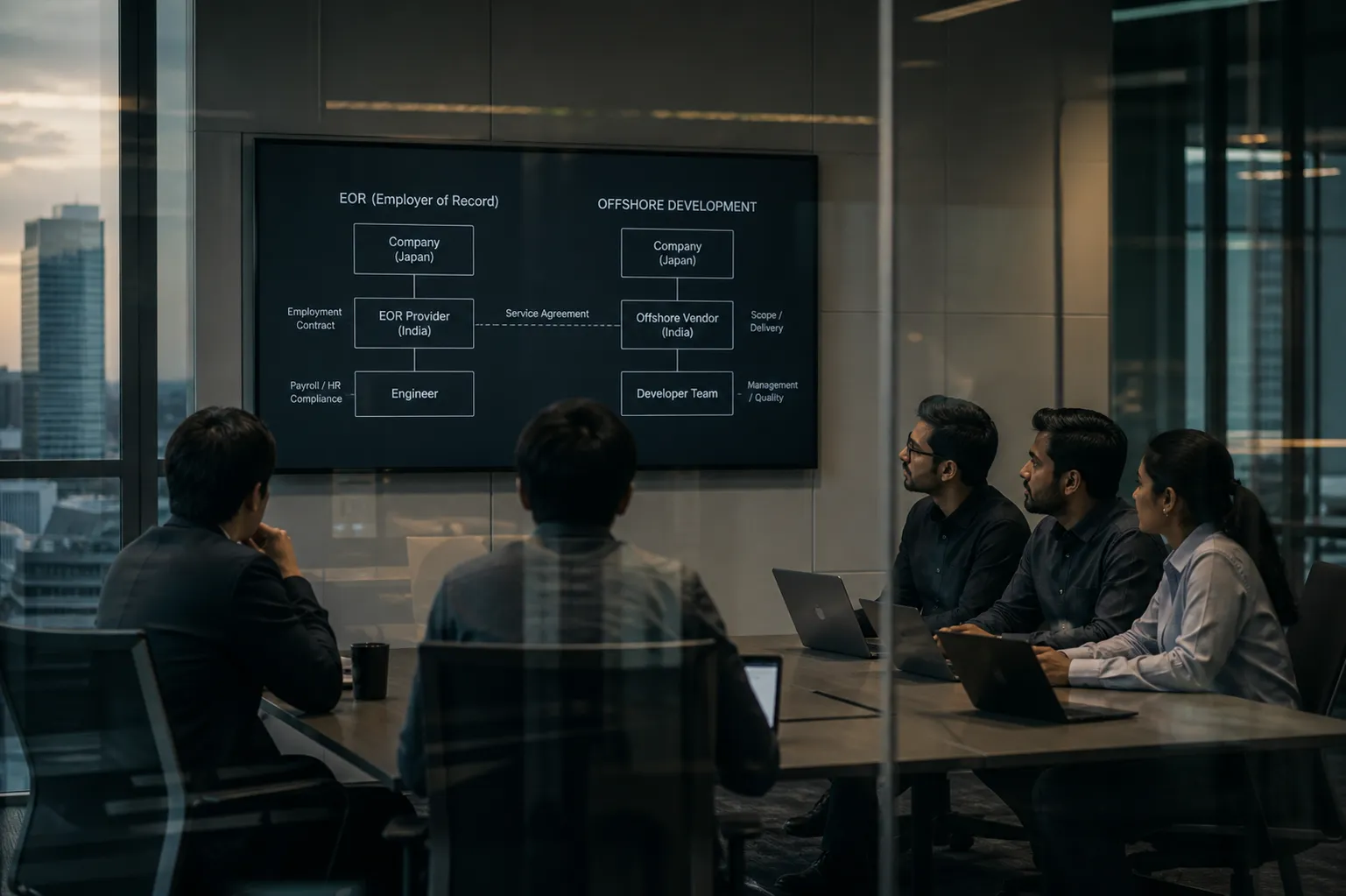
More companies are combining EOR and offshore, but if roles and responsibilities are not clearly defined, it often leads to lower quality and a heavier management burden. This article explains the structural differences between EOR and offshore, plus common pitfalls and practical design methods when using both.
Common buying mistakes
Failure in AI-era offshore development often stems from passing the same ambiguity to both AI and offshore teams.
Sending instructions with multiple interpretations to AI only multiplies plausible-looking drafts.
If offshore teams implement them and the Japan team later rejects them, speed becomes a liability.
Leaving Everything to AI and Offshore Teams
Leaving everything to AI comes from the expectation that natural language prompts yield a finished product.
However, AI cannot automatically grasp past agreements, internal politics, compliance, or legacy exceptions.
For high-impact features, humans must define the prerequisites before using AI.
Leaving everything to offshore teams shares this flaw.
Sending vague requirements and expecting a "good-enough" result only increases queries.
AI speeds up implementation, but without clear premises, it only speeds up rework.
Lack of Reviewers on the Japan Side
Another failure is outsourcing without a capable reviewer on the Japan side.
Even if the offshore team refines and tests AI-generated code, the client must judge if it fits business requirements.
Delegating this entirely means losing both technical judgment and business knowledge internally.
Reviewers do not need to read every line of code.
However, someone must verify goals, data handling, exceptions, workflows, and acceptance criteria.
In the AI era, you must first decide whether to build this review capability in-house or partner with a reliable local PM/FDE.
Summary
AI won't kill offshore development; it shifts where value is created.
While AI handles bulk coding based on specs, tasks like defining requirements, review, and knowledge management become more crucial.
Success depends on deciding which tasks go to AI, which stay with the Japanese side, and which the offshore team runs autonomously.
Building this setup internally requires managing AI tools, dev processes, review standards, and offshore communication simultaneously.
Relying on individual skills causes quality to drop when staff change, losing project learning.
Thus, a system to store specs, reviews, and test cases as knowledge for future reuse is essential.
Phinx excels at designing Global Delivery by combining Japanese customer understanding/PM with an offshore network, mainly in India, and AI-native dev processes.
By pairing engineers fluent in Japanese with AI, we strengthen the PM and Techlead layers, securing projects from the planning stage.
The more you use AI and offshore resources, the more roles based on Japanese communication and technical skills determine success.
Rethinking setup to scale dev capability, not just cut costs, is the starting point in the AI era.
Sources
GitHub Blog "Research: quantifying GitHub Copilot's impact on developer productivity and happiness" https://github.blog/news-insights/research/research-quantifying-github-copilots-impact-on-developer-productivity-and-happiness/
McKinsey "Unleashing developer productivity with generative AI" https://www.mckinsey.com/capabilities/tech-and-ai/our-insights/unleashing-developer-productivity-with-generative-ai
McKinsey "Unlocking the value of AI in software development" https://www.mckinsey.com/industries/technology-media-and-telecommunications/our-insights/unlocking-the-value-of-ai-in-software-development
Stack Overflow Developer Survey 2025 "AI" https://survey.stackoverflow.co/2025/ai
Qiita "Will AI kill offshore development? Redefining its value in 2026" https://qiita.com/okikusan-public/items/c2347fb113a0590d2fb0
Zenn "Offshore vs AI-driven development: Complete 6-pattern comparison for 2026" https://zenn.dev/y_takashi/articles/d6152d2e33aa17
Brycen "Offshore Development Guide in the AI Era" https://offshore.brycen.co.jp/column/ai-offshore-development-guide.html

Latest Articles

Stay up-to-date
Related articles

India University Tiers & Hiring: Salary Data & Candidate Assessment

AI Subsidies: What to Outsource vs. In-house or SaaS

AI Security for SMBs: Data Breach Lessons

Stricter Visa Rules for Dispatched Engineers in Japan (2026)