India Hiring: Visa & Legal

For Indian recruitment, check skills, Japanese level, visa status, COE, referral route, and contract type together.
Contents
※Please be noted that this blog is translated automatically by AI
Summary
For visas in humanities/international services, job duties must match your degree or experience.
From April 15, 2026, Categories 3 and 4 require additional documentation.
N2-level language proof is not uniformly required for all job categories.
Failing to verify Indian recruitment channels and contracts poses legal risks after hiring.


Legal risks in Indian hiring
Legal risk in hiring Indian talent refers to the risk of application delays, non-approval, or contract disputes caused by discrepancies between candidate status of residence, employment contracts, recruitment channels, or duties and system requirements.
Particularly when hiring Indian IT talent for a Japan HQ, the issue goes beyond "can they get a visa?"
If hiring criteria, candidate majors/careers, job descriptions, contracts, and agency roles align poorly, the explanation becomes weak during the COE application.
The following mismatches often occur on the ground:
Stage | Common Issue | Checkpoints |
|---|---|---|
Job design | Too broad job description | Are duties explainable as technical work? |
Recommendation | Weak link to education/career | Relevance of major/experience to duties |
Post-offer | Delayed document preparation | Who is responsible for COE documents? |
After joining | Changes in physical duties | Consistency with request/application |
This mismatch is not due to candidate inability, but to a lack of design on the company side.
Thus, legal checks should start at the job criteria phase, not as administrative tasks post-offer.
Basic requirements for engineer/humanities/international services visa
To hire Indian IT talent in Japan, the typical visa status is "Engineer/Specialist in Humanities/International Services".
Immigration defines this status as activities requiring natural sciences, humanities, or foreign culture skills.
Examples include engineers, interpreters, designers, private language teachers, and marketers.
For IT engineers, simply stating "hiring as an engineer" is not enough for visa approval.
You must explain the specific technical field, job scope, and how it aligns with the candidate's background.
Here are three key points to verify:
Key Point | Details to Check | Practical Note |
|---|---|---|
Duties | Scope of development, design, analysis, and operation | Ensure it does not look like simple routine tasks |
Candidate Info | Major, diplomas, and career history | Explain relevance to assigned duties |
Host Company | Business activities, finances, and employment terms | Align with actual tasks after hiring |
Recruiters often forget that resume skills differ from the detailed job descriptions required for visa applications.
For example, just showing "Python experience" is too weak to prove highly skilled work.
You must link tasks to company business, such as data platform development or machine learning model design.
Related articles

Starting April 15, 2026, N2-level Japanese proof is not required for all Engineer/Specialist in Humanities/International Services visa applicants. It applies based on company category, application type, and if the job mainly involves interpersonal duties using Japanese. This article explains which roles require the N2 proof, which do not, and what companies must check before applying, based on Immigration Services Agency guidelines.
New required documents from April 15, 2026
Applications after April 15, 2026, for some "Engineer/Specialist in Humanities/International Services" visas require extra documents.
Under ISA guidelines, Category 3 or 4 sponsors must submit a declaration form signed by their corporate representative.
Additionally, jobs mainly requiring language skills for interpersonal duties now need proof of CEFR B2 level proficiency.
Crucially, do not over-interpret the scope of these new requirements.
For IT engineers, distinguish whether duties are technical or primarily language-based (e.g., interpreting, sales, customer service).
Point | Subject Cases | Checkpoints |
|---|---|---|
Rep. Declaration | Category 3 and 4 sponsors | Confirm sponsor category |
Language Proof | Translators, hotel reception, etc. | Are main duties language-focused? |
Visa Renewal | When job or employer changed | Changes since last application |
SMEs and startups are likely to fall under Category 3 or 4.
Thus, corporate category checks and preparation time can affect the overall application timeline.
When planning hiring, factor in time to gather corporate documents alongside applicant preparation.
When N2 language proof is required
Japanese language documents are often misunderstood in the new requirements effective April 15, 2026.
The ISA states CEFR B2 proof is needed if duties mainly involve interpersonal work using Japanese.
JLPT N2+, BJT 400+, a Japanese university degree, or vocational school graduation meet the CEFR B2 equivalence.
However, this does not mean all Indian IT engineers must have N2.
The key is whether the core duties involve interpersonal work in Japanese.
Role Example | Language Requirement | Practical Decision |
|---|---|---|
Backend Dev | Not always required for tech-focused roles | Clarify job descriptions |
PM (Client-facing) | High interpersonal Japanese use | N2 equivalent recommended |
Translation/Interpretation | Language is core to duties | Prepare for submission |
Sales Support | Depends on client interaction ratio | Clarify duty percentages |
In recruitment, separate legal requirements from business needs.
Even if not legally required, N2 conversation skills may be needed for client communication or support.
For R&D or English-speaking teams, prioritizing tech skills over N2 often leads to better hiring results.
Related articles

When considering hiring Indian IT engineers, the biggest debate is how to set the Japanese language requirement. On April 15, 2026, the screening guidelines for the Engineer/Specialist in Humanities/International Services visa were officially revised, and applicants mainly doing language-related work now need proof of CEFR B2 (equivalent to N2). However, it has been officially confirmed that technical roles such as IT engineers are not directly covered. Legal requirements and the Japanese skills actually needed on the job do not always match. This article examines the N2 standard from the perspective of real workplace needs. [Updated April 15, 2026]
COE Application: Required Company Documents
Applying for a Certificate of Eligibility (COE) requires documents from both the candidate and the company.
Required documents are classified by category on the Immigration Services Agency's website.
Common documents include the application, photos, return envelope, and category proof.
Employment terms, resumes, degrees, career history, registers, and financial statements are also required depending on categories.
Documents to be prepared by the company can be organized as follows:
Document Group | Main Contents | Responsible Department |
|---|---|---|
Employment Terms | Employment contract, salary details | HR / Labor Relations |
Business Overview | Brochure, business details, organization | HR / Corporate Planning |
Financial & Legal | Registry, financial statements | Administration / Accounting |
Candidate Info | Resume, graduation/career certificates | Candidate / Recruiter |
Delays in COE applications often stem from gathering internal company documents, not candidate documents.
SMEs especially find recruiters unaware of where registries or financial statements are kept.
To streamline recruitment, decide who collects which documents by when before offering the job.
Related articles
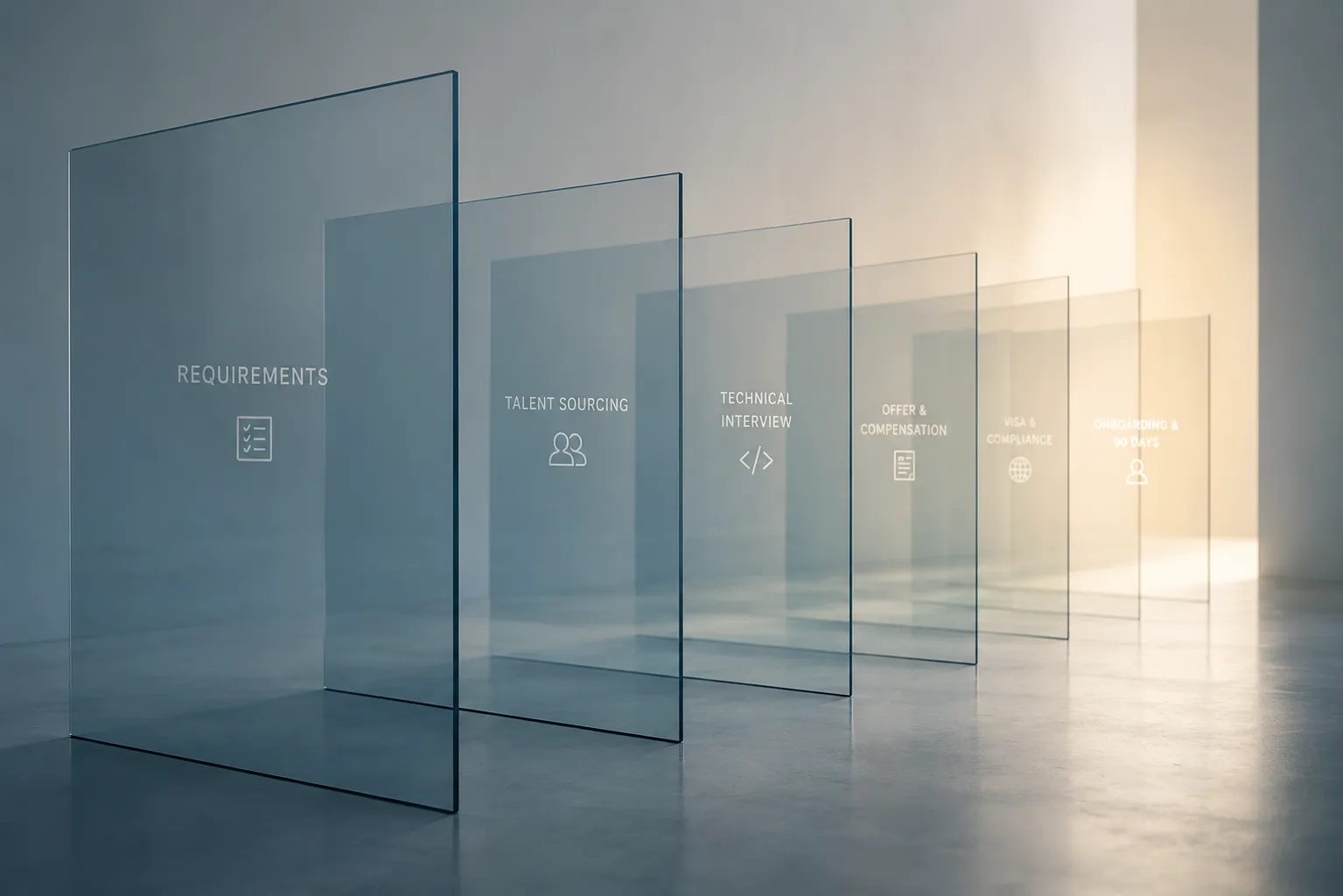
Hiring from India requires more than just posting jobs. You must simultaneously design hiring criteria, local sourcing, tech interviews, offers, visas, and onboarding.
India's Referral & Registration
With Indian talent, check both Japanese visas and Indian referral routes.
Clarify which local recruiter finds candidates, who signs with the Japanese firm, and who bears liability.
In India, check Recruiting Agent certification (Emigration Act, 1983) and eMigrate registration for overseas placement.
Japanese firms need not make all regulatory judgments directly.
However, verify what permits and licenses local partners use to recruit candidates.
Consult local experts if recruiting, job ads, candidate fees, or travel support are involved.
Items to verify are as follows:
Item | Details | Risk |
|---|---|---|
Contractor | Japan- or India-based? | Vague division of liability |
Sourcing | Who sources candidates? | Hidden candidate fees |
Licensing | RA / eMigrate registration | Illegal referral channels |
Charges | Are candidates charged? | Candidate disputes |
Do not just look at "can they supply candidates."
Confirm consent, data privacy, fee flow, visa support, and pre/post-departure liabilities.
Choose recruiters based on legal and visa expertise, not just headcount or fees.
Illegal risks in contract & dispatch types
When hiring Indian talent, several contract types like direct hire, outsourcing, dispatch, EOR, and offshore development are compared.
However, when working in Japan under a residence status, a mismatch between the contract type and the actual command structure increases risks.
For example, if contracted as an independent contractor, but the Japanese firm strictly controls working hours, location, and tasks, this mismatch raises issues.
For dispatch work, relevant contract documents must also be submitted to the Immigration Services Agency.
Required documents differ from direct hire, including the applicant's pledge on dispatch work and proof of activities/period at the host company.
Key points for each contract type are summarized below.
Type | Key Points | Best Fit |
|---|---|---|
Direct Hire | Alignment of COE and duties | Mid-to-long term roles at HQ |
Dispatch | Needs employer and host docs | Legally compliant setups |
Outsourcing | Check command structure | Deliverable-based projects |
EOR | Separate employ/manage roles | Local hiring needs |
Legal risk is not determined solely by the contract's name.
It must be confirmed by actual command, work location, company of engagement, and how pay is processed.
Pre-hire checklist
Delaying legal checks for hiring Indian talent until after offering jobs causes issues.
Dividing checks into four stages (pre-hire, post-offer, pre-COE, and post-entry) prevents omissions.
Timing | Key Checks | Key Criteria |
|---|---|---|
Pre-hire | Job role and applicant background | Is it viable for a work visa? |
Post-offer | Japanese ability and tasks | Is N2-level proof needed? |
Pre-COE | Company papers and category | Are extra files required? |
Post-entry | Actual duties assigned | Do they match the visa data? |
Recruiters should draft a clear job description first, rather than a visa checklist.
Without clear job roles, you cannot assess visa eligibility, Japanese needs, or required documents.
Next, verify candidate backgrounds and link them to the specific job duties.
Then, set up contracts, pay, start dates, COE timelines, and internal roles.
Finally, define scope responsibilities with agencies and immigration lawyers.
Company workload varies vastly based on agency support levels, from sourcing to COE and settling-in help.
Summary
Legal checks for hiring Indian talent go beyond visa applications.
Job description, candidate background, company category, language proof, sourcing channel, and contract terms must be designed as one.
From April 15, 2026, firms must check new Category 3/4 papers and CEFR B2 proof for language-heavy roles earlier.
Key to success: define the job first, separate visa and business needs, and clarify roles among agencies, lawyers, and HR.
In-house handling risks relying on individual experience, lowering document accuracy and process consistency.
Phinx screens candidates via its India network while helping Japanese firms organize hiring requirements.
Integrating visa/COE handling with candidate selection is vital for successful Indian recruitment.
Sources
Immigration Services Agency of Japan, "Status of Residence 'Engineer/Specialist in Humanities/International Services'" https://www.moj.go.jp/isa/applications/status/gijinkoku.html
eMigrate, Ministry of External Affairs, Government of India https://emigrate.gov.in/

Latest Articles

Stay up-to-date
Related articles

How to Outsource Development with Unclear Requirements: Scope & Contracts

Retaining Indian Talent 2026: Turnover Prevention & Year 1 Guide

Why AI Agent PoCs Fail and Enterprise Design Essentials

Is FDE Viable for Japanese Firms? SES Differences & Setup