Why graduates in India decline job offers and how to prevent it

Indian graduate hiring can secure top talent, but many candidates go silent or choose other offers after acceptance. This is driven by a multi-offer market and the slow hiring and communication design common in Japanese firms. This article outlines why offer declines happen, the typical losing patterns for Japanese companies, and practical criteria and process design to prevent dropouts.
Contents
※Please be noted that this blog is translated automatically by AI
A hiring model that assumes offer declines
In India’s graduate hiring, offer declines are not exceptions—they should be built into the process.
Candidates compare multiple offers and decide rationally, so priorities can shift even after an offer is made.
A market where multiple offers are normal
As a baseline, students at Tier 1 and Tier 2 universities commonly hold 3–5 offers at once, unlike Japan’s model where one offer often ends the decision process.
So candidates compare offers side by side, and an offer is treated not as “final” but as one comparison point.
If companies assume “offer made = high certainty,” post-offer follow-up weakens, while competitors keep improving terms and holding meetings, and the company loses in the final comparison.
Especially when no added information is shared after the offer, candidates lean toward companies that provide more information.
Difference in decision speed
At the same time, decision speed in India is very fast, and many candidates decide within days of receiving an offer. If Japanese firms assume a 1–2 week review period, competing offers appear during that time and comparison options increase.
Time set by companies as a “review period” works for candidates as time to gather comparison material.
As a result, even candidates who initially preferred your company often move to firms with better terms or clearer growth opportunities.
In short, slow speed is not just a bad impression—it structurally weakens your position in candidate decision-making.


Typical way Japanese companies lose
Offer declines are amplified not only by market structure but also by Japanese companies’ design flaws.
Slow hiring and limited information become critical disadvantages in competition.
Slow hiring misses opportunities
A common issue is lost opportunities from prolonged hiring processes.
If it takes 2–3 weeks from document screening to final interview, then offer timing is further delayed by internal coordination, candidates receive other offers and move into comparison mode.
In practice, when an offer was made one week after the final interview, the candidate had already accepted one from a foreign IT firm, leaving only the impression of “a slow decision-making company.”
In this state, there is no room even for condition negotiation, and the company is effectively out of the competition.
Lack of information stalls decisions
Insufficient information is another major cause of declines.
Japanese firms often make offers while leaving job details and career paths vague, but Indian candidates specifically evaluate “what skills they can gain in three years at this company.”
So even with similar pay, candidates choose companies with clear growth opportunities and technical domains, while firms with abstract explanations fall out of comparison.
As a result, companies end up thinking, “We don’t know why they declined,” when in fact key decision information was missing.
If you cannot visualize at which step candidate decisions are being blocked, the same declines will repeat.
3 factors candidates compare
Whether Indian new graduates accept an offer is decided by clear criteria, not intuition.
If you make an offer without understanding these criteria, you can lose to competitors even if your terms are not bad.
Salary and Market Value
Salary is the easiest factor to see, but they judge not just amount, but whether it matches market value.
For Tier 1 talent, global IT firms and startups offer high starting pay, so if a Japanese company offers below market, it is excluded from comparison early.
On the other hand, simply offering a high amount is not enough. If skill and pay are unbalanced, candidates may think, "This company will not evaluate me fairly," and decline for long-term career reasons.
So the key is not the amount, but whether there is a convincing basis.
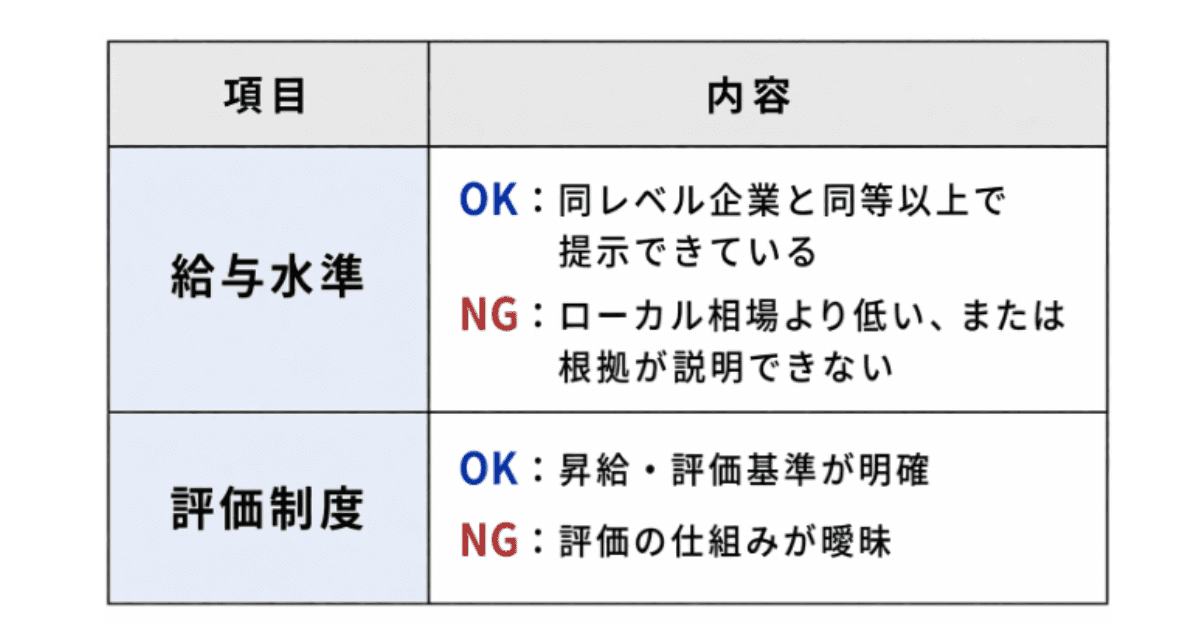
Brand and Growth Opportunities
At the same time, brand and growth opportunities are valued as much as, or more than, salary.
Especially for younger talent, "which company they worked for" directly affects future market value, so name recognition, tech stack, and project quality are key factors.
Therefore, even a less-known company can be chosen if it clearly shows technologies and roles. But abstract claims like "work globally" or "a place to grow" cannot win comparisons.
As a result, candidates choose companies with specific information and lower priority for those with vague explanations.
Related articles

We analyze how Indian engineers are motivated—often very differently from Japanese engineers, including pay expectations and preferred tech stacks. In India’s highly fluid labor market, attracting and retaining top talent requires a clear understanding of their rational decision-making. We explain practical management essentials that directly improve retention and engagement.
When candidates decline offers
Offer declines are not sudden; they happen step by step in the decision process.
Especially after an offer is made, company actions largely decide acceptance or decline.
Silent withdrawal
Most common is silent withdrawal, where contact stops after the offer.
For example, after saying, "Please reply within one week," the candidate never responds, ignores reminders, and the process fades out.
Often, the candidate is already interviewing elsewhere and waiting for better terms.
So the company’s "decision period" is the candidate’s "comparison period," and priorities can change during that time.
Reversal in offer comparison
Another common case is losing later, even when you were ahead at offer stage.
For example, a candidate expected to accept first may later get a higher salary and clear career path from a foreign firm, then choose that offer.
At that point, candidates judge not "which is better" but "which is more rational," and move to firms stronger in pay, brand, or growth opportunities.
As a result, Japanese firms can act first but still lose at the end.
If you cannot see when you lose in this competition, declines keep being treated as random, and no repeatable improvement is made.
Offer design to prevent declines
To prevent offer declines, don't just raise conditions; design offers to match each candidate’s decision pattern.
Especially, alignment with preference type and timing strongly affects acceptance.
Tailor by Preference Type
First, change your value proposition based on candidate preference.
Indian new graduates are broadly split into “pay-focused,” “growth-focused,” and “market-value-focused,” and each decides differently.
For example, stressing only salary to a growth-focused candidate will not move the decision; to win comparisons, show clearly what technologies they can work on and what role they will have.
On the other hand, for pay-focused candidates, if your offer is below market, they are dropped immediately, so expectation alignment in advance is essential.
In short, offers should not be uniform; they must be designed by preference type.
Design Offer Timing
Another key split point is offer timing.
In India, speed itself is competitiveness, so you need a system that can present a decision the same day or next day after the final interview.
For example, companies that share verbal offer intent right after the final interview and then issue a formal offer quickly can strongly pull candidate decisions at that moment.
If internal coordination takes several days, other companies’ offers appear in that gap, and the candidate moves to comparison mode.
As a result, even if your terms are not worse, only the impression of “a slow decision-making company” remains, and acceptance rates fall.
Communication design to gain agreement
Post-offer communication design is the final step that determines offer acceptance.
Without it, even strong terms can lose in comparisons.
Follow-up frequency and content
First, what matters is contact frequency and information quality after the offer.
Even after receiving an offer, candidates have not finished deciding and keep comparing companies.
For example, if a candidate is left alone for a week after the offer, they may meet other firms multiple times, gain clearer views of work and career paths, and choose the company that feels more convincing.
In contrast, companies that quickly arrange engineer meetings or project briefings can deepen understanding and move decisions forward.
In short, after an offer, switch from "waiting" to "driving decision-making."
Closing with competition in mind
Another key point is closing on the assumption that competitors exist.
Since Indian new graduates are expected to compare multiple offers, communication must be designed with that in mind.
For example, ask specifically, "What concerns do you have when comparing us with others?" and "What information do you need to decide?" Then answer each point to remove decision barriers.
If you skip this and only present terms one-sidedly, candidates choose companies with more information, and you lose the comparison.
Companies with high acceptance rates all intentionally design this closing process.
Summary
In India’s new-graduate hiring, offer declines are not accidental; they are a "design issue" created by a market where multiple offers are standard.
So, instead of only revising terms, companies must design screening, offers, and acceptance as one decision process.
There are three key success points.
First, raise hiring speed to market level and secure decisions before candidates enter comparison mode.
Second, present clear, concrete information on the main comparison factors: pay, brand, and growth opportunities.
Third, design post-offer communication and keep a process that moves decisions forward.
However, when this is designed only in-house, companies often cannot accurately grasp India-specific salary levels, candidate preferences, and university trends, causing gaps in evaluation and offer terms.
Especially when screening across Tier 1 to Tier 2 and building offers after judging both technical skill and career orientation, both local networks and technical understanding are required.
These mismatches drop significantly when there is a system that has direct ties with groups of universities, including Indian Institutes of Technology, ensures screening accuracy, and can manage end-to-end support—from evaluation design and post-offer follow-up to VISA handling—based on technical understanding in AI and DX fields.
If in-house design is difficult, one option is to break down the full hiring process, identify where decisions are stalling, and use external expertise.
[Sources]
• India Skills Report 2024
https://wheebox.com/india-skills-report/
• LinkedIn Talent Insights (India hiring trends)
https://business.linkedin.com/talent-solutions

Latest Articles

Stay up-to-date
Related articles

How to Outsource Development with Unclear Requirements: Scope & Contracts

Retaining Indian Talent 2026: Turnover Prevention & Year 1 Guide

Why AI Agent PoCs Fail and Enterprise Design Essentials

Is FDE Viable for Japanese Firms? SES Differences & Setup