Retaining Indian Talent 2026: Turnover Prevention & Year 1 Guide

Retaining Indian talent depends on pre-determining hiring requirements, offers, assignments, evaluations, and onboarding support. This article explains how to design a retention strategy based on the 2026 Indian talent market and youth career trends.
Contents
※Please be noted that this blog is translated automatically by AI
Summary
For retention, focus on which turnover risk to solve first, not the number of initiatives.
With Indian talent, gaps in pay, growth, role, evaluation, or support lead to quick exits before complaints surface.
Indian talent retention begins with job requirements and offer terms, not post-hiring interviews.
In 2026, despite rising salaries, candidates also prioritize learning, flexibility, support, and AI skill updates.
To prevent turnover, assign HR and manager roles for pre-entry, week 1, day 90, 6 months, and 1 year.
Design 1on1s to check career goals, evaluation satisfaction, and market value growth, not just small talk.
End-to-end support—from selection and visa processes to relocation and post-onboarding—helps spot early risks.


Retaining Indian Talent
Retaining Indian talent means defining roles, compensation, evaluation, learning, living support, and communication channels before hiring, ensuring they consistently perform in Japanese companies.
It is operational design to align pre-hire expectations with post-hire reality, going beyond mere onboarding and Japanese language training.
Start before hiring, not after
Addressing retention only through HR interviews after joining is too late.
Candidates evaluate salary, location, tech stack, evaluation, and career outlook at the offer stage.
If their actual work differs from what was explained, trust in the company drops quickly.
Indian IT talent, in particular, look for specific job scopes and skill growth; assigning only maintenance or testing to those hired as developers limits their perceived growth opportunities.
While Japanese firms view this as an "adaptation period," the talent may see it as stagnant market value.
Do not leave retention to a single person
Retention design distributes roles among HR, managers, mentors, general affairs, and management.
If a single manager handles work instructions, life support, evaluations, and career talks, the employee cannot speak honestly.
For example, work complaints go to managers, life issues to HR/general affairs, and career advice to external mentors, making it easier to spot warning signs early.
Defining who monitors what, rather than relying on personal goodwill, is the key to retention.
Retention risks to review in 2026
2026 retention risks aren't just about salary.
Aon's survey shows India's overall salary growth at 8.9% in 2025 and 9.1% (est.) for 2026, with overall attrition dropping to 16.2% in 2025.
Meanwhile, Technology Platform & Products is projected at 9.4% in 2026, showing continued talent competition.
Though Salary Growth Cools, Alternatives Remain
A lower overall attrition rate in India doesn't mean lower retention risks for Japanese firms.
Candidates compare offers with local firms, GCCs, MNCs, and jobs in Singapore or the Middle East.
They look beyond salary at tech exposure, job role, and future marketability.
Japanese firms must avoid competing solely on first-year salary.
Even with a good starting package, lack of learning, no English-based tech discussions, or unclear raises will trigger a job search within six months.
Youth Focus on Growth and Flexibility
Deloitte's 2025 survey notes 94% of India's Gen Z value on-the-job learning for career growth.
They, alongside Millennials, look at work purpose, learning, and well-being, not just income.
EY's 2025 study also links AI skill development with lower attrition.
In 2026, offering a "job in Japan" is no longer enough.
Companies that clearly explain what AI-era skills candidates can develop, what tasks they can master, and how managers support them will retain talent better.
Design flaws causing turnover in Japanese firms
Indian talent turnover isn't just about nationality.
Flaws in hiring and onboarding plans cause gaps between expectations and reality.
Cultural training alone won't prevent turnover if these gaps are ignored.
Vague Job Roles and Evaluations
Japanese firms often hire assuming roles will be adjusted later.
However, Indian talent, especially IT engineers, value knowing their specific tech, tasks, and scope.
Vague roles leave them unsure about their career growth.
At hiring, you must document initial tasks, 6-month goals, and evaluation criteria.
Saying "learn the job first" sounds unplanned to them, even if normal in Japan.
Siloed Feedback Systems
Firms missing resignation signs often keep 1on1 notes locked with individual managers.
Even if they say "no problem," issues with workload, pay, tech, or life may be growing.
In Gallup's State of the Global Workplace (2026), India's 2025 employee engagement was 23%.
While this varies by firm, it shows employees aren't always highly satisfied.
If HR and managers don't share info, you can only react after they decide to leave.
Onboarding Roadmap: Day 1 to Year 1
Onboarding plan is not a one-time setup after joining.
Break down checkpoints and responsibilities by milestones: pre-entry, first week, 90 days, 6 months, and 1 year.
The table below shows the minimum operational guide even for first-time hires.
Period | Key Checkpoints | Company Actions |
|---|---|---|
Pre-entry | Terms, duties, relocation anxiety | Offer brief, COE, housing, family support |
1st week | Daily life, setup, who to ask | PC, work tools, mentor assignment |
90 days | Job adaptation, learning, isolation | Tech review, 1on1, life check |
6 months | Evaluation satisfaction, role expansion | Evaluation criteria, discuss next scope |
1 year | Retention intent, career path | Agree on year-2 role and growth plan |
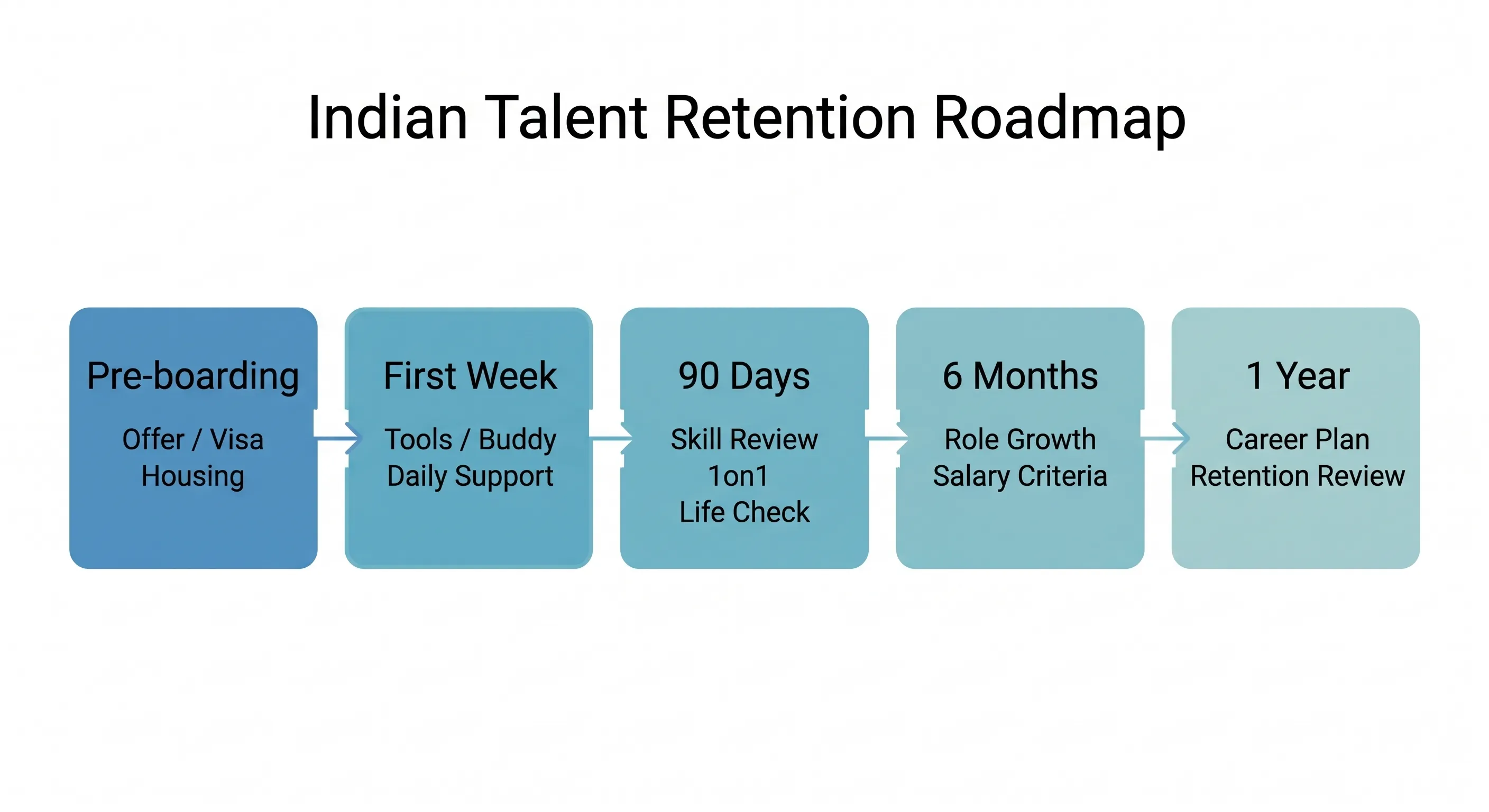
The key here is that focus areas shift at each milestone.
Only focusing on career chats in the first week fails if daily life setup is unstable.
Conversely, only assisting with housing and procedures won't retain them if their role doesn't expand after 6 months.
Pre-entry: Align Terms and Reduce Anxiety
The period from offer acceptance to start date determines retention and prevents withdrawal.
Explain salary, location, tasks, visa/COE, relocation, housing, and family needs individually to help them visualize working in Japan.
Postponing these as "to be explained after joining" creates anxiety.
For first-time global hires, housing, food, banking, bureaucracy, and family support often impact decisions more than the job itself.
90 Days: Balance Work and Life
The first 90 days are not just for tech skills, but also for checking communication in Japanese, meeting participation, and life setup.
Raising job expectations without proper support makes them feel isolated.
On the other hand, focusing only on life support slows down their growth as an engineer.
Detailed 90-day onboarding steps are covered in a separate article.
Here, we define this period as "stabilizing both life and work" to prepare them for role expansion after 6 months.
Related articles

The biggest factor influencing the success and retention of new Indian graduates is "the first three months after joining." Depending on the design of this period, growth rate and turnover rate can vary greatly. Here's a summary of successful companies' mechanisms.
Aligning pay and career expectations
Salary drives retention, but it isn't the only factor.
For 2026 India hiring, you must explain CTC, raises, roles, tech stack, and learning opportunities together.
Candidates compare not just JPY-converted amounts, but what career experience they will gain in a few years.
Explain CTC and Raises
In India, offering salary as CTC (Cost to Company) is standard.
CTC includes base pay, allowances, bonuses, benefits, and statutory contributions.
Stating only monthly or annual salary can cause gaps in expected take-home pay and raises.
At hiring, show the first-year salary and the criteria for raises or role expansion in 6 to 12 months.
As noted in salary reports, average pay and IT market rates differ greatly; offering national averages lacks competitiveness.
Show Growth via Tasks
The best candidates evaluate the tech domains they will handle.
Gaining experience in AI, cloud, data, and product development shapes their career differently than simple maintenance or basic coding.
You don't need to assign difficult tasks immediately.
Instead, connect initial tasks, reviews, next steps, and evaluation criteria.
Even with smaller tasks, a clear growth path helps candidates accept short-term gaps.
Related articles

Average salaries in India vary widely by region and IT role. IIT top grad start at 20-40 LPA (2026). This article explains CTC structures, PPP, raises, and how to set realistic offer lines.
1on1 vs Evaluation
1on1s are vital for hearing out Indian talent's concerns.
However, status updates or small talk won't reveal turnover signs.
Sharing concerns with evaluators feels risky, so you must separate meeting purposes.
Don't let only evaluators listen
Evaluation meetings check salary, promotion, and performance.
1on1s should check market value growth, desired tech exposure, and psychological safety.
Mixing both makes employees hide issues that could affect their evaluation.
Turnover signs are caught easier if HR or mentors listen from different angles.
Just asking "Any concerns?" is not enough.
Ask instead: "What skills here help your future career?" or "What matters most if you compared other offers?"
Share records across the organization
Do not keep 1on1 insights to individuals.
Track workload, tech stack, evaluation satisfaction, and life stress, then review monthly with HR.
Be careful with privacy, but shared data ensures support doesn't stop when managers change.
For silent signs and detailed 1on1 question guides, see our 1on1 design article.
Related articles

Hiring Indian talent offers strong ambition and expertise, but projects can stall when hidden dissatisfaction leads to sudden resignations. This article explains why dissatisfaction is hard to detect, the cultural factors behind it, and why 1-on-1s often fail in Japanese firms, then gives practical design and decision criteria to prevent turnover.
Shared responsibilities for support and team operations
Retention isn't just about work.
For Indian talent, housing, banking, mobile setup, paperwork, food, healthcare, family contact, and religious/dietary needs must be settled first, or they cannot focus on work.
Leaving this to them creates invisible stress.
Ongoing Life Support
Life support doesn't end after day one onboarding.
Monitor procedures in month 1, daily rhythm in months 2-3, and isolation or family issues at 6 months.
Diet, housing, healthcare, and weekend activities are especially hard for them to bring up.
Split the roles: HR handles lifestyle checks, while managers focus on work and team fit. This makes it easier for them to share.
Don't burden HR alone; set up mentors or peers to catch minor daily issues.
Low-Context Team Management
Indian talent thrives when expectations, deadlines, criteria, and decisions are documented.
Relying on implicit Japanese cultural norms leaves them unsure of their goals, increasing evaluation anxiety.
Teams should document specs, tasks, reviews, and contacts.
Don't leave meeting decisions verbal; confirm them in English or simple Japanese to avoid misunderstandings.
This also improves work quality for Japanese members.
Summary
Retaining Indian talent is not about more post-hiring meetings, but about aligning hiring criteria, offers, placement, evaluation, and relocation support. Relying solely on salary fails if job duties, tech growth, managers, and living conditions mismatch, leading to early exits. Success requires clear pre-hire terms, stabilizing work and life in 90 days, and continuously tracking career and appraisal satisfaction after six months.
However, managing this internally is hard. If candidate expectations, Indian market rates, VISA/COE, housing, and technical evaluations are siloed, retention risks are missed. Phinx leverages global experience at Rakuten and Mercari, Tier 1–3 university networks, tech-focused screening, and VISA/COE support to assist from hiring to onboarding. Our strength lies in managing the process end-to-end rather than treating retention as a post-hire issue.
Sources
Aon Survey Projects Slight Uptick in Salaries in India From 8.9 Percent in 2025 to 9.1 Percent in 2026 https://www.aon.com/apac/in-the-press/asia-newsroom/2026/aon-survey-projects-slight-uptick-in-salaries-in-india-2026
Deloitte 2025 Gen Z and Millennial Survey India https://www.deloitte.com/in/en/issues/work/genz-millennial-survey.html
EY India's workforce reimagined: preparing organizations for talent reset https://www.ey.com/en_in/insights/workforce/india-s-workforce-reimagined-preparing-organizations-for-talent-reset
Gallup State of the Global Workplace: India Country-Level Data https://www.gallup.com/workplace/705650/state-global-workplace-india-country-level-data.aspx
Indian workers prioritize family time over career advancement in 2025: insights from Indeed's survey https://economictimes.indiatimes.com/jobs/mid-career/indian-workers-prioritize-family-time-over-career-advancement-in-2025-insights-from-indeeds-survey/articleshow/117768971.cms

Latest Articles
Stay up-to-date
Related articles

How to Outsource Development with Unclear Requirements: Scope & Contracts
Retaining Indian Talent 2026: Turnover Prevention & Year 1 Guide

Why AI Agent PoCs Fail and Enterprise Design Essentials

Is FDE Viable for Japanese Firms? SES Differences & Setup