RAG Data & Access Control Prep Guide

For RAG-based internal AI search, simply uploading documents to a vector DB is not enough. This article outlines key preparation areas—data, documents, permissions, update ownership, and search quality—from a practical perspective.
Contents
※Please be noted that this blog is translated automatically by AI
Summary
Before RAG, define authoritative docs, owners, and archival rules first, rather than just adding data.
For internal AI search, design searchability and user access permissions separately.
RAG quality depends on chunking, metadata, permissions, and evaluation data, not just model performance.
Prepare sample Q&As, source docs, citation limits, and restriction rules before PoC for smoother production.
Phinx excels in integrating workflow design, data infra, AI-native dev, system integration, and adoption.


What to prepare first for RAG
RAG (Retrieval-Augmented Generation) is a system where AI searches external data or internal documents to generate answers.
AWS defines RAG as a way to feed external data, like company documents, into LLMs.
While useful for internal searches and FAQs, RAG itself does not automatically solve document or permission management.
Define the Task Before Adding Documents
The first step is not deciding which documents to upload, but defining who will search for what business decision.
Required documents and access rights differ vastly whether sales reps search past proposals, support agents draft replies, or IT refers to company rules.
Importing documents without defining tasks only increases clutter.
Without clear sources, latest versions, access rights, and update ownership, it remains a mere demo.
RAG is More Than Just Technical Parts
RAG consists of ingestion, chunking, embedding, retrieval, reranking, generation, and citation.
OpenAI's Retrieval API uses semantic search to find relevant content even without exact keyword matches.
However, whether retrieved docs are accurate, authorized, or useful for business decisions is a separate issue.
In PoCs, getting answers from dozens of PDFs looks like success.
In production, you need department-level permissions, version control, source verification, and log auditing.
RAG adoption requires designing both search technology and document operations together.
Inventory pre-filing
RAG quality depends on document state rather than volume.
Internal documents often mix official rules, past data, and chat fragments.
First, separate document accuracy and handling.
Define Official Documents
Classify AI reference documents into three types.
1. Official: Company regulations, manuals, templates, specifications, approved FAQs.
2. Reference: Past proposals, minutes, chats, inquiry histories (provides context but not direct answers).
3. Excluded: Outdated price lists, expired rules, personal notes, duplicates, highly confidential data.
Without this, the AI may treat outdated data or exceptions as official rules.
Even if PoC answers look natural, RAG is hard to use in production if the document source and approver are untraceable.
Set Update Ownership and Expiry Rules
For document auditing, assign update owners alongside file names and locations.
Clarify who maintains the content (e.g., Sales Planning for sales materials, HR/Admin for regulations).
RAG cannot automatically identify the latest information.
Leaving outdated documents active leads to incorrect answers.
Keep metadata like publish date, last update, expiry date, archived flag, and contact info for easier maintenance.
RAG blocked by permission design
The biggest risk with internal AI search is mismatch between searchable documents and user access rights.
Amazon Bedrock Managed Knowledge Bases support connectors like SharePoint and ACL-based filtering.
However, even with these features, ambiguous source permissions can stall production approval.
Ensure Source Permissions are Correct
RAG permissions should not be retrofitted only on the AI side.
First, organize access rights in the original file servers, SaaS, and databases.
Then, sync those same permissions with your search index or vector DB.
Document access varies by department, role, project, and employment status.
For example, HR rules are public, but evaluation history and candidate info must be restricted.
Sales decks are shared, but specific client discounts cannot be treated the same way.
Design Pre-response Verification
Permissions must be verified during search, answer generation, and display.
If restricted fragments enter search results, the AI might summarize them in its answer.
This causes a data leak even if the user cannot open the source document itself.
In practice, use user IDs, roles, and document security levels to filter search and answers.
Also, apply a rule: do not answer if the user lacks access to the cited sources.
Prioritize data security over convenience from the start.
Related articles

Before using AI agents at work, you must first organize your data, docs, and permissions for secure AI access. This article explains the difference between traditional BI/DWH and the data foundations needed for the AI era.
Data Prep for Search Quality
RAG response quality depends not only on the model but also on search quality.
Search quality is affected by document chunking, metadata, synonyms, structure, re-ranking, and evaluation.
Changing the model without reviewing these may not yield the expected improvements.
Reviewing Chunking and Metadata
Dividing documents into smaller units is called chunking.
Too coarse a split retrieves irrelevant context.
Too fine a split lacks the necessary surrounding context.
Optimal chunk size varies for contracts, FAQs, minutes, specs, and internal rules.
Additionally, assign metadata to documents.
This includes department, type, business, client, dates, security, language, and expiration.
Metadata helps filter search results and verify the sources for answers.
Adjusting Search Results
For RAG, simply retrieving similar documents is not enough.
OpenAI's Retrieval API allows adjusting results via ranking options and score thresholds.
This concept is also crucial for internal document searches.
For example, if a sales rep asks about contract renewal discount rules, generic prices, past discounts, and the latest rules may all appear.
Without prioritizing which document to use or reference, the AI will output plausible but useless answers.
Search quality must be tuned alongside internal business rules.
Evaluation data before PoC
A RAG PoC isn't just to see if it answers.
It tests production-ready search quality, citations, permissions, and guardrails.
Thus, prepare test questions and correct source docs before the PoC.
Prepare Target Questions and Source Docs
Evaluation data should use real user questions.
Examples: "Who approves side jobs?" (HR rules), "Which case study fits this industry?" (Sales), or "How to handle this error?" (Support).
For each, define target documents, required answer details, and valid citations.
Include "do-not-answer" questions as well.
This tests if the AI blocks unauthorized customer data, private HR info, or expired pricing.
Without this, the PoC succeeds only on convenient questions.
Four Key Evaluation Categories
Evaluation needs more than just accuracy.
Separating these four areas helps pinpoint where to improve:
Category | What to Check | Primary Action Area |
|---|---|---|
Search | Are key documents retrieved? | Chunking, metadata |
Citation | Are sources correct? | Source display, versioning |
Access | Only authorized data used? | ACL, user attributes |
Rejection | Did it decline when needed? | Guardrails, system rules |
Creating this matrix before the PoC clarifies whether to change models, fix documents, or adjust permissions.
Isolating failure points is the first step toward successful production deployment.
Related articles
For enterprise AI success, you must define tasks, data, access, KPIs, and ownership before choosing tools. This article explains why AI adoptions fail and how to plan before starting a PoC.
Go Live Steps
RAG deployment should proceed in phases, from document inventory to production.
Starting with all company documents at once makes permissions, volume, and evaluation too complex.
It is more practical to narrow the scope first and build a small, working model.
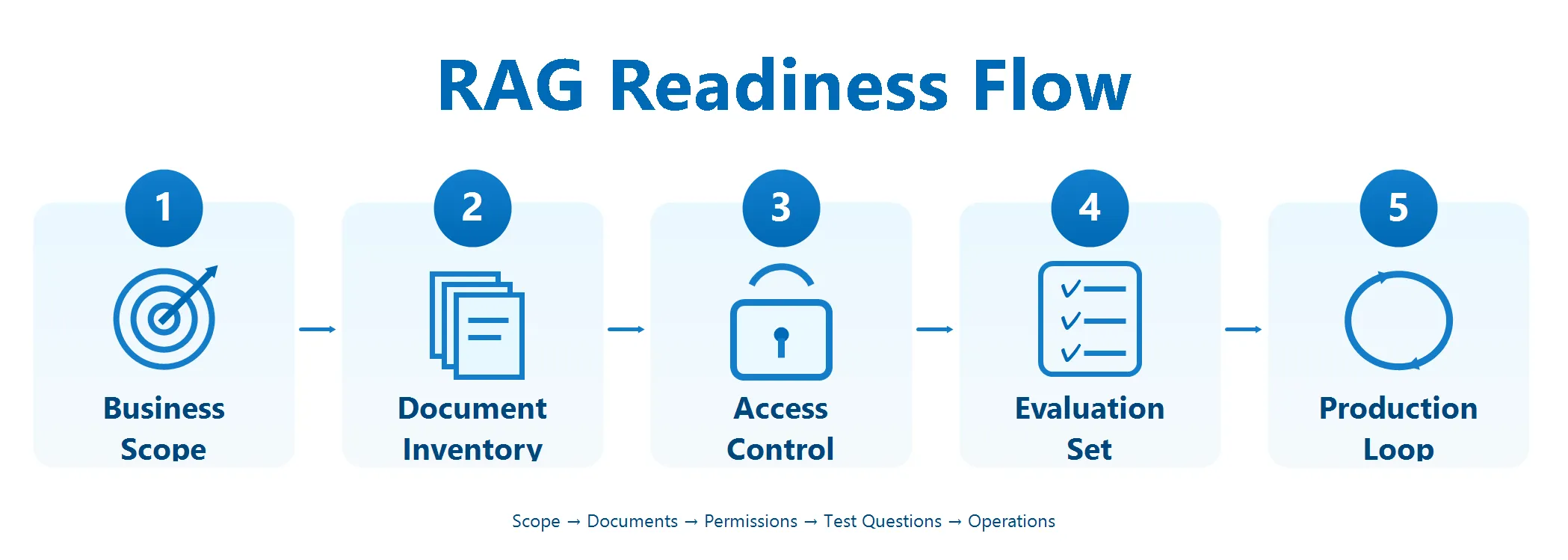
The diagram shows 5 steps from task selection to operational improvement.
Crucially, do not start with document ingestion.
Deciding on tasks, documents, permissions, evaluation, and operations in order turns RAG into a practical AI platform, not just internal search.
Prepare in 5 Steps
The basic workflow is as follows:
Select target tasks, inventory documents, check permissions, create evaluation data, and launch a small-scale production run.
Skipping these steps to start with ingestion leads to backtracking on access rights, version control, and accuracy.
Conversely, you do not need a perfect enterprise knowledge base from day one.
Building a template with one task—like support, sales collateral, or internal rules—and expanding it reduces risk.
When to Use External Support
External support is not just for RAG setup challenges.
A third party adds great value when document management, data infrastructure, permissions, workflows, evaluation, and systems are siloed internally.
Often, business units know the search needs, IT manages permissions, and admin teams own the master documents.
In such cases, tech alone cannot solve RAG deployment.
You must first align business owners, document owners, IT, and security teams under a single decision framework.
Summary
RAG is not just a document search tool, but a design task to organize knowledge, permissions, and operational duties.
To succeed, you must classify documents (official, reference, or excluded) and define update responsibilities and archiving rules before ingestion.
Success requires searchable documents, secure user permissions, verifiable sources, and the ability to refuse invalid queries.
However, doing this internally often scatters tasks across business units, IT, data teams, and external vendors.
Phinx manages everything holistically: from issue scoping, data infrastructure, and RAG to AI-native dev, systems integration, and adoption.
Our strength lies in transforming RAG from a mere demo into a practical, operational internal AI search.
Sources
AWS Prescriptive Guidance "Understanding Retrieval Augmented Generation" https://docs.aws.amazon.com/prescriptive-guidance/latest/retrieval-augmented-generation-options/what-is-rag.html
Amazon Bedrock User Guide "Retrieve data and generate AI responses with Amazon Bedrock Knowledge Bases" https://docs.aws.amazon.com/en_en/bedrock/latest/userguide/knowledge-base.html
OpenAI Developers "Retrieval" https://developers.openai.com/api/docs/guides/retrieval
Microsoft "The AI adoption journey: Moving from AI pilots to transformation at scale with Microsoft Foundry" https://adoption.microsoft.com/files/agents/MicrosoftFoundryAIAdoptionJourney.pdf

Latest Articles
Stay up-to-date
Related articles
RAG Data & Access Control Prep Guide

AI Implementation Guide 2026: Steps & Pitfalls

How to Outsource Development with Unclear Requirements: Scope & Contracts

Retaining Indian Talent 2026: Turnover Prevention & Year 1 Guide