The reason engineer hiring drags on is “screening design” | Common traits of failing companies

Hiring engineers is becoming harder as the job-to-applicant ratio rises. As hiring drags on, candidates often leave for other companies before an offer is made, causing many hiring failures. This article breaks down the selection design and decision-making structure behind long hiring processes, and explains concrete process designs and criteria to prevent dropouts.
Contents
※Please be noted that this blog is translated automatically by AI
A structure that prolongs hiring
Companies with long engineering hiring cycles share a structural problem.
It is not simply too few applicants; in most cases, the selection process and decision-making design itself is flawed.
Decentralized decision-making
A common issue is delays caused by scattered decision-making.
When document screening is done by HR, first interviews by the team, and final decisions by executives, each uses different criteria, slowing hiring decisions.
As a result, after passing the first interview, a candidate may be sent back with, "Actually, the skills are not enough," leading to re-evaluation and extra interviews that stretch the process.
When it is unclear who holds final hiring responsibility, it is easy to raise the bar or postpone judgment, and decisions stall.
In this state, it is the company structure, not candidate quality, that is slowing hiring.
Proceeding with vague criteria
Another root cause is undefined evaluation criteria.
If decisions are made on vague impressions like "looks strong" or "seems like a culture fit," interviewers will differ in judgment, causing re-screening and extra interviews.
Especially in engineering hiring, technical skills and problem-solving ability are often not evaluated separately, creating contradictions such as passing a coding test but failing the final round for weak design skills.
In such cases, candidates also sense the lack of transparency in the criteria and are more likely to withdraw during the process.
In other words, vague criteria are not just an internal problem; they also hurt the candidate experience.


Misunderstanding of Japanese companies' speed
Many companies whose hiring drags on rely on the assumption that “the more carefully we assess, the better the hire.”
But in the engineering market, that assumption itself reduces competitiveness.
Caution Reduces Competitiveness
First, engineering hiring requires not only assessment accuracy but also decision speed.
Especially for Tier 1 ready-to-hire talent, multiple companies make offers at the same time, so companies with long selection processes fall behind immediately.
For example, if it takes more than three weeks from first interview to final interview, candidates will get offers from other companies and finish their decisions in that time.
As a result, by the time your company reaches the final interview, they may already have declined.
In other words, “caution” is not quality assurance; it acts as a risk factor that directly causes missed opportunities.
Decision Speed of Overseas Candidates
This trend is even more pronounced in overseas markets, especially for Indian talent.
As salaries and market value rise, Indian engineers commonly make quick decisions based on multiple offers.
The India Skills Report also shows that the higher the skill level, the more candidates compare multiple companies and decide quickly, making the disadvantage of long hiring processes clear.
Delays in salary offers or unclear conditions also often lead directly to rejection, and time spent “under consideration” can quickly become a reason to drop out.
Therefore, a process designed on the assumption of domestic hiring speed will not work in overseas markets.
Hiring speed is not a culture issue; it is a competitive condition and a factor that should be controlled through design.
The moment a candidate withdraws
Long hiring cycles are not just a matter of time; they are caused by candidates dropping out at specific stages of the process.
The companies that cannot identify where drop-off is happening are the least likely to improve.
Drop-off from more interviews
The most common drop-off point is an increase in interview rounds.
A process that should end in two interviews can stretch to three or four due to mismatched evaluations or deferred decisions, increasing candidate burden and distrust.
For example, after a second interview, a company may add another meeting with a different member. Then, two days later, the candidate says, “I accepted another offer, so I will withdraw,” and drops out.
For candidates, more interviews signal that they are “not being properly evaluated,” while the company’s uncertainty becomes visible.
Withdrawal due to offer delays
Another critical drop-off point is delayed offer presentation.
When internal approvals or salary reviews take time after the final interview, the company misses the candidate’s decision window.
For example, if internal approval takes one week after the final interview, and the candidate receives another offer that is 1 million yen higher, they often decline without any real comparison.
In particular, Indian talent is highly sensitive to salary and market value, so offer speed and pricing transparency directly affect decisions.
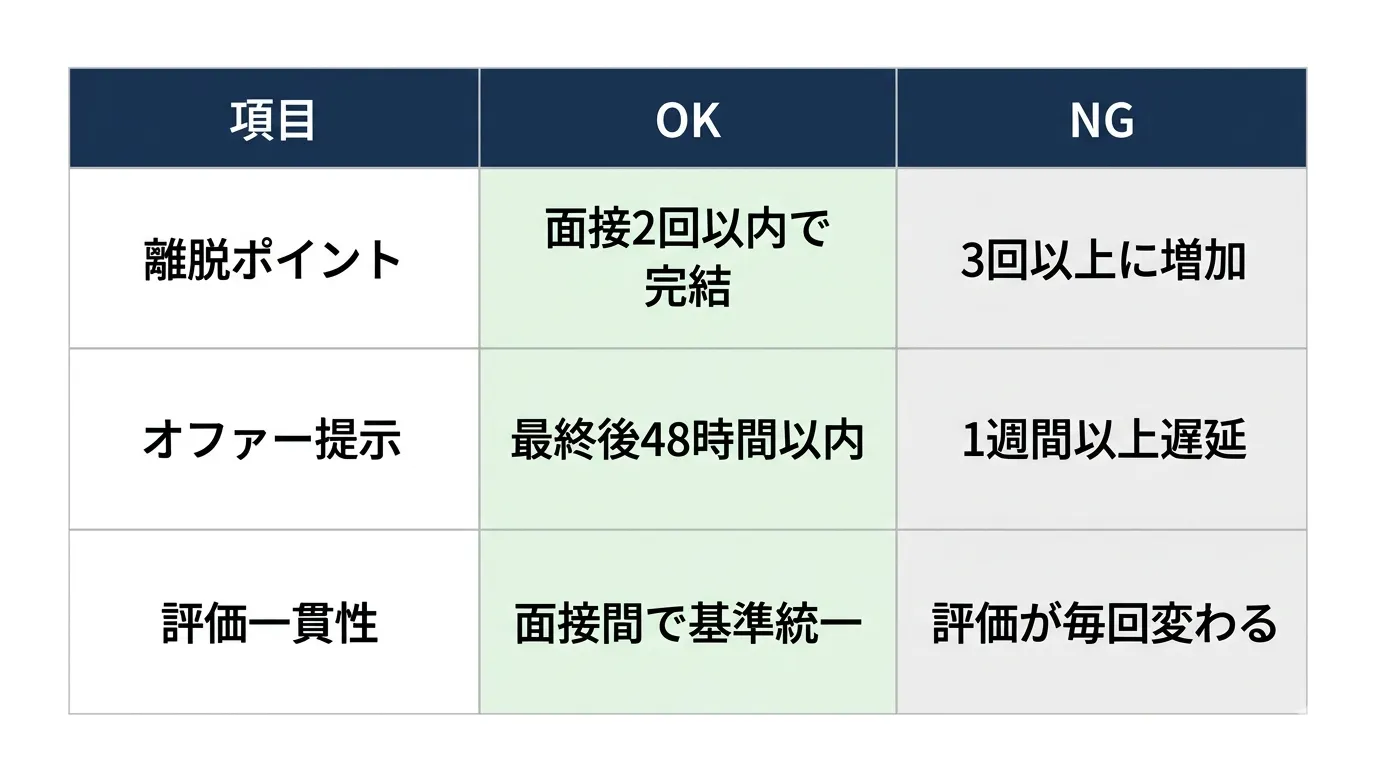
In this way, drop-off is not random; it happens repeatedly because of process design flaws.
If you cannot break down where drop-off occurs, you need to redesign the entire hiring process.
Failed selection process
In companies where hiring drags on, the process itself becomes the goal, and the core “screening” function often stops working.
As a result, more steps are added, while both accuracy and speed decline.
Insufficient Screening
A fundamental issue is poor initial screening design.
If technical level and motivation are not properly assessed at the resume and casual interview stages, the burden shifts to later steps.
For example, even for a role requiring Tier 2-level hands-on experience, candidates passed for their potential may be rejected in the final interview for “insufficient design experience.”
In this case, what should have been identified early is pushed back, increasing interview rounds and slowing decisions.
In other words, weak screening is not just an accuracy problem; it becomes a factor that slows the entire hiring process.
Overlapping Interview Roles
Another common failure is when interview roles overlap.
This happens when the same technical questions are repeated in first and second interviews, or when culture fit is checked multiple times, with no clear division of evaluation.
In this structure, each interview makes decisions independently, so evaluations are not integrated and extra confirmation becomes necessary.
As a result, “just to be safe, let’s ask again” piles up and the process drags on.
For candidates, it feels like the same questions again and again, and they may see it as poor preparation by the company, lowering their interest.
The evaluation process should be designed by role, not by number of interviews; overlap directly increases hiring failure risk.
If evaluation criteria and interview design are separated, the same delays will keep happening, so the structure itself needs to be reviewed.
Related articles

The success of hiring Indian talent is determined not only by acquisition but also by "retention and contribution." This text explains the characteristics of teams and specific organizational design that bridge the gap between high-context Japanese organizations and thinking traits to maximize their performance.
Identifying steps to shorten
The most common mistake when shortening hiring is trying to cut every step.
The key is to separate the steps to remove from the evaluations to keep.
Processes to Cut
First, remove steps that do not contribute to decisions.
Typical examples are duplicate evaluations and interviews done only to confirm.
For example, if a first-round interview already checks technical skills but a second round repeats the same coding task, it adds no value—only time lost.
Also, steps like "just in case" executive interviews, with no clear criteria, only slow decisions and create no value.
Removing or merging these steps can shorten the whole selection process.
Evaluations to Keep
What should not be cut is core skill assessment.
In engineering hiring especially, problem-solving and design ability cannot be shortened.
For example, if hiring is decided only by a coding test, you cannot see the design thinking or trade-off judgment needed in real work, which risks poor performance after joining.
So the evaluation process should be designed around "criteria," not "number of steps."
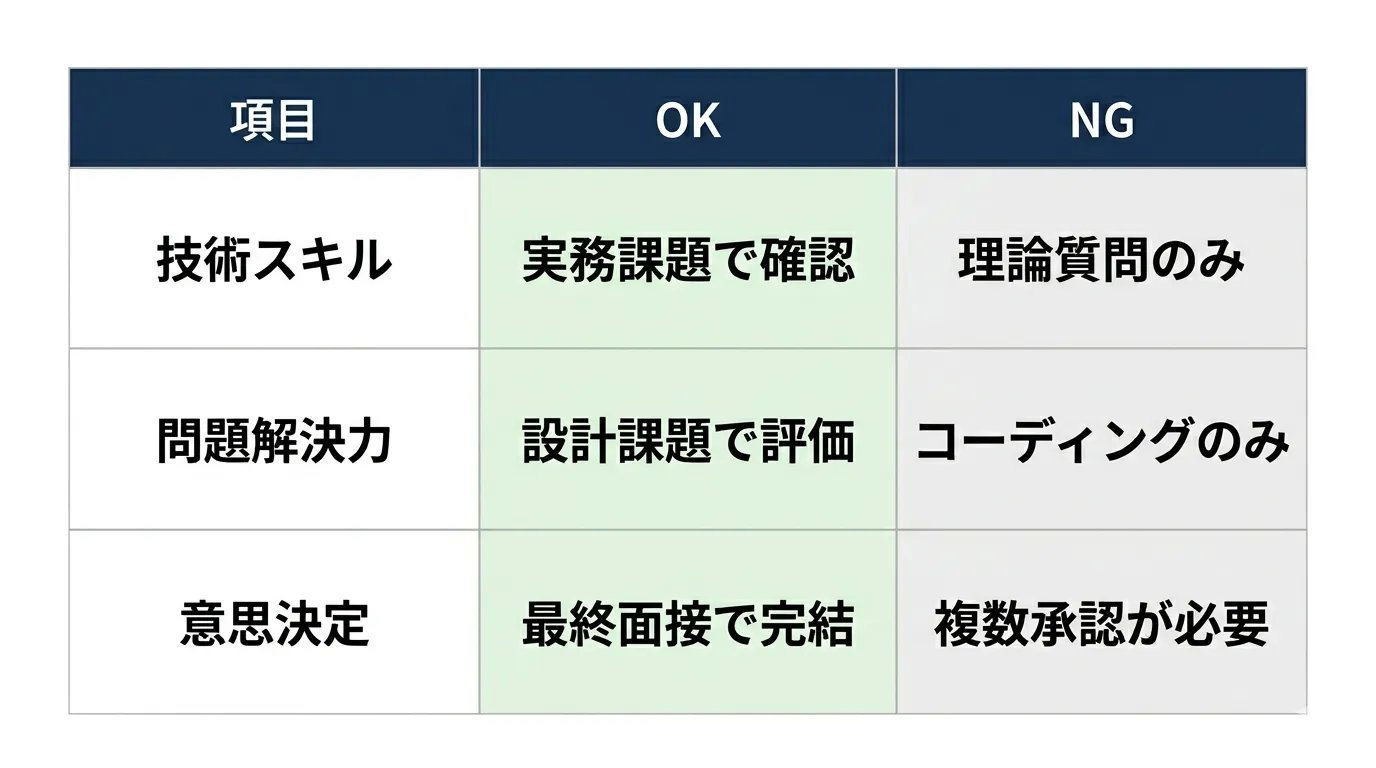
In this sense, shortening is not cutting but optimizing; with the right design, speed and accuracy can coexist.
Design Transformed by Global Hiring
Considering optimization of the hiring process, a design based only on Japan has limits.
Especially for companies with severe engineer shortages, they need to shift to a design that assumes overseas hiring.
Differences in speed requirements
First, overseas hiring requires speed by default.
In Japan, 2–3 weeks of screening may be acceptable, but in overseas markets such as India, a design that reaches a decision within 1–2 weeks is required.
This is not just a cultural difference; it comes from intense overseas competition.
Global companies may even extend same-day offers, and the speed of the process itself functions as a competitive advantage.
For that reason, simply applying the traditional process of Japanese companies makes hiring structurally impossible.
Optimal process for hiring in India
For Indian talent, the process design becomes even clearer.
When targeting immediately productive Tier 1 talent, document screening and technical tests should be completed in advance, interviews limited to two rounds, and offers issued within 48 hours after the final interview.
For Tier 2 hires, screening accuracy is key, so you need to assess candidates by combining pre-work and technical interviews.
Also, if you do not present the salary range in advance, the chance of candidates dropping out mid-process rises sharply, so early disclosure of conditions is important.
In addition, if VISA and COE procedures are not designed as part of the hiring process, declines after the offer or delays in joining will occur.
In other words, overseas hiring is not just expanding the candidate pool; it is rebuilding the process design itself.
Companies that feel the limits of domestic hiring especially need this shift in design.
Summary
Prolonged engineer hiring is not just a hiring shortage; it is a design issue caused by misalignment between decision structure and selection design.
If left unaddressed, it leads not only to declined offers and missed hiring targets, but also to direct business impact such as strained team capacity and project delays.
To succeed, first define the evaluation criteria and clearly break down the role of each interview stage.
Then separate technical skills from motivation in the screening stage, and design the process so final decisions are completed in the last interview.
Also, the needed process changes greatly depending on whether you are targeting Tier 1 talent or hiring Tier 2 talent with training in mind.
On the other hand, if you build these processes in-house, criteria often become person-dependent and interview quality can vary, making it hard to establish a reproducible hiring process.
Especially in overseas hiring, a combined design that includes speed, salary, and VISA support is required, so partial optimization often does not work.
Phinx has members with experience in hiring and organizational building at global companies such as Rakuten and Mercari, and uses a network of Tier 1 to Tier 3 universities, including the Indian Institute of Technology (IIT), to provide end-to-end support from technically informed screening to VISA/COE handling and onboarding.
More than a staffing agency, we are a partner that designs the hiring process itself and helps build a repeatable hiring system.
If your challenges include long hiring cycles due to unclear criteria, inconsistent interview design, or concerns about process design for overseas hiring, please contact Phinx.
We support hiring improvement from the perspective of improving it as a structure, not just as one-off actions.
[Source]
India Skills Report
https://wheebox.com/india-skills-report/

Latest Articles

Stay up-to-date
Related articles

Why AI Agent PoCs Fail and Enterprise Design Essentials

Is FDE Viable for Japanese Firms? SES Differences & Setup

India New Graduate Starting Salary and Annual Income 2026 | CTC Structure and Offer Design

Stricter Visa Rules for Dispatched Engineers in Japan (2026)