Engineer/Humanities/International (Gijinkoku) VISA: N2 Requirements & Jobs (2026)

Starting April 15, 2026, N2-level Japanese proof is not required for all Engineer/Specialist in Humanities/International Services visa applicants. It applies based on company category, application type, and if the job mainly involves interpersonal duties using Japanese. This article explains which roles require the N2 proof, which do not, and what companies must check before applying, based on Immigration Services Agency guidelines.
Contents
※Please be noted that this blog is translated automatically by AI
Conclusion Summary
For the "Engineer/Specialist in Humanities/International Services" visa, JLPT N2 level proof is mainly required for roles involving interpersonal tasks in Japanese.
Category 3 and 4 companies must verify additional documents for applications submitted on or after April 15, 2026.
IT engineers focused on technical tasks like development or design are generally not directly subject to the N2 requirement.
Besides N2, BJT 400+, a Japanese university degree, or 20+ years of residency also satisfy the CEFR B2 equivalent.
Companies must check job duties, category, application type, and the language used before verifying N2 status.


What is the N2 requirement for the IIT visa?
The "Engineer/Specialist in Humanities/International Services" visa (Gijinkoku) is for foreign professionals in Japan.
It applies to roles requiring knowledge in science, engineering, humanities, or foreign culture based on contracts with Japanese firms.
Typical examples include IT engineers, interpreters, designers, and marketers.
Starting April 15, 2026, the Immigration Services Agency updated Gijinkoku visa requirements.
Applicants for roles mainly involving interpersonal communication must now prove CEFR B2-equivalent language proficiency.
For Japanese, holding a JLPT N2 certificate or higher is a standard way to meet this requirement.
N2 is not required for everyone
A common misunderstanding is that all Gijinkoku visa applicants now need JLPT N2.
Official guidelines show that N2 is not a uniform requirement for all job types under this visa.
It only applies to jobs relying heavily on language skills, such as translation, hotel reception, or customer service.
This distinction directly affects hiring. Making N2 a strict rule for all may exclude highly skilled technical candidates.
However, applying as a "developer" while actually doing customer-facing or translation work causes visa discrepancies.
Employers must evaluate language needs based on actual duties, not just job titles.
When N2 docs are required
Need for N2-equivalent proof depends on multiple factors.
Check company category, application type, and job duties together.
SMEs and startups often fall into Category 3 or 4, so check before hiring.
Company categories are classifications used by Immigration to determine required documents.
Category 3 includes companies that filed withholding tax reports but do not meet Category 2 criteria. Category 4 covers all other companies.
Criteria | What to Check | Practical View |
|---|---|---|
Company Category | Category 3 or 4? | Often requires extra documents |
Job Duties | Language-facing work? | Caution: translation, interpreting, service |
Application Type | New, change, or renewal? | Check when changing jobs/duties |
Language Used | Which language is used? | N2 for Japanese; proof for English |
The key is whether the job mainly uses that language for communication.
For example, a developer using Japanese only for internal meetings differs from a role requiring client interaction in Japanese.
Roles Likely Needing Proof
Roles where language is the core value often require proof.
Prepare N2 documents for translation, interpreting, hospitality, and customer support.
Bridge SEs or sales engineers mainly doing client negotiation also require caution.
However, do not judge by job title alone.
A Bridge SE focused on tech design has a high tech-work ratio.
Conversely, an IT engineer mainly doing translation or client support will face language proof requirements.
Roles Less Likely Needing Proof
Tech-focused roles like development, infrastructure, or AI rarely require N2 proof.
This does not mean no Japanese is needed.
Immigration still checks the link between duties and background, company business, and salary.
For IT hiring, do not base decisions solely on N2.
Required Japanese depends on tasks like reporting, specs, or client contact.
Separate visa requirements from actual on-the-job language needs.
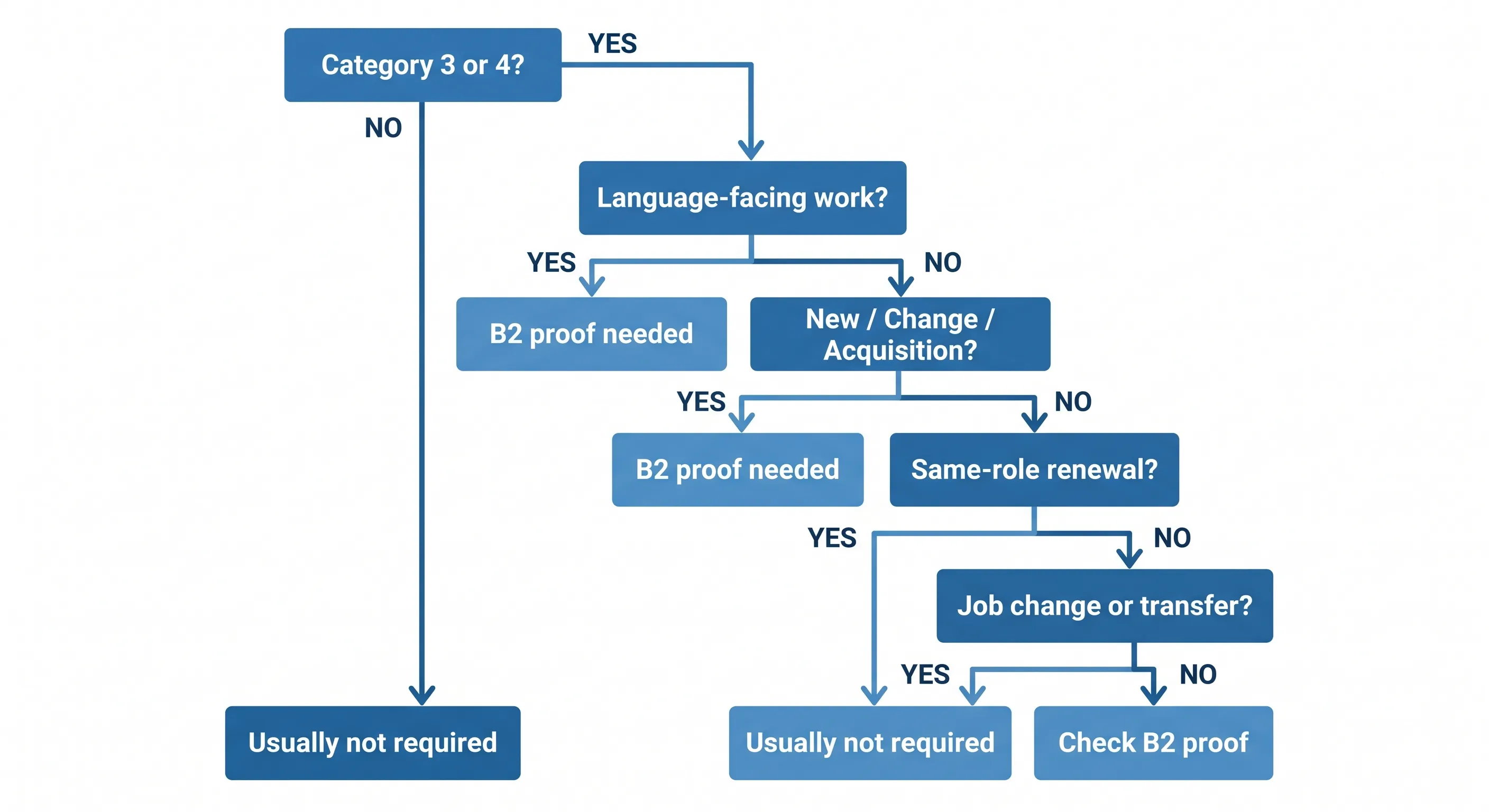
Source: Immigration Services Agency "Status of Residence 'Engineer/Specialist in Humanities/International Services'" https://www.moj.go.jp/isa/applications/status/gijinkoku.html
"Language-facing work" refers to roles like translation, interpreting, and customer service that mainly use language skills.
Related articles

When hiring foreign engineers, the biggest bottleneck isn't sourcing candidates, but confirming corporate categories and required COE application documents. Based on August 2026 immigration guidelines, this article outlines the necessary documents for the "Engineer/Specialist in Humanities/International Services" visa, key precautions for Categories 3 and 4, and how to assign internal preparation tasks.
IT recruitment criteria
For firms hiring Indian IT engineers, the key is not "making N2 mandatory."
First, clarify if the job is technical or communication-based.
Vague definitions lead to mismatched hiring requirements and visa documents.
Key Points in the Job Description
For technical roles, detail development, design, and testing tasks in the job description.
Overemphasizing "client support" or "translation" may lead immigration to view it as a language role.
If client interaction is required, don't hide it; plan your hiring schedule around the needed language proof.
A common mistake is advertising "No Japanese required" but writing "handles client negotiations" in visa documents.
This mismatch raises red flags.
Align your hiring criteria, job post, interviews, and visa descriptions.
Why Avoid Making N2 a Flat Requirement
Top Indian IT talent is educated in English and sought by global firms.
Requiring JLPT N2 severely limits your access to highly skilled candidates.
Since learning Japanese takes 1.5 to 2+ years, exam schedules rarely match hiring timelines.
This does not mean Japanese is useless.
If the job requires internal alignment or reading specs, N3-N2 level skills may be needed.
Even if visa rules don't require N2 proof for the role, assess practical language skills separately.
Distinguishing these two lets you widen your talent pool while avoiding mismatches.
Related articles

When considering hiring Indian IT engineers, the biggest debate is how to set the Japanese language requirement. On April 15, 2026, the screening guidelines for the Engineer/Specialist in Humanities/International Services visa were officially revised, and applicants mainly doing language-related work now need proof of CEFR B2 (equivalent to N2). However, it has been officially confirmed that technical roles such as IT engineers are not directly covered. Legal requirements and the Japanese skills actually needed on the job do not always match. This article examines the N2 standard from the perspective of real workplace needs. [Updated April 15, 2026]
CEFR B2 equivalent documents
Even if N2-equivalent proof is required, JLPT N2 is not the only option.
Immigration Services Agency guidelines treat several methods as equivalent to CEFR B2.
Depending on the candidate's background, you may gather documents without new exams.
Document/Background | B2 Equivalence | Verification at Hiring |
|---|---|---|
JLPT N2 or higher | Treated as Japanese proof | Passing certificate |
BJT 400+ points | Serves as alternative proof | Test date and score report |
Graduated Japanese university | Deemed B2 equivalent | Graduation certificate |
20+ years of residency | Deemed B2 equivalent | Residency history check |
Japanese compulsory/high school | Deemed B2 equivalent | Academic certificates |
In practice, check which document the candidate can prepare fastest.
Since JLPT is held infrequently, waiting for its exam will delay the joining date.
Required documents differ for BJT holders, Japanese university grads, or long-term residents.
For English-Speaking Roles
The issue is not limited to Japanese.
Official guidelines require proof of CEFR B2 level in the language used for work.
For positions using English, English proficiency documents will be required.
If "Japanese N2" is the only focus, companies might only check Japanese exams.
However, the assessment checks if the candidate can use the actual work language.
Clarifying whether English or Japanese is primary in job descriptions is the first step.
Declarant & Renewal Notes
Changes after April 15, 2026 add a sponsor representative declaration, alongside N2-equivalent documents.
This document covers the host organization's structure and details.
Treat it as a separate requirement, not to be confused with N2 criteria.
New Applications (Category 3 & 4)
Companies in Categories 3 and 4 must now submit the representative declaration for COE, change of status, and acquisition of status applications.
As SMEs and startups often fall into these categories, check your category when hiring.
Coordinate document preparation responsibilities among HR, accounting, and the representative.
The representative declaration is a critical document, not a mere attachment.
Discrepancies between the declaration and reality risk being viewed as a false application.
Ensure the candidate's duties, workplace, salary, and support system are fully prepared before applying.
Renewals, Job Changes & Role Changes
For status renewals, language proficiency documents are generally not required if continuing the same duties.
However, changing jobs or switching to language-intensive roles may require submitting these documents upon renewal.
Verify requirements even for current "Engineer/Specialist in Humanities" visa holders when their duties change.
Employers must monitor internal transfers as well as initial hiring.
Moving an employee from R&D to translation or client-facing roles changes the original application details.
To ensure compliance, verify the required documents at the time of transfer rather than waiting for renewal.
Pre-application checklist for companies
First, don't just demand JLPT N2.
Check company category, job duties, documents, and schedule in order.
Skipping this leads to unnecessary exams or missing documents.
Check Item | Who Checks | Key Point |
|---|---|---|
Company Category | HR / Finance | Category 3/4 requires extra documents |
Job Duties | Hiring Manager / HR | Technical vs. Language-based |
Candidate Docs | HR / Candidate | N2, BJT, education, visa history |
Application Timing | HR / Specialist | Exam schedule vs. start date |
Doc Responsibility | CEO / General Affairs | Declared details must match reality |
Start this check during job design, not after offering the job.
Otherwise, mismatch occurs—e.g., evaluating tech skills but describing the job as language-focused in documents.
This burdens both parties.
Structuring Job Duties
Separate main and secondary duties in descriptions.
Clarify their balance (e.g., main: backend dev; secondary: internal Japanese reporting).
If the main role is requirements definition or client meetings in Japanese, N2 is required.
Hybrid roles (tech + communication) often confuse HR.
Organize: work hour ratio, key performance metrics, client contact frequency, and language used.
Clarifying these four points helps determine required Japanese levels and necessary visa documents.
Hiring Indian Talent: Practical Guide
Phinx supports cross-border recruitment from India. We often see tech candidate evaluation and visa prep done at the same time.
For Indian tech hiring, deciding job roles and language split first works better than just requiring JLPT N2.
This is because tech skills, Japanese, English, and team onboarding capacity should be evaluated separately.
Setting Onboarding Setup Before Demanding N2
Even for skilled Indian engineers, doing client-facing work in Japanese right after joining can be tough.
If you start with tech reviews in English and let internal PMs or bridge engineers handle Japanese client work, it simplifies things.
Conversely, if client-facing work is required, you must include N2-equivalent documents and conversation skills in your hiring criteria.
Rejecting non-N2 candidates without deciding this split reduces the pool of talent you can hire.
On the other hand, hiring without Japanese skills when you can't support them burdens the team during daily updates and spec checks.
You need to separate visa and team requirements, deciding what candidates must have and where the company will support.
Designing the Schedule Leading to Joining
For roles needing N2-equivalent proof, plan backward from the exam dates and visa application timing.
Waiting for the JLPT can delay the start date by several months.
If candidates can use BJT or degree certificates instead, you can shorten the prep period.
In cross-border hiring from India, degree certificates, contracts, COE, visa applications, and travel prep happen back-to-back.
Checking if they need N2-equivalent proof late in the process often disrupts the whole timeline.
It is crucial to verify the job description, language requirements, and visa documents all together when setting hiring criteria.
Related articles

When hiring new graduates from India for a Japanese HQ, the biggest post-offer bottleneck isn't finding candidates, but aligning documents for the visa and COE applications. Based on August 2026 guidelines, this article outlines required/additional documents, N2-equivalent proof, and post-COE visa steps.
Summary
The N2 requirement for the "Engineer/Specialist in Humanities/International Services" visa is not just about Japanese proficiency, but also about aligning job duties with application documents.
From April 15, 2026, Category 3/4 companies and those planning interpersonal duties using language skills must verify CEFR B2-equivalent materials and Representative Declarations.
Conversely, N2 is not uniformly required for IT engineers focused on technical tasks like development, design, and infrastructure construction.
Success depends on aligning the company category, main duties, language used, candidate documents, and post-hiring roles before hiring.
Separating legal submission requirements from actual on-site Japanese needs avoids narrowing the talent pool and eases application explanations.
Mismatches between job postings, interview evaluations, job descriptions, and actual assignments complicate both screening and post-hiring operations.
Making these decisions internally often fragments policy checks, HR evaluations, and on-site integration planning.
Phinx aligns hiring conditions for each company by combining its local network in India, tech-literate screening, VISA/COE support, and end-to-end support from selection to onboarding.
Instead of rejecting candidates solely based on N2 status, designing requirements that fit the job and your onboarding system is the realistic way to recruit Indian talent.
Sources
Status of Residence "Engineer/Specialist in Humanities/International Services," Immigration Services Agency https://www.moj.go.jp/isa/applications/status/gijinkoku.html
Clarification on the Status of Residence for "Engineer/Specialist in Humanities/International Services," Immigration Services Agency https://www.moj.go.jp/isa/applications/resources/nyukan_nyukan69.html
Table of Statuses of Residence, Immigration Services Agency
https://www.moj.go.jp/isa/applications/status/qaq5.html

Latest Articles
Stay up-to-date
Related articles

Stricter Visa Rules for Dispatched Engineers in Japan (2026)

Limits of Man-Month & AI-Era Estimation: Client's Guide
Engineer/Humanities/International (Gijinkoku) VISA: N2 Requirements & Jobs (2026)

Will AI Replace Offshore Dev? Lost vs. Value-Added Phases