Do Indian hires really need N2? Field reality

When considering hiring Indian IT engineers, the biggest debate is how to set the Japanese language requirement. On April 15, 2026, the screening guidelines for the Engineer/Specialist in Humanities/International Services visa were officially revised, and applicants mainly doing language-related work now need proof of CEFR B2 (equivalent to N2). However, it has been officially confirmed that technical roles such as IT engineers are not directly covered. Legal requirements and the Japanese skills actually needed on the job do not always match. This article examines the N2 standard from the perspective of real workplace needs. [Updated April 15, 2026]
Contents
※Please be noted that this blog is translated automatically by AI
Conclusion Summary
What you'll learn in this article
The difference between what JLPT N2 measures and the Japanese needed in business settings
The "true" Japanese level needed by role and position
Examples of when N2 is not enough and when work can still run with N3
Five practical tips to supplement Japanese ability
Why IT engineers were excluded under the new April 2026 guidelines
How to set Japanese level requirements for hiring


What Is N2?—What the Test Can and Cannot Measure
JLPT N2 is the second-highest of the five Japanese proficiency levels. It is defined as the level at which you can understand Japanese used in everyday situations and, to some extent, in a wider range of contexts.
Abilities measured by N2
Can understand the gist of newspaper and magazine articles
Can listen to structured conversations or news and understand the flow and key points
Can listen to Japanese at near-natural speed and grasp the development and intent of the talk
Business skills N2 does not measure
This is the key point for recruiters. N2 is only a test of comprehension, so the skills below are not assessed.
Discussion in meetings: You may understand what is said, but the ability to state your opinions immediately is a separate skill
Writing business emails: Proper use of honorifics and standard phrases for external emails is outside the exam scope
Phone communication: On the phone, where listening conditions are limited, even N2 holders often struggle
Understanding implied context: The “reading between the lines” style common in Japanese business culture cannot be measured by the exam
Using technical terms: The ability to handle IT terminology in Japanese is not included in N2
In short, having N2 does not necessarily mean you can use business Japanese, and conversely, even without N2, some people can use Japanese in practical work without problems.
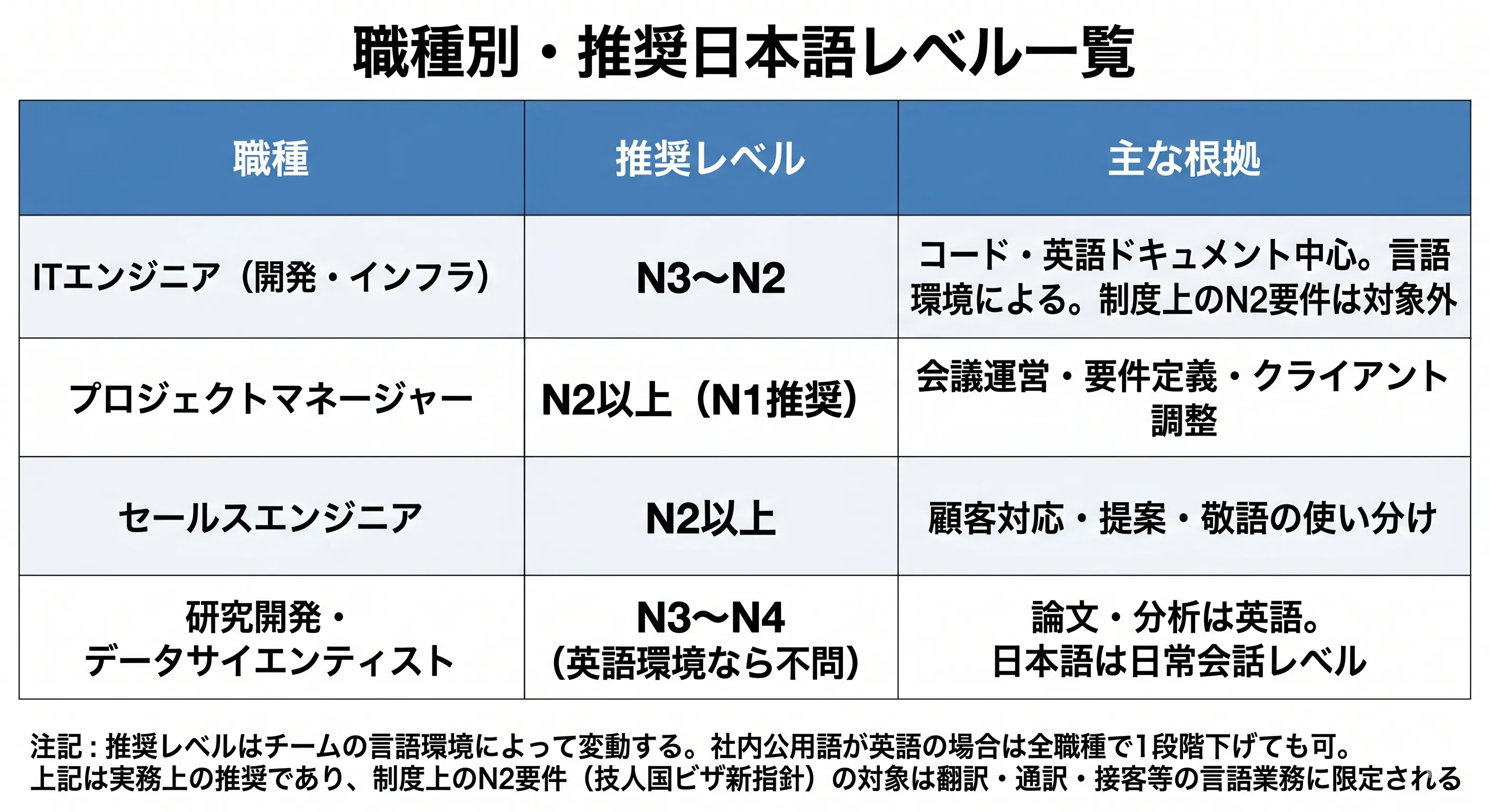
Required Japanese Level by Job Type
Japanese language requirements vary greatly by role and position. Requiring N2 across the board risks needlessly narrowing hiring opportunities.
IT Engineers (Development / Infrastructure)
Recommended: N3 to N2 (depends on work environment)
Most development work can be done with code and English documents. If team communication is in English or text-based, N3 can be enough.
However, if there are morning meetings or review meetings in Japanese, N2 is preferable. First clarify the internal language environment, then set requirements based on it.
Under the new April 2026 visa guidelines, IT engineers do not fall under “mainly engaging in interpersonal work using language skills,” so they are not directly subject to the N2 requirement. The level recommended here is only a practical guide for smooth work.
Project Manager (PM)
Recommended: N2 or higher (N1 preferred)
PMs mainly coordinate with Japanese team members and clients. They need strong Japanese skills for meeting facilitation, minutes, and defining requirements in words. N2 is the minimum; in practice, N1 is often required.
Sales Engineer / Pre-Sales
Recommended: N2 or higher
In addition to technical knowledge, you need to explain and propose solutions to customers in business Japanese. Since you also need polite speech and presentation skills, N2 or higher is required.
R&D / Data Scientist
Recommended: N3 to N4 (not required in English-speaking environments)
Papers and data analysis are often done in English, and if internal presentations can also be in English, Japanese becomes less important. Japanese is mainly needed for everyday internal communication and daily life.
Situations where N2 isn’t enough, and where N3 works (our examples)
Situations difficult even with N2
Phone meetings: Understanding Japanese in low-audio-quality calls is hard even for N2 holders. Comprehension drops fast when several people talk at once or dialects appear.
Using honorifics correctly: N2 tests honorific comprehension, not situational use. Switching tone between client emails and internal chat needs separate training.
Reading implicit instructions: In cases where "That may be a bit difficult" means "better not do it," communication depends on cultural context and is outside N2 scope.
Writing technical documents in Japanese: Writing design docs or incident reports in Japanese is difficult at N2 level without training.
Cases where work runs fine with N3 or below
Assigned to a global team: If English is the internal language, Japanese at greeting/daily-chat level can be enough.
Coding-focused work: Teams where code reviews, Slack, and JIRA are all in English.
Teams with bridge staff: Bridge staff handle Japanese-required communication, so engineers can focus on technical work.
Remote-first work: Communication is mainly text-based, making translation tools easy to use.
Phinx examples — Indian engineers in key roles at Japanese firms with N3
Here are real cases of Indian engineers at Phinx. After coming to Japan, they earned N3 while working. They did not have N2 on arrival.
Even so, through 10+ years of work in Japan, they have succeeded at companies such as Rakuten, Mercari, LINE, and Fast Retailing. Some now hold key roles managing Japanese members.
These cases show that for engineering work, N3-level conversation can be enough to be fully effective. What matters is not test score, but whether daily work communication actually functions.
On the other hand, some people have N2 but lack practical conversation ability. JLPT measures reading/listening comprehension; quick speaking and business communication are different skills. Even N2 passers often cannot speak in meetings or handle phone calls.
In short, using N2 as a rigid hiring rule can cause major opportunity loss by missing strong talent.
Related articles
Starting April 15, 2026, N2-level Japanese proof is not required for all Engineer/Specialist in Humanities/International Services visa applicants. It applies based on company category, application type, and if the job mainly involves interpersonal duties using Japanese. This article explains which roles require the N2 proof, which do not, and what companies must check before applying, based on Immigration Services Agency guidelines.
Indian IT Engineers' Japanese Skills
Japanese Language Learning Environment
There are about 40,000 Japanese learners in India (Japan Foundation survey, 2021), and the number is rising. Major hubs for Japanese education are concentrated in Delhi, Bangalore, Chennai, and Pune.
There are mainly three paths for Indian IT engineers aiming to get jobs at Japanese companies to learn Japanese.
Study at Japanese language schools or sending organizations: 6 months to 2 years. Reaching N4 to N3 is common, and N2 usually takes 1.5 to over 2 years.
Japanese as a minor at universities in India: Offered at limited universities. Study time is limited, so many reach N4 to N3 level.
Self-study / online learning: Highly motivated candidates may reach N2 on their own, but they are few.
Realistic Difficulty of Obtaining N2
The JLPT N2 pass rate worldwide is about 35-40% (official JLPT statistics). Among test takers in India, only a limited number of IT engineers have N2.
Making N2 a required hiring condition greatly shrinks the candidate pool. In particular, excellent engineers from Tier 1 universities are often sought after by U.S. Big Tech and Singapore companies, so they often cannot spend much time on Japanese study.
Under the new April 2026 visa guidelines for Engineer/Specialist in Humanities/International Services, IT engineers are confirmed to be exempt from the formal N2 requirement. For companies, treating N2 as a bonus rather than a must, and evaluating technical skills, potential, and motivation to learn Japanese together, makes it easier to secure strong talent.
Speaking Over Reading/Writing — Japanese Skills in the AI Era
There is a gap between the reading and listening skills emphasized by JLPT and the skills truly needed in business settings. What engineers need in daily work is spoken communication more than perfect reading and writing. Communicating in meetings, answering questions immediately, and building trust through small talk with team members. These are different from JLPT scores.
In addition, the rapid progress of AI translation tools has greatly lowered the barrier to reading and writing. Slack messages, emails, and documents can be handled well with tools like DeepL. This trend will only accelerate. On the other hand, real-time conversation skills cannot be fully replaced by AI.
When hiring, what matters is not whether someone has N2, but whether they can communicate in conversation and are willing to learn Japanese. In the Phinx case mentioned earlier, engineers who obtained N3 while working after arriving in Japan built practical Japanese skills through daily communication rather than test preparation.
5 Tips to Supplement Japanese Skills
Even when hiring people with limited Japanese, smart operations can keep work quality high.
1. Define internal language rules
Set and document the team language, document language, and meeting language in advance. By clarifying language by context, such as "English by default, Japanese on the internal portal," foreign members can clearly see what they need to prepare.
2. Assign a bridge person
Assign one team member who can use both Japanese and English. A technical bilingual is ideal, but a Japanese in-house member with English skills can also work. The key is to formalize the bridge role and include it in evaluations.
3. Make documents and tools multilingual
Prepare key parts of the internal wiki, work manuals, and work rules in English as well. Integrate translation tools (DeepL, Google Translate) into Slack and email to lower barriers in text-based Japanese communication. Perfect translation is not needed. If the intent is understood, that is enough, and efficiency improves greatly.
4. Design post-hire Japanese training
Plan in advance to raise Japanese ability within 6 to 12 months after joining. Corporate plans for online Japanese lessons (2 to 3 times per week) can be introduced at about 20,000 to 50,000 yen per person per month. Custom materials focused on work terminology are more efficient than general Japanese study.
5. Spread "plain Japanese" internally
Japanese members also need to adapt. Share plain Japanese rules in the team (use short sentences, simplify honorifics, avoid katakana words). This helps not only foreign staff but also makes overall internal communication clearer.
Related articles

The biggest factor influencing the success and retention of new Indian graduates is "the first three months after joining." Depending on the design of this period, growth rate and turnover rate can vary greatly. Here's a summary of successful companies' mechanisms.
Guide to Japanese Level Requirements for Hiring
Setting Japanese language requirements proceeds in the following steps.
Step 1: Organize the position's language environment
List specific situations and how often Japanese is used in the job
Check the company's official language and the team's language mix
Recheck tasks assumed to require Japanese (many can actually be handled in English)
Step 2: Separate minimum and ideal levels
Minimum line: The minimum Japanese needed to perform the job (e.g., N3 + basic business email)
Ideal line: Japanese enough to work independently and complete the job (e.g., N2 + technical terms)
It is more realistic to hire at the minimum level and build a plan to reach the ideal level
Step 3: Manage legal and operational requirements separately
Under the new Gijinkoku visa guidelines announced on April 15, 2026, the legal Japanese requirement has been clarified. The Japanese needed for visa approval and the Japanese needed for the job must be considered separately.
Legal requirement (confirmed): For the Gijinkoku visa, if you mainly do interpersonal work using language skills, proof of CEFR B2 (equivalent to N2) is required. However, this applies only to Category 3 and 4 companies. Technical roles such as IT engineers are excluded
Operational requirement: Varies by role. Some positions are fine with N3
If N2 is required by law (roles such as translation, interpretation, or customer service), design the hiring schedule on the assumption that it will be obtained, and assess the practical level separately
Proof equivalent to B2 is not limited to JLPT N2; BJT 400+ or graduation from a Japanese university also qualifies
Related articles

As Japan’s workforce shrinks, hiring talented new-graduate engineers from IT powerhouse India is essential for advancing DX. This article explains key hiring challenges and practical steps for success, from university partnerships and visa applications to onboarding and retention support.
Summary
JLPT N2 is a "comprehension" test and does not measure conversational ability, communication skills, or cultural understanding required in business
JLPT N2 is a "comprehension" test and does not measure conversational ability, communication skills, or cultural understanding required in business
Actual required Japanese level varies greatly by job type, position, and team language environment
There are real examples of Indian engineers with N3 level working in key roles at major companies. Rigidly judging by whether they have N2 leads to major hiring missed opportunities
Advances in AI translation tools are rapidly lowering the barriers to reading and writing. What matters more than test scores is whether they can communicate in conversation and whether they are motivated to learn Japanese
Even when Japanese ability is insufficient, it can be supplemented through operational design such as assigning bridge personnel, multilingual documentation, and post-hire training
Under the new April 2026 guidelines for the Engineer/Specialist in Humanities/International Services visa, technical roles such as IT engineers were confirmed to be outside the N2 requirement. The N2 requirement in the system and the Japanese-language requirement in practice should be managed separately
Source
Japan Foundation Test for Japanese Official Site — N1 to N5 level standards https://www.jlpt.jp/about/levelsummary.html
Japan Foundation FY2021 Survey of Overseas Japanese-Language Education Institutions https://www.jpf.go.jp/j/project/japanese/survey/result/
BJT Business Japanese Proficiency Test Official Site https://www.kanken.or.jp/bjt/

Latest Articles

Stay up-to-date
Related articles

Stricter Visa Rules for Dispatched Engineers in Japan (2026)

Limits of Man-Month & AI-Era Estimation: Client's Guide

Engineer/Humanities/International (Gijinkoku) VISA: N2 Requirements & Jobs (2026)

Will AI Replace Offshore Dev? Lost vs. Value-Added Phases