Why Global Talent Strategies Fail and How to Improve Them | Integrated Hiring, Placement, and Development

Even if global talent strategy increases hiring, many cases stall after placement because roles remain unclear and employees never become effective. The cause is the disconnect between hiring and organizational design. This article breaks down the structure behind strategic failure and explains decision criteria and practical design to unify hiring, placement, and development.
Contents
※Please be noted that this blog is translated automatically by AI
Why Strategy Fails
Global talent strategies are often judged by whether hiring succeeded, but in reality success depends on whether they work after placement.
Therefore, strategies designed around hiring alone structurally break down.
A Structure That Stops at Hiring
In many companies, hiring overseas talent is treated as the goal, and selection proceeds without defining post-hire roles or evaluation criteria.
As a result, what output level is expected after joining is not shared on the ground, leading to rejected reviews or excessive revisions, increasing the burden on both the employee and the receiving team.
Moreover, without clear evaluation criteria, it becomes impossible to judge performance, and the company ends up in a state where hiring was successful but the person cannot yet contribute.
Mistakes in a Japan-Centric Design
On the other hand, if the system is designed on the same assumptions as Japanese hires, mismatches with overseas talent’s goals and market conditions become apparent.
For example, Indian engineers tend to value not only salary but also market value growth and technical development, and if roles and growth opportunities are vague, many will choose to change jobs within a short period.
In other words, a design that assumes long-term development just like domestic hires does not work as a strategy and creates turnover risk from the moment of hiring.


Misunderstanding that hiring is the starting point leads to collapse
Many companies whose global talent strategy fails start by designing it around “hire first.”
However, this order itself becomes the trigger that breaks the entire strategy.
The misconception that hiring solves everything
In practice, teams decide to “hire overseas because we’re short-staffed,” but because roles and performance expectations are still vague at that point, gaps between expectations and reality emerge after hiring.
For example, someone hired as a backend engineer may end up handling spec sorting and Japanese-language coordination, and their evaluation drops because they cannot deliver their core development output.
In other words, as long as you try to solve the issue through hiring, the structure of the problem does not change; it only amplifies the mismatch.
Different assumptions about overseas talent
Even more important, in overseas markets, the structure is not “companies choose talent” but “talent chooses companies.”
Especially for candidates from Tier 1 and Tier 2 universities, competition with global companies is fierce, so if the role, tech stack, growth opportunities, and salary are not clearly shown, they drop out during the process.
Meanwhile, many Japanese companies are used to hiring for potential and vague job definitions, so they proceed without recognizing this difference in assumptions, and as a result, offer rejections and process drop-offs become routine.
Unless this gap is addressed, no matter how much you strengthen recruiting, it will not work as a strategy.
Common On-Site Mistakes
If these hiring-related misunderstandings are left unresolved, problems will inevitably surface after the employee joins the workplace.
And most of them are caused not by "individual ability" but by "poor design."
Does not work after assignment
For example, an overseas engineer is hired and assigned to a development team, but because task size and specification assumptions are not shared, deliverables are submitted with a mismatch from expectations.
As a result, work is repeatedly sent back in review, revision requests keep increasing, and development does not move forward, delaying the entire project.
In this situation, the person feels, "I don't know what is being asked," while the team thinks, "They are not acting as expected," creating mutual distrust. It is not uncommon for them to be treated as ineffective in a short time.
Stagnation because it cannot be evaluated
Even more serious is the state where performance cannot be judged because evaluation criteria have not been defined.
For example, if it is unclear whether code quality, speed, or team contribution matters, review standards differ by person and evaluation loses consistency.
As a result, the individual does not know what to improve and stops growing, while the company also stalls without being able to make proper reassignment or development decisions.
If this continues, the issue eventually surfaces as resignation or removal from the project.
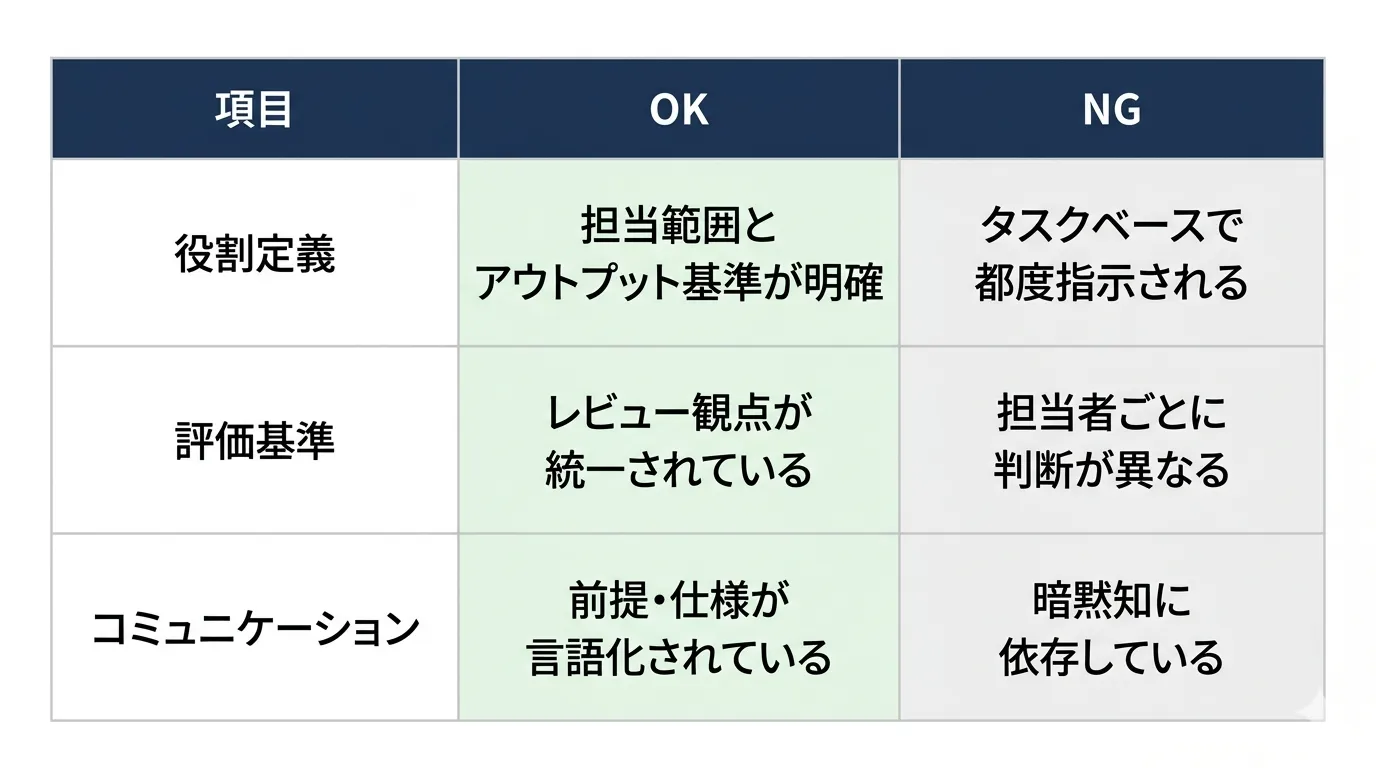
If it is unclear which stage lacks design, the same failures will repeat.
You need to break down the entire process from hiring to after assignment and identify where expectations are breaking down.
Related articles

The biggest factor influencing the success and retention of new Indian graduates is "the first three months after joining." Depending on the design of this period, growth rate and turnover rate can vary greatly. Here's a summary of successful companies' mechanisms.
Break down the structure of strategic dysfunction
The failures up to this point may seem like separate problems, but in fact they all come from the same structure.
It is a design flaw: recruiting, placement, and development are disconnected.
Disconnection of Recruiting, Placement, and Development
In many companies, the recruiting team defines the talent requirements and hands them off to the workplace, while the workplace accepts them without a clear role design or development policy, making responsibility unclear.
As a result, even when there is a gap between the skills assumed at hiring and the output required on site, it is hard to know at which stage to fix it, so the problem is left unresolved.
Also, in the development phase, because evaluation standards are not linked to hiring, the direction of growth is unclear, and the overall strategy breaks down.
Difference from Domestic Strategy
By contrast, in domestic hiring, the gap is less visible because tacit know-how and long-term development act as a buffer.
But for global talent, if roles, evaluation, and career paths are not clear, it immediately leads to turnover risk, so a disconnected approach cannot work as a strategy.
In other words, unless we shift from extending the same domestic design to designing with integration from the start, a global talent strategy will not be repeatable.
Design criteria for an effective strategy
To make a global talent strategy work, you need to design it by working backward from “what role should do what” rather than “who to hire.”
Whether hiring, placement, and development are designed as one system determines whether the strategy succeeds.
Defining Roles and Expectations
First, clarify for each position what level of output is needed and by when.
For example, for an API developer, break it down into measurable units such as “can define specifications at a level that passes design review” or “can implement in line with the existing codebase.”
If this definition is vague, both hiring decisions and post-placement evaluations become subjective, leading to inconsistent hiring results.
Hiring Strategy by Tier
Next, decide which talent tier to target.
Tier 1 talent can contribute immediately, but competition with global companies is intense and salaries are high, making them harder to hire.
Tier 2 talent may vary in skill, but with proper screening and role design, they can perform strongly.
In short, unless you clearly choose the tier that fits your company stage and onboarding setup, your hiring strategy will not work.
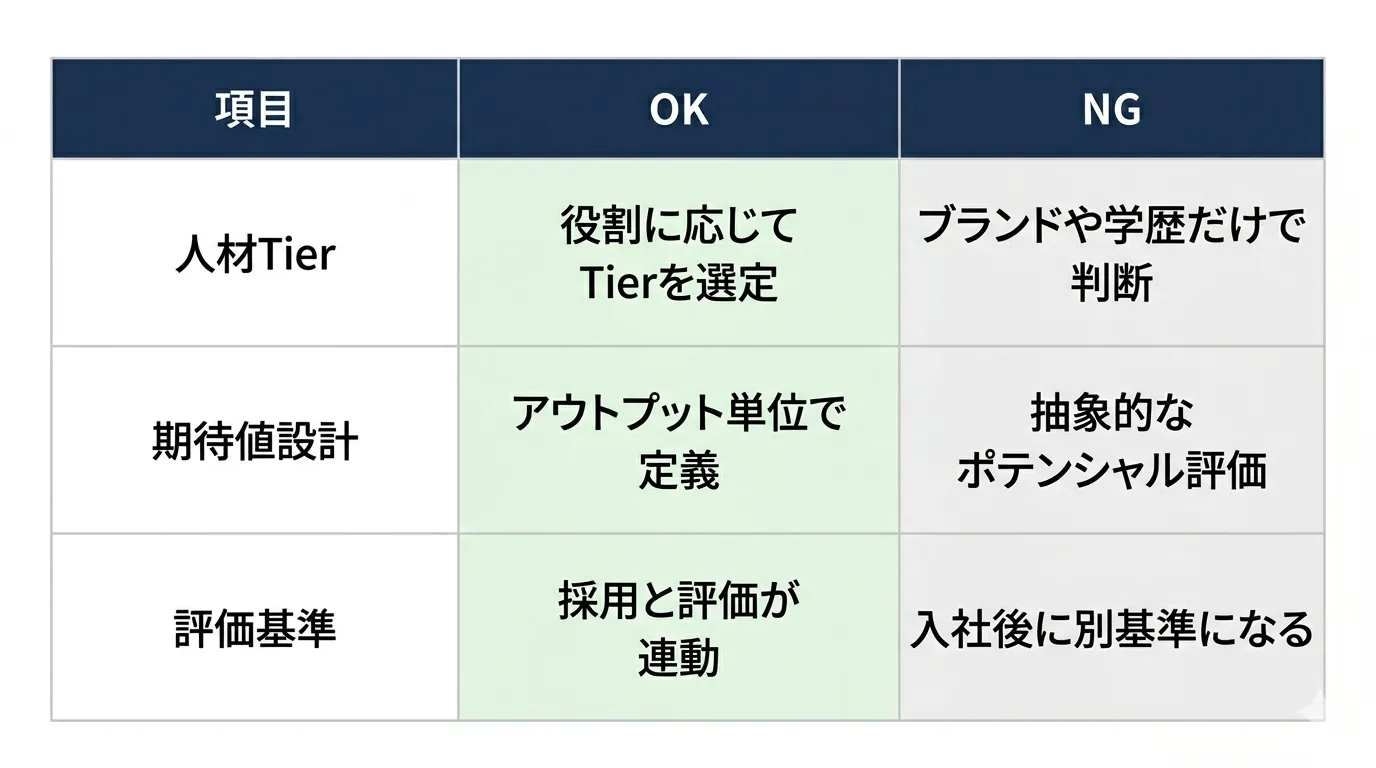
If these three points are not aligned, hiring more people will not improve productivity; instead, it will increase organizational strain.
Connecting to Indian Talent
Considering the design criteria so far, it becomes clear how difficult it is to make a strategy work with domestic hiring alone.
As a result, overseas hiring, especially Indian talent, emerges as a practical option.
Why India Becomes an Option
First, in Japan the supply of immediately productive engineers is limited, while in India there is a broad talent pool from Tier 1 to Tier 3.
Tier 1 is highly competitive because it rivals global companies, but Tier 2 includes many people who can perform well in practice, and with proper screening, hiring can be highly cost-effective.
Salaries are also easier to set competitively compared with domestic talent at the same level, making this a realistic way to scale the organization.
Key Practical Design Points
However, hiring Indian talent does not automatically make things work; if anything, it raises the bar for design quality.
For example, if you hire with vague role definitions, after a few months some hires may leave because they feel the expected results are unclear.
In addition, if VISA and COE procedures, as well as onboarding systems, are not in place, the lead time before joining becomes longer, increasing the risk that candidates will go elsewhere in the meantime.
Therefore, hiring in India is not just about securing talent; it is about whether you can execute the design needed to make the strategy work.
Related articles

As acquiring global talent becomes more important, the country Japanese companies should focus on as the first step is “India.” It has advantages that other countries do not have, such as population, IT skills, and English proficiency.
Summary
Failure in global talent strategy is not a hiring-method issue; it is a design issue.
Even if hiring is strengthened alone, if people do not function after placement, productivity will not improve. Instead, review burden and management costs increase, lowering overall organizational performance.
The conditions for success are clear: first, define roles and expectations by output; second, separate hiring strategies by tier to ensure screening accuracy; third, design hiring, placement, and evaluation as one system.
Only when these are aligned does hiring become a structure that turns into workforce strength.
If you build this design in-house, translating evaluation standards into words, understanding overseas markets, and redesigning the selection process tend to depend on individuals, making reproducibility difficult.
In particular, hiring in India is highly complex, including candidate assessment, compensation design, and VISA/COE handling, and partial optimization will not work.
Phinx has members with experience building global organizations at Rakuten, Mercari, and more, and leverages a university network from Tier 1 through Tier 3, including the Indian Institutes of Technology (IIT), to support end-to-end hiring—from screening based on technical understanding to VISA/COE support and onboarding design.
Its strength is that it goes beyond hiring as a point solution to the design needed to make it work as a strategy.
If you are hiring with vague evaluation standards, or considering overseas hiring but have not yet translated it into a workable design, please contact Phinx.
We support building a reproducible global talent strategy tailored to your company’s stage.

Latest Articles

Stay up-to-date
Related articles

Why AI Agent PoCs Fail and Enterprise Design Essentials

Is FDE Viable for Japanese Firms? SES Differences & Setup

India New Graduate Starting Salary and Annual Income 2026 | CTC Structure and Offer Design

Stricter Visa Rules for Dispatched Engineers in Japan (2026)