Why Engineer Offers Keep Being Declined | Why Better Pay Alone Won’t Win Acceptance

In engineering hiring, more candidates are rejecting offers even after salary increases. This article outlines the criteria candidates compare and the gap in Japanese companies’ offer design, and explains hiring strategies to improve acceptance rates.
Contents
※Please be noted that this blog is translated automatically by AI
Why more engineering candidates are declining offers
In engineer hiring, cases of candidates declining after passing the final interview are no longer rare.
Especially in the mid-career engineer market, more candidates job hunt while comparing multiple companies, creating a gap between the criteria companies expect and the actual points candidates compare.
First, we need to structurally sort out why “raising salary still doesn’t close the deal.”
Comparison criteria are changing in a seller's market
In the engineer hiring market, the standards candidates use to choose companies are changing significantly.
In the past, salary and company size were often the main comparison points, but now “where can I grow?” strongly affects decisions.
In particular, experienced candidates in backend, AI, and cloud often receive offers from multiple companies at once.
As a result, candidates tend to judge not by simple conditions, but by which company can raise their market value.
For example, the following points are often compared.
Is the tech stack modern?
Is technical debt being left unresolved?
Can engineers take part in decision-making?
Is the evaluation system suited to technical roles?
Is remote work or discretionary work possible?
On the other hand, some Japanese companies still think that increasing salary makes them more competitive.
But in reality, even if salary is slightly lower, companies with a clear technical environment and growth opportunities are often chosen.
Especially at startups and product companies, “what can I build?” and “how much autonomy do I have?” directly affect acceptance rates.
In other words, hiring competition is shifting from compensation competition to career-environment competition.
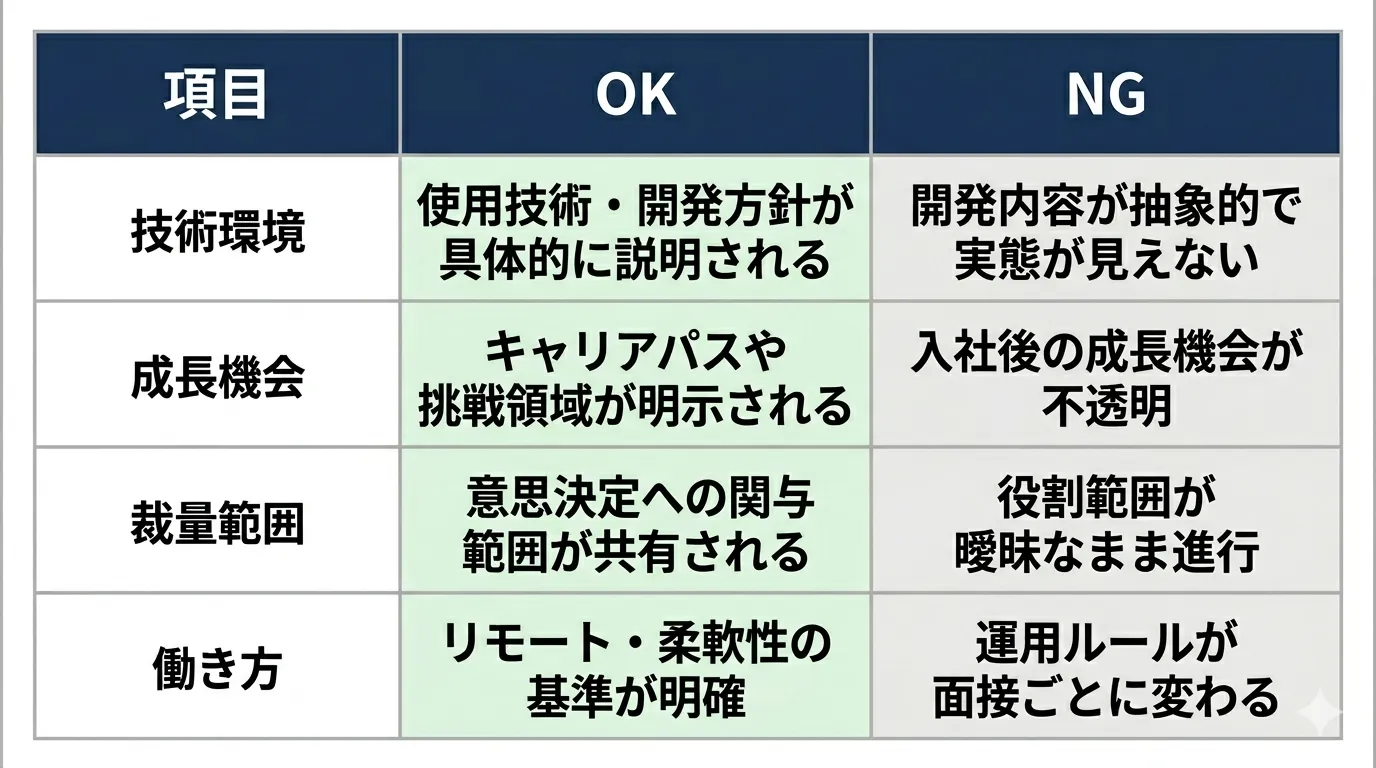
Salary alone can't differentiate you
Companies with rising offer declines in engineer hiring share a common misunderstanding.
That is the idea that “if we improve compensation, acceptance rates will improve too.”
Of course, if conditions fall below a certain level, you won't be competitive.
However, even if you improve salary alone, it is hard to win acceptance unless candidates can clearly picture life after joining.
In practice, candidates are looking at how their market value would change after working at the company for a few years.
So more and more cases involve checking technical strategy, organizational stage, and even how decisions are made within the engineering team.
The problem here is companies that do not share enough on-site information at the offer stage.
If only HR explains the terms and development structure or technical issues are not discussed, candidates can't ease their concerns.
At one SaaS company, they only presented the terms after the final interview.
However, the candidate had an interview with the CTO at another company and received a detailed explanation of the product strategy and technical investment policy.
As a result, despite the first offer being higher, the candidate chose to join the latter company.
In this way, acceptance rates are affected not only by the strength of the offer, but also by how convincing the post-join picture is.
Therefore, in offer design, you need to understand not only compensation improvements but also the comparison criteria candidates are using.
Related articles

There is a reason why many excellent Indian new graduate engineers do not choose Japanese companies as their first choice. This article explains the avoidable factors and how to become a 'chosen company' by overturning them.


Pitfalls in offer design that Japanese companies often misunderstand
In companies with low offer acceptance rates, the offer design itself may have structural issues.
A common cause is building hiring design on the assumption that candidates ultimately decide by salary.
In reality, candidates compare not only conditions, but also how they will work after joining and the decision-making environment.
Relying only on better compensation
In engineer hiring, more companies are raising offered salaries to match competitors.
But designs that rely only on salary improvements often reach a ceiling in improving acceptance rates.
The reason is that candidates look not at the level of conditions, but at whether they are reasonable.
For example, even if salary is high, they may worry about long-term career value if there is no technical decision-making authority or the work is mainly maintaining legacy systems.
Especially experienced engineers value not just a higher salary now, but what experience they can gain next.
So companies that cannot explain their technical investment direction or growth phase at the offer stage struggle to stay competitive.
In Japan, the belief that offering strong conditions shows sincerity still remains strong.
But from the candidate side, a high salary with little explanation can leave them unsure why the offer is what it is, and can create distrust.
Especially at startups, companies that can clearly explain which problem they want the person to solve and why that talent is needed have more stable acceptance rates.
In other words, an offer should be designed not as a mere conditions notice, but as a process to align expectations.
Lack of frontline information
In companies with low acceptance rates, poor information sharing between HR and the front line is also common.
The biggest problem is when what was heard during selection does not match what is explained at the offer stage.
For example, interviews may say new development makes up a large share of the work, but the offer meeting reveals that existing operations work is actually the main focus.
When this happens, candidates worry that explanations may change after joining too.
Also, Japanese companies may treat the offer stage as just a condition notice.
But for candidates, it is an important phase for gathering information before making a final decision.
Therefore, the following gaps in information can lower acceptance rates.
Role of the assigned team is unclear
Scope of authority over technology choices is unclear
Development roadmap is not shared
Actual operation of the evaluation system is not visible
Few touchpoints with the frontline manager
In engineer hiring, who you work with strongly affects the decision.
So companies with higher hiring success intentionally create opportunities to talk with frontline members before and after the offer.
If the evaluation criteria are not clearly defined, the same mismatch may happen again.
Insufficient offer interviews lower acceptance rates
In engineering hiring, the offer interview after the final interview is sometimes overlooked.
However, if candidate concerns and questions are not resolved at this stage, acceptance rates drop sharply.
Especially when compared with competing companies, those that end with "just presenting terms" tend to be at a disadvantage.
Candidate concerns remain unresolved
The most important thing in an offer interview is reducing the candidate's uncertainty.
However, in Japanese companies, there are many cases where "terms notice = offer interview."
For example, there are cases where only salary, grade, and start date are explained, and the meeting ends in about 30 minutes.
But at that point, candidates still have concerns such as the following.
What the actual development process is like
How much technical debt exists
Whether the evaluation system works
Whether the manager understands technology
What role is expected after joining
If they are forced to decide without these concerns being resolved, candidates feel the risk of lacking information.
As a result, more candidates move toward companies with more explanation and higher transparency.
At one web company, candidates kept asking additional questions after the offer.
HR answered each time, but there was no direct conversation with the person in charge on the ground.
Meanwhile, a competitor held meetings with an engineering leader and shared technical issues and organizational policies in detail.
In the end, the candidate chose the competitor because they could picture themselves after joining.
In this way, acceptance rates may be determined not by differences in terms, but by differences in information clarity.
For that reason, the offer interview should be designed not as a simple notice, but as decision support.
Expectation setting is not done
In companies where early turnover happens after acceptance, there is often too little expectation setting at the offer stage.
The main problem is prioritizing looking good and failing to share real issues.
In engineering hiring, candidates also understand that there are organizational issues.
So the key is not to hide the issues, but to explain which issues will be improved, and in what order.
For example, the following explanations help set expectations.
Why technical debt exists
Current stage of the organization
Areas where decisions are slow
Future technology investment policy
Constraints faced by the team
On the other hand, abstract phrases like "high autonomy," "modern environment," and "a lot of discretion" do not let candidates judge the reality.
As a result, gaps arise after joining, increasing the risk of early resignation.
Especially strong engineers check not only what is in place, but also what is not yet set up.
Therefore, in offer interviews, it is important to share not only positive information but also current issues with transparency.
Related articles

The success of hiring Indian talent is determined not only by acquisition but also by "retention and contribution." This text explains the characteristics of teams and specific organizational design that bridge the gap between high-context Japanese organizations and thinking traits to maximize their performance.
Why the selection experience affects acceptance rates
In engineering hiring, candidates do not judge a company by offer terms alone.
Communication during screening and the interview experience itself become clues to how the organization will run after they join.
So companies with an inconsistent hiring process may see lower acceptance rates, even with better terms.
Hiring speed changes decisions
In engineering hiring, screening speed directly affects acceptance rates.
Especially for high-demand talent, multiple processes often run at once, so delays in decision-making can be critical.
But the key point here is not that faster is always better.
The problem is when candidates cannot see why the company is taking its time.
For example, two weeks may pass between the first and second interview, yet the reason is never shared.
From the candidate's side, this can feel like low priority or chaotic internal coordination.
Even if the process is somewhat longer, companies that share information like the following tend to keep acceptance rates steadier.
Interview evaluation criteria
Purpose of the next interview
Internal decision flow
Feedback
Current hiring status
Engineers, in particular, read the organization's decision-making structure through the hiring experience.
So delays in communication and unclear evaluation criteria create the impression that the same confusion will happen after joining.
On the other hand, companies with strong hiring success keep the process itself organized.
Each interviewer has a clear role, and the explanation given to candidates is consistent.
As a result, candidates are more likely to think, 'This organization runs in a repeatable, stable way.'
Interviewers' technical understanding matters
In engineering hiring, interviewers' technical understanding also has a major effect on acceptance rates.
The biggest issue is when interviews move forward with little real understanding of the work.
For example, a candidate may talk about system design or technical improvements, but the interviewer may not fully understand it.
In that situation, candidates may feel, 'This company may not fairly value technical work.'
Japanese companies often emphasize 'culture fit.'
But in technical hiring, if culture is judged only in vague terms, the criteria become unclear.
Especially top engineers look at the following:
Can technical discussion happen?
Does the person in charge understand the challenges?
Is management involved in technical investment?
Do engineers have a voice?
Is the evaluation system designed for technical roles?
In other words, through the interview itself, candidates are checking whether they will be respected as engineers at this company.
So to improve acceptance rates, interview design matters as much as employer branding.
Companies where frontline engineers, EMs, and CTOs are properly involved tend to gain more competitiveness at the offer stage.
A structure that's hard to improve with domestic hiring alone
In engineering hiring, some companies struggle to achieve results beyond a certain level, even after improving offers and selection processes.
Behind this lies market-structure issues that are hard to solve through individual company efforts alone.
In the highly skilled IT talent segment, competition in the domestic market is intensifying.
Hiring competition has become structural
In today’s engineering hiring market, job openings are concentrated in certain talent segments.
In particular, in areas such as cloud, AI, data infrastructure, and security, the number of experienced professionals is limited.
As a result, candidates are constantly being approached by multiple companies.
In addition, major companies, mega-ventures, and foreign firms are offering high-level conditions, raising the overall standard of competition in the market.
The problem here is that mid-sized and regional companies try to compete on the same terms.
For example, situations like the following occur.
Cannot beat large companies on salary
Lose in technical brand comparison
Cannot build a candidate pool due to low recognition
Differences emerge in the volume of recruiting communications
Cannot leverage referral networks
In this situation, simply improving compensation tends to increase hiring costs only.
And if expectations after joining are not properly aligned, early turnover risk also rises.
In other words, engineering hiring is shifting from a “compensation competition” to a “hiring design competition.”
Unless you define which talent market to target and which evaluation criteria to compete on, improving acceptance rates will be difficult.
Candidate pool building is near its limit
More companies can no longer fill their needed talent through domestic hiring alone.
Especially in advanced technical fields, there are simply too few people in the market that they want to meet.
For example, in specialized roles such as SRE and ML engineers, the number of applicants drops sharply the moment job requirements are set strictly.
As a result, many companies are forced to choose between lowering hiring standards or accepting long vacancies.
However, if they respond only by loosening standards, mismatches with the field become more likely.
In organizations with heavy technical demands, lower hiring accuracy can increase the burden on existing members.
In addition, the engineer population itself is unevenly distributed in Japan.
While candidates are concentrated in the Tokyo area, regional companies often struggle to secure enough interviewees.
Under these conditions, the hiring strategy itself needs to be reviewed.
Rather than simply improving job postings, the key is to consider which market to access.
Especially in advanced talent areas such as engineering, the difficulty of design changes greatly depending on the country or market targeted, so the choice of market must be part of the decision.
Recruitment design for overseas hiring
If you aim to improve acceptance rates only in the domestic hiring market, you are more likely to be constrained by the market structure itself.
Therefore, more companies are redesigning their hiring market, including overseas engineer hiring.
However, overseas hiring does not allow simple condition transfer, so the hiring design itself must be reviewed.
Redesigning Hiring Criteria Is Necessary
In overseas engineer hiring, applying the same evaluation standards as domestic hiring often creates mismatches.
A particularly common issue is overemphasizing "fit with Japanese companies."
For example, if you judge candidates only by standards like the following, you are likely to miss highly skilled candidates.
Japanese fluency
Domestic company experience
Adaptability to seniority-based hierarchy
Tolerance for long working hours
Acceptance of vague roles
On the other hand, in the overseas engineer market, transparency in scope and evaluation criteria is valued.
If you proceed with hiring while requirements remain vague, acceptance rates are likely to drop.
What matters most is clearly stating what you expect.
You need to share clearly which technical challenges they will handle, how much discretion they will have, and how performance will be evaluated.
In overseas hiring, candidate experience also matters more.
If the process is slow or feedback is not transparent, more candidates will go to competitors.
In other words, for overseas hiring, before competition on terms, whether the process is organized determines acceptance rates.
Conditions Differ by Hiring Market
In overseas engineer hiring, the conditions that matter vary by market.
So designing hiring around the broad label "overseas talent" often leads to failure.
For example, in Western markets, remote flexibility and salary range tend to matter more, while in Asia, growth opportunities and technical experience are often the key comparison points.
Even within Asia, candidate expectations change depending on how mature the local startup market is.
What matters here is understanding which market you are competing in.
If you compare only with other Japanese companies, you will miss how candidates actually make decisions.
Also, in overseas hiring, post-hire design matters.
VISA/COE support
English communication
Onboarding
Performance review operations
On-site acceptance support
If you hire without these in place, it affects not only acceptance rates but also retention.
Especially for highly skilled roles like engineers, the design difficulty changes greatly depending on the country or market you target, so you need to decide with the market choice in mind.
Key Acceptance Criteria for Hiring Indian Engineers
In overseas engineer hiring, the evaluation criteria candidates value differ by market.
Among them, the Indian market is drawing more attention from Japanese companies because of its large supply of advanced IT talent and deep engineering pool.
However, offers designed with the same approach as domestic hiring can significantly lower acceptance rates.
Phinx supports cross-border hiring of Indian talent, and here we summarize our practical insights.
Technical growth opportunities matter
In hiring Indian engineers, 'what technical experience can they gain?' strongly affects acceptance rates.
Especially top candidates tend to value long-term market value more than short-term compensation.
This is partly because IT competition in India is also rapidly intensifying.
Global companies and local unicorns are hiring aggressively, and comparing multiple offers has become common for candidates.
So if Japanese companies assume that simply being able to work in Japan is attractive, acceptance rates will not rise easily.
In practice, candidates compare the following points:
Can they work with modern technologies?
Can they join technology selection?
Can they gain product development experience?
Can they work in a global environment?
Is technical evaluation done properly?
Among top-tier candidates in India, work focused on maintenance and operations, or wait-for-instructions tasks, tends to be rated low.
So when hiring, you need to explain concretely what challenges the person will take on.
In the Indian market, the quality of technical interviews is also highly valued.
If technical discussions with engineers on the team do not work, it can create the impression that the company does not value technology.
In short, in hiring in India, 'technical career design' has more impact on acceptance rates than simply presenting conditions.
Clarity of job scope is important
In hiring Indian engineers, unclear job scope also lowers acceptance rates.
Especially common in Japanese companies is saying, 'We will flexibly adjust after you join.'
Even if this is a normal expression in Japan, overseas candidates may read it as 'the role is not clearly defined.'
As a result, they cannot picture the evaluation criteria or career path after joining, which becomes a concern.
The following points are especially important.
Product in charge
Technical responsibility scope
Reporting line
Evaluation system
Promotion conditions
In the Indian market, candidates make decisions after clearly understanding what is expected of them.
So if the job details stay abstract, it becomes easier to lose out to competing companies.
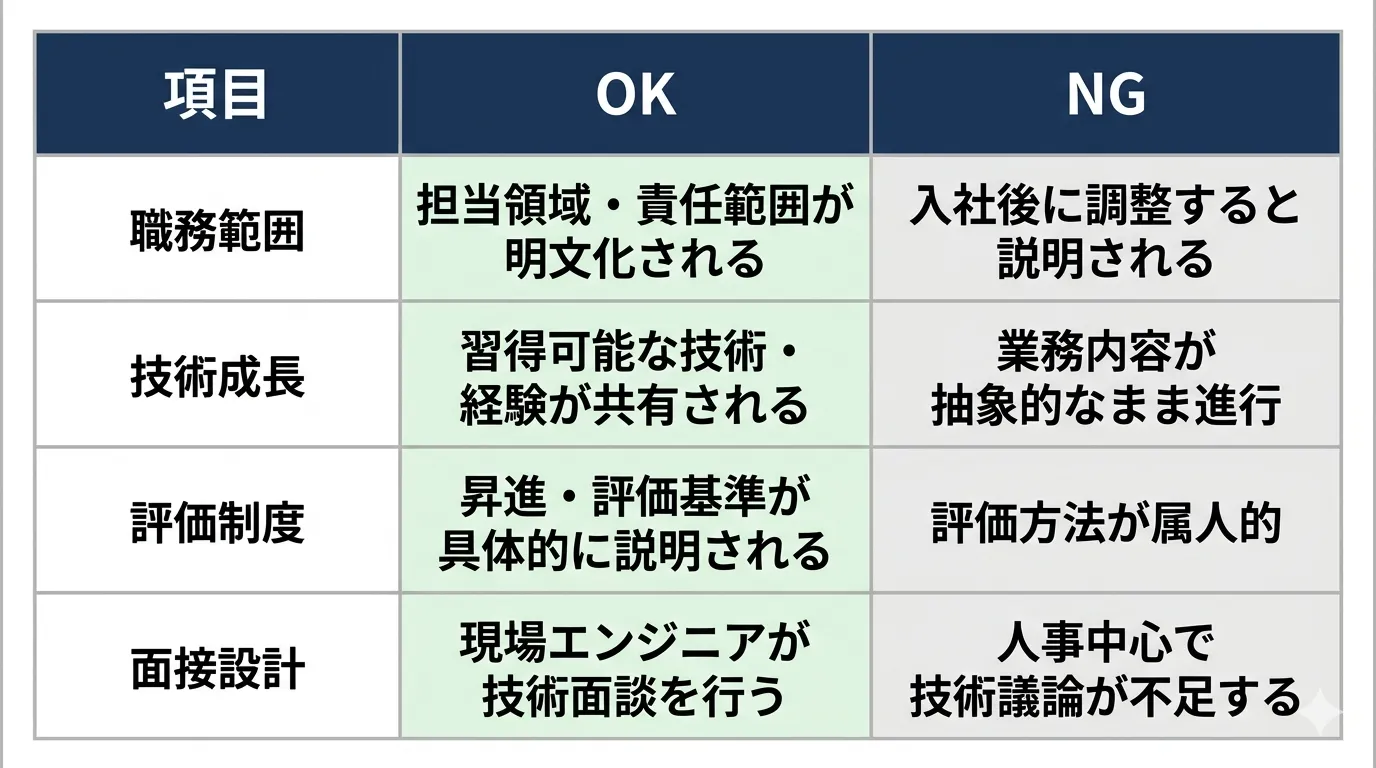
In the Indian market, there is a large supply of advanced IT talent, but top candidates are also in a global competitive environment.
Japanese companies therefore need not just a 'good enough to hire' mindset, but the ability to structurally explain why candidates should choose them.
Related articles

The recruitment of new Indian graduates is greatly influenced by 'post-employment management.' This article organizes the commonalities of Japanese companies succeeding in retention and performance using concrete examples.
Designing Offers to Improve Acceptance Rates
In engineering hiring, some companies treat improving offer acceptance as a “better conditions” issue.
However, in reality, acceptance rates are determined by how aligned the entire hiring design is.
Therefore, you need consistent information design from before selection through after the offer.
Align expectations before the selection process
Companies with high acceptance rates adjust expectations not at the offer stage, but from the early stages of selection.
The reason is that if a mismatch is discovered at the final stage, better conditions alone cannot fix it.
Especially in engineering hiring, it is important to share early which problem the person will be asked to own.
For example, if you expect technical debt reduction but the candidate thinks the role is focused on new development, a post-hire mismatch is more likely.
Therefore, from the early stages, you need to clarify the following.
Current technical issues
Development structure
Organization phase
Expected role
Evaluation criteria
It is also important to increase the level of detail as the process moves forward.
By showing the big picture in the first interview, technical details in the second, and the expected role in the final interview, candidates can more easily picture themselves after joining.
Top candidates especially care about what they will be expected to do after joining.
So, vague appeals to attractiveness alone will not improve acceptance rates.
Divide roles between the hiring team and HR
To improve acceptance, it is also important not to leave hiring to HR alone.
Especially in engineering hiring, companies where on-site managers and technical leads are properly involved tend to earn more candidate trust.
However, what matters here is not that everyone gives the same explanation.
In companies with high hiring success, roles are clearly divided.
For example, the following division is made.
HR: systems, conditions, and selection management
EM: team structure and evaluation operations
Tech Lead: technical issues and development policy
CTO: technical strategy and organizational direction
On the other hand, when roles are vague, the explanation tends to vary by candidate.
As a result, it leads to distrust: “What they say does not match.”
It is also important not to treat the offer interview as a standalone event.
Throughout the entire process, the message needs to stay consistent: “What does this company expect, and what do they want me to take on?”
Especially in the advanced IT talent market, candidates are also evaluating the company.
So improving acceptance rates requires not salary competition, but better hiring design itself.
Summary
Offer declines in engineering hiring are increasingly caused not by simple pay gaps, but by misalignment in the overall hiring design.
Especially in the advanced IT talent market, candidates decide after comparing multiple companies, so improving salary alone will not stabilize acceptance rates.
If the tech stack, growth opportunities, role clarity, and hiring experience are not designed consistently, distrust before joining is likely to grow.
As a result, this leads not only to hiring costs, but also to heavier team load and lower productivity.
To improve acceptance rates, you first need to define evaluation criteria in words.
Unless you organize what problems the person will handle, what technical expectations you have, and how performance will be assessed, candidates cannot picture life after joining.
It is also important to clarify the roles of HR, the frontline team, and management, and keep the explanation consistent throughout the process.
In engineering hiring in particular, the interview and offer experience itself is seen as a sign of organizational strength.
On the other hand, it is becoming difficult to keep improving acceptance rates using only the domestic hiring market.
In the advanced IT talent market, competition is global, and ad hoc hiring operations cannot maintain repeatability.
When overseas hiring is included, companies also need new capabilities in areas such as VISA/COE handling, evaluation system design, and onboarding.
Phinx supports cross-border hiring of India’s advanced IT talent, led by members who have built global organizations at Rakuten, Mercari, and others.
Using networks from Tier 1 universities, including IIT, through Tier 3 universities, we provide end-to-end support for technical screening, selection design, VISA/COE handling, and onboarding.
Rather than simple talent referral, we help design each company’s hiring strategy while organizing the structure behind “why offers are not accepted.”
If you are dealing with issues such as “offer declines do not improve even after raising salary” or “we want to hire overseas engineers but do not know where to start,” please contact Phinx.
【Sources】
・Ministry of Economy, Trade and Industry: Survey on IT Talent Supply and Demand
https://www.meti.go.jp/policy/it_policy/jinzai/houkokusyo.pdf
・IPA DX White Paper 2025
https://www.ipa.go.jp/publish/wp-dx/dx-2025.html
・Stack Overflow Developer Survey
https://survey.stackoverflow.co/2025/
・LinkedIn Global Talent Trends
https://business.linkedin.com/talent-solutions/global-talent-trends
・NASSCOM Strategic Review
https://nasscom.in/knowledge-center/publications
・India Skills Report
https://wheebox.com/india-skills-report/

Latest Articles

Stay up-to-date
Related articles

Why AI Agent PoCs Fail and Enterprise Design Essentials

Is FDE Viable for Japanese Firms? SES Differences & Setup

India New Graduate Starting Salary and Annual Income 2026 | CTC Structure and Offer Design

Stricter Visa Rules for Dispatched Engineers in Japan (2026)