Why prioritizing culture fit in engineering hiring fails

In engineer hiring, “culture fit” is often emphasized, but it can reinforce sameness and weaken technical evaluation, leading to hiring failures. This article explains why culture bias happens, how to set priorities with skill assessment, and the criteria needed in the era of global hiring.
Contents
※Please be noted that this blog is translated automatically by AI
Why culture-fit hiring has increased
In engineering hiring, more companies are emphasizing not only technical skills but also whether a candidate fits the organization.
As competition for talent has intensified, the focus on culture fit has grown, partly to avoid the risk of early turnover.
However, if culture is prioritized without a clear evaluation design, alignment with technical requirements can break down, often leading to hiring failures.
Harder Skill Evaluation
As the shortage of IT talent deepens, the burden on companies to assess technical skills has risen sharply.
In engineering hiring especially, the growing variety of technologies and the specialization of development areas have made it harder to judge whether a skill can be reproduced in real work.
Ideally, hiring should confirm not just what a candidate knows, but also in what environment they worked, what they improved, and at what scale they delivered results.
But when frontline managers are busy, it becomes difficult to assess technical ability within interview time alone.
As a result, abstract factors such as “easy to talk to,” “shares our values,” and “fits the vibe” tend to dominate the evaluation.
In Japanese companies in particular, a culture that values cooperation and reading the room is strong, so there is a tendency to use culture fit to make up for uncertainty in technical assessment.
However, this structure has a major problem.
Culture is often used with vague definitions, and evaluation criteria vary by interviewer.
As a result, “being similar to existing members” is prioritized over technical reproducibility, and hiring becomes more homogeneous.
In growth-stage companies especially, it often leads to hiring people who can blend into the current organization rather than people who can adapt to change, causing organizational rigidity.
Prioritizing Avoidance of Frontline Burden
Behind the overemphasis on culture fit is also a practical need on the front line to reduce the management burden after hiring.
In engineering teams especially, onboarding and requirement sharing take time, so there is a tendency to prefer people who are easy to explain things to and easy to communicate with.
For example, when a development team is under heavy deadline pressure, they may skip proper technical checks and decide based on whether a candidate seems similar to existing members.
It is not uncommon for someone to be judged as “easy to work with” based only on their responses in a meeting or the vibe during small talk, leading directly to an offer.
This may provide short-term reassurance, but in the medium to long term it can create technical debt.
That is because if hiring keeps avoiding friction with the existing organization, the number of people who can propose new technologies or improvements to development processes will decline.
This problem becomes even more visible in global hiring.
If companies assume a Japanese-style communication approach that relies on reading between the lines, then evaluation itself stops functioning for people from different cultural backgrounds and communication styles.
As a result, rejections increase not because of a lack of skill, but because of a sense of “mismatch,” making it harder to build a candidate pool in the first place.
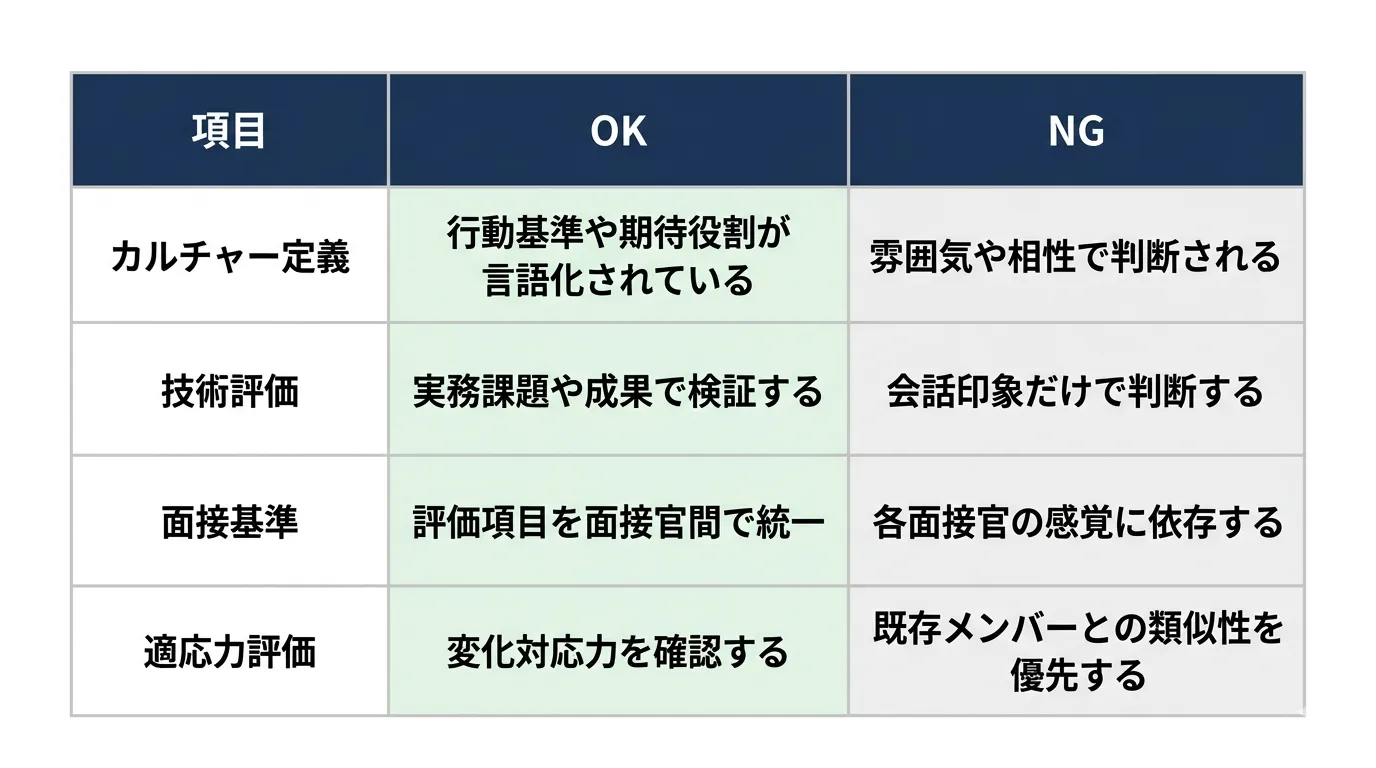


Hiring failures caused by focusing on culture
Focusing on culture fit itself is not the problem.
The problem is when culture is left vague and prioritized over technical evaluation.
In engineering hiring, this accelerates homogenization and weakens hiring power itself.
Homogeneity Is Reinforced
In organizations that keep hiring for culture fit, people similar to existing members are favored.
As a result, only candidates with similar thinking and communication styles gather, and diversity fades.
Especially in Japanese companies, traits like 'team-oriented,' 'reads the room,' and 'polite responses' tend to be highly valued, and 'reassurance' can be prioritized over technical strength.
But engineering teams need more than people who simply adapt to the current environment.
For new technology choices and development process improvements, they also need people who can challenge existing assumptions.
Even so, organizations that overvalue culture fit tend to exclude people who create a sense of discomfort.
This is especially true in mid-career hiring.
People who have worked in different development cultures are more likely to point out differences from existing rules, so they are often judged as 'not a culture fit.'
As a result, hiring may succeed, but organizational improvement stalls and only technical debt accumulates.
Moreover, in teams made up of members with similar values, problem-finding ability declines.
Even in reviews and design discussions, dissent becomes rare, leading to more quality incidents and decision-making errors.
Organizations That Avoid Dissent
As culture-fit bias grows, organizations shift into a structure that avoids friction.
In the short term this may look efficient, but in the long run it reduces adaptability to change.
For example, one development team hired by focusing on whether candidates would 'fit in with the team.'
Although technical test results varied, candidates with similar conversation pace and values were prioritized.
As a result, decision speed improved temporarily, but a few months later proposals to introduce new technologies dropped, and improvements to the existing architecture also stopped.
The background was an atmosphere of 'you'll stand out if you speak up.'
When fewer people in the organization voice objections, the quality of reviews and the depth of technical discussion decline.
In addition, junior engineers begin to conform to existing members, and improvement proposals disappear.
This is especially likely when the organization is built entirely through domestic hiring.
Because many candidates share similar educational backgrounds and corporate cultures, their values tend to converge.
As a result, hiring standards also become closed, widening the gap from the external market.
If the evaluation design is not clearly defined, the same hiring failures may happen again.
Common IT Company Pitfalls
Problems caused by overemphasis on culture fit show up not only in hiring philosophy, but also in day-to-day screening.
Especially in IT companies, prioritizing hiring speed often makes evaluation criteria vague, making it hard to judge both technical skill and organizational fit correctly.
As a result, companies end up able to hire “easy-to-talk-to” people, but not people who drive development results.
Technical screening becomes hollow
In hiring engineers, the real goal is to confirm “technical ability that can be reproduced on the job.”
But as hiring competition intensifies, teams lose the time to do enough technical screening.
As a result, the process moves forward with only portfolio reviews or brief interviews, and technical evaluation becomes a formality.
The biggest problem is that “ease of communication” becomes the focus of evaluation instead of “technical depth.”
For example, candidates may get high marks because they explain things fluently in interviews or naturally chat with current team members.
Meanwhile, even highly capable candidates can be disadvantaged if they speak Japanese slowly or come from different development cultures.
In this structure, “interview adaptability” is valued more than actual development results.
This is especially clear in global hiring.
Candidates from different cultural backgrounds or conversational styles can be misunderstood in short interviews and may not have enough time to explain their technical strengths.
In addition, Japanese companies often rely on the vague criterion of whether someone “seems like they can work with the team,” so interview impressions can outweigh technical test results.
As a result, technical gaps are discovered after hiring, increasing the burden on the team.
The management load the company wanted to avoid at hiring comes back later in a bigger form after the person joins.
Each interviewer uses different standards
The biggest reason culture-fit hiring fails is that evaluation criteria often depend on the individual.
Especially in IT companies, what makes a “good engineer” can vary widely by interviewer.
One interviewer may value communication skills, while another may place more weight on technical blogging.
Also, managers may prioritize “ease of team operation,” while CTOs focus on “technical growth potential,” so their perspectives often do not align.
When “culture fit” is judged in this state, interviews become highly subjective.
That is because “culture” itself is abstract and often used without a shared definition.
As a result, candidate evaluation shifts into vague impressions like “seems like a fit” or “feels off.”
This problem becomes even more serious when hiring overseas talent.
For example, candidates from cultures that encourage strong self-assertion are often judged in Japanese organizations as lacking teamwork.
Yet in reality, they may be able to deliver strong results in code reviews and design discussions.
In other words, overemphasizing culture fit does not mean choosing people who fit the organization; it often means choosing people current members can easily understand.
Related articles

In engineering hiring, technical interviews are the key screening step. Yet mismatches are common after joining—code reviews fail, or candidates cannot handle design work. The main causes are unclear evaluation criteria and too much reliance on potential-based judgment. This article breaks down why technical interviews fail and explains practical evaluation design and decision criteria to improve screening accuracy.
Prioritizing culture and skills
In engineering hiring, the debate over whether to prioritize culture or skills keeps coming up.
But the real problem is treating it as an either/or choice.
The key is to break it down and design which skills are required and which culture factors are adaptable.
Judge by repeatability
The top priority in hiring is whether results can be repeated.
In engineering hiring especially, you cannot judge practical ability correctly unless you verify what problems someone solved before and in what environment.
On the other hand, companies that overfocus on culture fit start with impressions like 'seems easy to work with'.
But this kind of assessment is hard to reproduce, and it does not consistently correlate with post-hire performance.
That is because interview impressions and the skills needed in real development work do not match.
For example, these abilities matter in development work.
Ability to organize unclear requirements
Ability to explain issues in reviews
Ability to prioritize during incidents
Ability to explain technical debt from a long-term view
These cannot be judged in a short small-talk interview.
So they should be evaluated through practical tasks and design reviews.
Also, culture adaptation should be judged not by whether personalities match, but by whether someone can adapt in behavior.
For example, responsiveness to asynchronous communication and adaptability to a documentation culture vary far more with work experience than with nationality or personality.
In other words, hiring design should not seek 'shared values'; it should use as the standard whether the behaviors needed to produce results can be repeated.
Break down adaptability
Culture fit should not be ignored entirely.
The problem is using the vague word 'culture' to judge multiple abilities at once.
In fact, the elements a company wants can be broken down in detail.
For example, all of the following are different abilities.
Ability to accept feedback
Ability to align on work priorities
Adaptability to document operations
Willingness to join team decision-making
Asynchronous communication skills
However, Japanese companies often bundle these together as 'culture fit,' which makes the criteria vague.
As a result, candidates are screened out simply because they 'feel off.'
This ambiguity becomes a major obstacle, especially in global hiring.
For example, candidates from cultures that speak from the conclusion first may be mistaken as 'too aggressive' in Japanese organizations.
On the other hand, in design reviews and incident response, that clear expression can be a major strength.
Therefore, in global hiring, the key is not to ask candidates to assimilate to our culture, but to define what behaviors are needed for the job.
If you cannot break the evaluation criteria down to the behavioral level, culture fit tends to function as nothing more than an exclusion standard.
Why domestic hiring alone is reaching its limits
The background to the continued focus on culture fit is an organization design built on domestic hiring.
But as the IT talent shortage worsens, it is becoming difficult to keep hiring only from the domestic market.
As a result, companies face a contradiction: they tighten hiring standards while also struggling to build a candidate pool.
Harder to Build a Candidate Pool
In engineering hiring, the number of candidates remains too low for the number of openings.
This is especially true for advanced IT talent, where hiring becomes harder in specialized fields such as cloud, AI, security, and data infrastructure.
In this situation, companies should normally clarify their evaluation criteria and define skill requirements.
However, the opposite is happening.
Fear of too few candidates makes companies lean harder toward “only people who fit our culture,” which further narrows the talent pool.
For example, if companies implicitly look for people who can communicate in a “Japanese-style” way or talk naturally with current team members, the range of candidates quickly shrinks.
This tendency is especially strong in startups and companies building in-house systems, where speed and team unity are often prioritized.
But in the overall hiring market, even top engineers have increasingly diverse work styles and values.
More candidates want full remote work, and more value being judged on results.
So if selection is based only on “closeness to the existing organization,” companies will lose out in the market.
As a result, the pool of hireable talent becomes fixed, and the organization’s technical growth also slows.
This is not just a hiring issue; it directly affects business competitiveness.
Hiring Competition Distorts Standards
In the IT talent market, competition among companies is intensifying.
In engineering hiring especially, large and foreign companies offer high salaries, flexible work styles, and global environments, making it hard for small and mid-sized domestic companies to stand out.
In this situation, companies should really evaluate “the ability needed to produce results,” but instead they tend to judge whether someone seems like a fit for their company.
That is because it is hard to gain an edge in a pure skills race.
However, this kind of judgment weakens an organization over the long term.
An organization made up only of people with the same values can no longer absorb new technologies or different development cultures.
And the more disadvantaged a company is in hiring competition, the more it starts using “culture” as a defensive line.
For example, behind the phrase “We value culture fit,” there are cases where poor preparation for cross-cultural adaptation or a weak evaluation design is actually hidden.
This is especially obvious when hiring overseas talent.
If job definitions and evaluation standards are unclear, it becomes impossible to accept people from diverse backgrounds.
As a result, companies that depend only on domestic hiring are more likely to lose hiring competitiveness.
In a market where building a candidate pool is difficult, companies need to design not only “who to hire,” but also “which market to hire from.”
Evaluation Design for Overseas Hiring
As it becomes harder to build a candidate pool through domestic hiring alone, more companies are considering overseas talent.
But if you use the same criteria as domestic hiring, selection accuracy drops sharply.
In particular, if culture fit is left vague, you can easily reject strong candidates for a mere “gut feeling.”
Do not judge by language skill alone
One of the most common mistakes in overseas hiring is overvaluing Japanese ability.
Of course, a certain level of communication is necessary.
But in engineering, “speaking fluency” and “ability to deliver results” do not always match.
For example, in design or code reviews, what matters is not natural Japanese, but whether the person can organize the issue and explain technical reasons.
Also, in organizations with solid documentation practices, asynchronous communication can matter more than live conversation.
In Japanese companies, however, the pace and atmosphere of an interview often strongly affect evaluation.
As a result, even highly skilled candidates may be rated lower because their Japanese phrasing sounds unnatural.
Overseas candidates, in particular, often think in English, so their explanation speed can drop in Japanese interviews.
Still, many perform very well on the job.
In fact, more global engineering teams are now running specs, design, and reviews mainly through English documents.
That is why overseas hiring should not ask, “Can they speak natural Japanese?” but rather, “Can they convey the information needed to do the job?”
Once language skill is used as a proxy for culture fit, hiring accuracy quickly declines.
Define the work structure first
In overseas hiring, you must first define how the work will be done.
This is because the less clear the work structure is, the more an organization relies on culture fit.
For example, Japanese companies may implicitly expect people to “read the room” and act accordingly.
But in global settings, that assumption does not hold.
If you do not clearly define task scope, decision makers, review standards, and reporting methods, the work itself becomes unstable.
Especially in engineering teams, you should define the following in advance:
Who finalizes the specs
What the review approval criteria are
What level of detail to keep in documents
Who has authority during urgent incidents
How to use English and Japanese
If you hire before making these clear, the issue gets reframed as “culture mismatch.”
But in reality, it is often a lack of organizational design, not a candidate problem.
In overseas hiring, before asking whether someone can adapt to your company culture, you need to check whether your work structure lets anyone succeed.
If you cannot organize the work design before the evaluation design, retention will not stabilize, even if you hire diverse talent.
Design varies with global hiring
In overseas hiring, whether your organization can accept talent matters more than simply hiring them.
Especially for engineers, if evaluation, work design, and management design are not aligned, friction often appears after hiring.
So global hiring requires more precise organizational design than domestic hiring.
Acceptance design is critical
In overseas hiring, success is not defined by an offer being accepted.
It is only successful when the design enables the person to deliver results after joining.
However, some Japanese companies still operate on the idea that “we adjust after hiring at the site.”
In this state, responsibility for onboarding becomes vague, and the burden on the team rises sharply.
In engineering organizations especially, understanding specs and sharing business context take time.
Even so, if people are accepted without clear role definitions or proper documentation, they may be judged as “unable to work independently.”
In reality, the work structure is often a black box.
Also, in global hiring, onboarding itself becomes part of evaluation design.
For example, organizations that clearly define review rules and decision flows make it easier for people from diverse backgrounds to adapt early.
By contrast, organizations that assume people will “read between the lines” create more misunderstandings.
As a result, people conclude that “the culture is not a fit,” but in reality the issue may be poor acceptance design.
In other words, global hiring requires designing not only candidate evaluation, but also whether the organization can explain itself clearly.
Evaluation criteria need translation
In global hiring, the criteria themselves need to be translated.
Here, translation does not mean language translation only.
It means making “what counts as results” a shared understanding across cultures.
For example, Japanese companies often use the word “initiative”.
But the term is very vague.
It may mean proposing ideas independently, or simply anticipating needs and acting ahead of time.
If you hire overseas talent with this vague standard, the evaluation criteria will not match.
The candidate may think they are delivering results, while the company decides they are “not what we expected.”
So in global hiring, you need to define behavior in concrete terms like these:
How many hours within should a review request be made?
Who should be informed when specs change?
Which meeting should technical proposals be made in?
How far should participation in decisions extend?
The more an organization can spell these out, the easier it is to accept diverse talent.
On the other hand, organizations that use “culture fit” in an abstract way repeat evaluation mismatches.
Especially in advanced talent areas such as engineering, design difficulty changes greatly depending on the countries and markets you target, so you need to decide which market to choose as well.
Why hiring Indian talent is an option
When considering overseas hiring, the key is deciding which country’s talent to hire from.
Especially for engineers, the difficulty of hiring design changes greatly depending on talent supply, skill level, and the level of hiring competition.
Phinx supports cross-border hiring of Indian talent, and this article summarizes practical insights from that work.
A large talent pool helps offset domestic shortages
In Japan’s IT labor market, the engineer shortage has become a structural issue.
In fields such as cloud, AI, backend, and data, it is becoming difficult to build a candidate pool with the required skill level.
India, on the other hand, is a market with an extremely large supply of advanced IT talent.
Each year, many science and engineering graduates enter the market, and there is also a strong pool of engineers with experience developing for global companies.
As a result, it is easier to build a hiring pool that cannot be formed within Japan alone.
India also has widespread remote development, multinational development, and English-based specification handling.
This makes it a good fit when Japanese companies move toward a global development setup.
One especially important point is that it can change the idea of “culture fit” itself.
In organizations that mainly hire domestically, familiarity with existing members is often valued.
But when hiring Indian talent, operations will not work unless job definitions and performance standards are clearly documented.
As a result, the organization must also build a work structure that anyone can understand.
This is not just a change in hiring method; it leads to a redesign of how the organization runs.
A strong fit for technical screening
One reason Indian talent hiring is getting attention in engineering is its fit with technical screening.
In global markets especially, what matters more than “which company you worked for” is “what you can build.”
For that reason, cultures that evaluate based on deliverables are widespread, such as coding tests, GitHub, algorithm tasks, and system design interviews.
This stands in contrast to the “overemphasis on culture fit” often seen in Japanese companies.
For example, in Japanese companies, interview responses and general atmosphere can strongly affect evaluation, while in Indian talent hiring, designing the process around technical tasks makes it easier to standardize criteria.
As a result, it becomes easier to choose not “the person who is easiest to talk to,” but “the person who can reproduce results.”
Also, because competition in the Indian market is very intense, it has a strong culture of continuous learning.
For companies that value adaptation to new technologies and quick ramp-up, this can be a strong match.
However, successful companies share one thing in common.
They do not ask people to work the same way Japanese employees do; they clearly define the behavioral standards needed to produce results.
The more a company manages culture fit by intuition, the more likely it is to fail in global hiring.
Related articles

In hiring Indian engineers, it is risky to judge university tiers only by academic scores. This article uses local data to explain Tier 1 (led by IIT), the talent-rich reality of Tiers 2/3, and which talent segments Japanese companies should target and how they view careers.
Summary
Overemphasis on culture fit in engineer hiring is not just a hiring-method issue; it is an evaluation-design issue.
Especially as the IT talent shortage worsens, the more you prioritize “whether they seem like a fit,” the more likely you are to shrink your candidate pool and create a more homogeneous team.
As a result, technical dissent and improvement ideas often decrease, leading to lower development productivity and growing technical debt.
The key is not to leave “culture” as an abstract concept.
For example, you need to organize evaluation criteria around reproducibility of results, define the behaviors required for operations, and reduce judgment differences between interviewers.
In global hiring, the focus should not be on making candidates “adopt our culture,” but on designing a structure where they can deliver results.
At the same time, fully building this in-house is not easy.
If hiring standards become person-dependent, interview quality becomes unstable and reproducibility is lost.
In global hiring, you also need a design that covers technical evaluation, English operations, visa support, and onboarding, so there are limits to what the on-site team can handle alone.
Phinx is made up of members who have built engineering organizations in global companies such as Rakuten and Mercari, and we support not just recruiting, but the hiring design itself.
Using a network of Tier 1 to Tier 3 universities, including the Indian Institutes of Technology (IIT), we provide end-to-end support from technically informed screening to visa and COE handling, selection design, and onboarding setup.
We are especially able to help with issues such as “We value culture fit, but our hiring accuracy is not improving” or “We want to hire overseas talent, but we do not know how to design the evaluation criteria.”
If you are facing organizational stagnation from homogeneity in engineer hiring, or challenges in evaluation design for global hiring, please contact Phinx.
[Sources]
・Ministry of Economy, Trade and Industry: Survey on IT Talent Supply and Demand
https://www.meti.go.jp/policy/it_policy/jinzai/houkokusyo.pdf
・IPA DX White Paper
https://www.ipa.go.jp/publish/wp-dx/
・Stack Overflow Developer Survey
https://survey.stackoverflow.co/
・NASSCOM Official Website
https://nasscom.in/
・India Skills Report
https://wheebox.com/india-skills-report/
・World Economic Forum Future of Jobs Report
https://www.weforum.org/reports/the-future-of-jobs-report/

Latest Articles

Stay up-to-date
Related articles

Why AI Agent PoCs Fail and Enterprise Design Essentials

Is FDE Viable for Japanese Firms? SES Differences & Setup

India New Graduate Starting Salary and Annual Income 2026 | CTC Structure and Offer Design

Stricter Visa Rules for Dispatched Engineers in Japan (2026)