Why companies that demand too much Japanese from engineers fail

In engineer hiring, demanding too much Japanese ability is causing companies to miss highly skilled candidates, which is raising both hiring difficulty and team workload. This article explains the Japanese-language requirement structure companies often misjudge, and shows how to set the right level for the job and decide on overseas hiring.
Contents
※Please be noted that this blog is translated automatically by AI
Why Japanese language requirements make hiring harder
In engineering hiring, the moment you set “must be able to converse in Japanese without issue” as a prerequisite, the candidate pool shrinks sharply.
Especially in backend, SRE, AI, and data roles, candidates with strong technical skills are often spread across English-speaking environments, and overemphasizing Japanese ability only intensifies hiring competition.
The issue is not whether Japanese is needed, but that hiring requirements are defined before breaking down which tasks need it and to what level.
Japanese requirements narrow the pool
Many companies list “Business-level Japanese required” in engineering job openings.
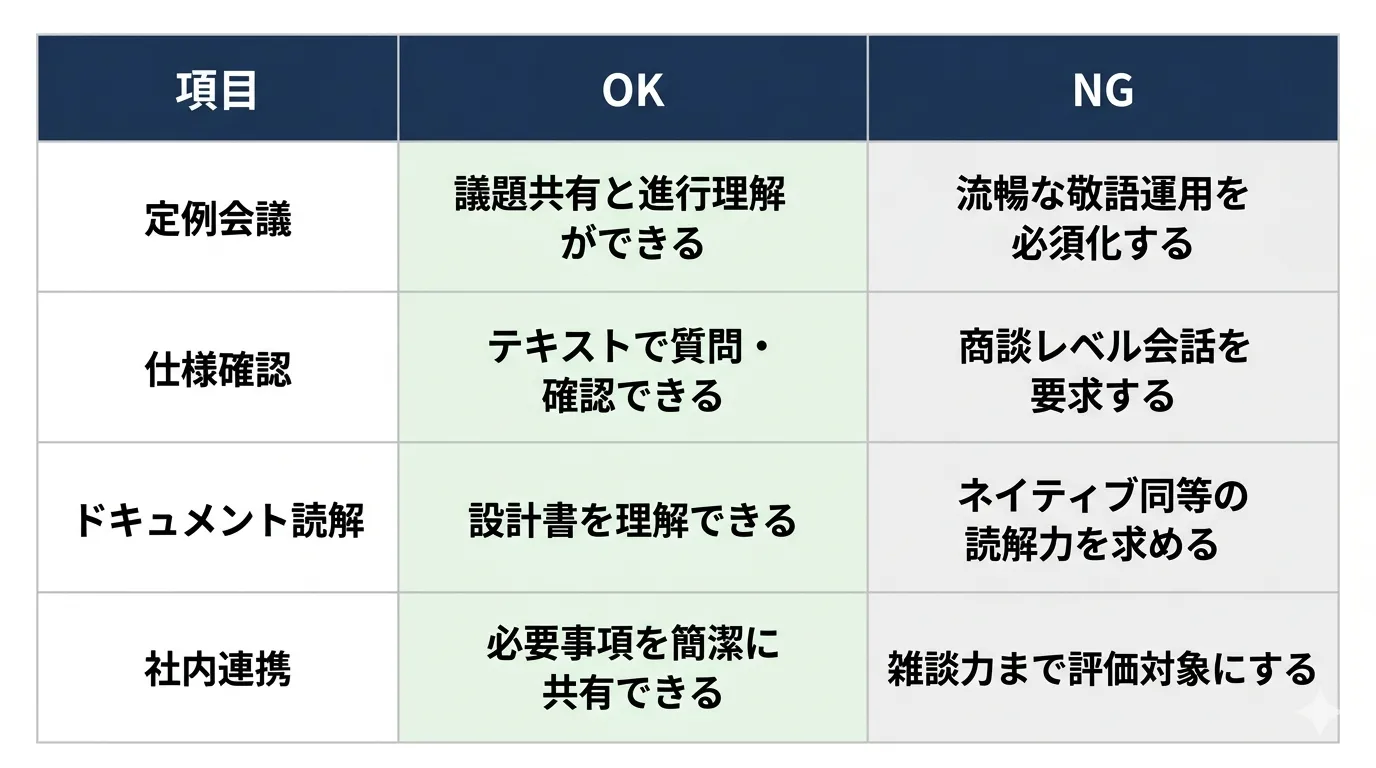
In practice, daily work usually only needs spec checks, text communication, and meeting attendance; advanced keigo or sales-level Japanese is rarely needed.
The problem is that setting unnecessary Japanese requirements causes strong technical candidates to drop out at the application stage.
Foreign engineers, in particular, tend to interpret language requirements strictly.
So the phrase “Business-level Japanese required” alone often makes them assume they are unlikely to qualify and skip applying.
As a result, companies often attract mostly candidates with strong Japanese but weaker technical skills.
This not only lowers hiring success, it also leads directly to technical debt after onboarding.
On the team, review quality does not improve, design discussions stay shallow, and the burden on existing members grows.
In especially competitive fields, the very design of screening people out by Japanese ability becomes a factor that breaks candidate sourcing.
The risk of judging technical and sales roles by the same standard
In Japanese companies, it is common to apply the same Japanese standard to all roles.
However, the language skills needed for sales and engineering are fundamentally different.
In sales, quick conversation handling, understanding customer emotions, persuasive wording, and negotiation directly affect results.
In engineering, most work proceeds through asynchronous communication and documents.
In other words, what is needed is not “advanced conversation skill,” but “not misreading specs” and “being able to communicate required points accurately.”
If you confuse the two, hiring evaluation shifts away from technical skill and toward “speaking fluently.”
Then in interviews, candidates who can chat in Japanese get high marks, while actual development ability and design skill are left untested.
In real workplaces, some people speak very fluent Japanese but still produce poor code reviews and cannot join design discussions.
Conversely, some engineers have limited Japanese but achieve strong results through communication on GitHub and reading technical documentation.
What matters is not “hiring people who are good at Japanese.”
It is defining the language ability needed to do the job, and not turning anything beyond that into an excessive requirement.
If evaluation criteria are vague, the same mismatch is likely to happen again.


The reality of "Japanese language skills" that Japanese companies often misunderstand
In Japanese companies, Japanese ability is often treated as one single skill.
In reality, it is made up of several skills: speaking, reading, writing, understanding meetings, and reading emotions.
If these are not separated before becoming hiring criteria, standards become vague and hiring mismatches happen.
Speaking skill and job performance are different
In interviews, Japanese fluency has a strong effect on evaluation.
So candidates who speak smoothly are often seen as likely to adapt well.
But for engineering work, what really matters is not speaking skill itself.
For example, in backend development, the needs are understanding specs, analyzing logs, handling code reviews, and managing issues.
Here, the key skill is not instant conversation, but the ability to avoid misunderstanding technical context.
In other words, even if daily conversation is fluent, development quality will not stay stable if design docs cannot be read accurately.
On the other hand, even with some unnatural Japanese speaking, engineers who can read technical documents accurately and organize needed points in text deliver strong results.
Especially in global development environments, work is often centered on asynchronous communication through Slack, Notion, and GitHub, so 'spoken fluency = job performance' does not really hold.
Even so, in Japanese companies, things like 'can make small talk' or 'can read the room' tend to mix into evaluation, which weakens technical assessment.
This is not only because hiring standards are vague, but also because the skills needed on the job are not clearly defined.
The mistake of focusing only on weak reading skills
When hiring non-Japanese engineers, people often worry that weak Japanese reading will cause accidents.
It is true that misreading specs and gaps in understanding can delay development, so basic reading skill is necessary.
But the problem is treating reading weakness only as the candidate's issue.
In reality, Japanese companies also have major problems in document design.
Spec changes are shared only by word of mouth.
Important information is not kept in meeting logs.
Design docs use inconsistent terms depending on the owner.
In such an environment, even Japanese engineers will have misunderstandings.
At one development site, foreign engineers were judged to be struggling with spec understanding.
But after investigation, spec changes had only been updated in verbal meetings, and no latest document existed.
As a result, Japanese members also did not share the same understanding, and review send-backs happened often.
In other words, some issues that look like language problems are really defects in information-sharing design.
If you try to improve only Japanese ability without this view, hiring standards become stricter, but organizational problems remain unsolved.
Related articles

When considering hiring Indian IT engineers, the biggest debate is how to set the Japanese language requirement. On April 15, 2026, the screening guidelines for the Engineer/Specialist in Humanities/International Services visa were officially revised, and applicants mainly doing language-related work now need proof of CEFR B2 (equivalent to N2). However, it has been officially confirmed that technical roles such as IT engineers are not directly covered. Legal requirements and the Japanese skills actually needed on the job do not always match. This article examines the N2 standard from the perspective of real workplace needs. [Updated April 15, 2026]
Team breakdown caused by overvaluing Japanese proficiency in hiring
Hiring that prioritizes Japanese ability may seem to secure people who communicate easily in the short term.
But when technical checks and job-fit evaluation are weak, the burden on the team spikes after onboarding.
In engineering orgs especially, if hiring criteria stay vague, the on-site manager often ends up absorbing the coordination cost.
The On-site Manager Turned Interpreter
Even when Japanese skill is valued, there are many cases where work communication still fails.
The reason is that being able to speak Japanese and understanding development work are different things.
For example, someone may handle small talk and casual conversation well, but lose track once the discussion turns to design.
They lack the background knowledge for technical terms, so the problem is domain understanding, not language.
But on the ground, this is often mistaken as 'they are foreign, so their Japanese is weak.'
As a result, the manager starts adding context in every meeting, reorganizing issues, and translating specs.
Time that should go to decisions and technical reviews is spent on communication support.
In one development org, several engineers hired for their Japanese ability joined the team.
At first they were seen as easy to talk to and reassuring.
But after assignment, weak review input and shallow design understanding surfaced, and the Tech Lead had to break down tasks and add spec details every day.
As a result, review backlogs built up and release delays became routine.
What matters is not Japanese ability itself, but verifying before hiring who can understand what information, and in what format.
If this stays vague, the team keeps paying the operating cost.
A Structure That Fails to Spot Weak Technical Skills
In organizations that rate Japanese ability highly, interviews tend to drift toward a pure conversation test.
As a result, the technical checks that should be the priority become shallow.
What needs special caution is the assumption that smooth answers in Japanese equal competence.
The more fluent the candidate, the more secure the interviewer tends to feel.
Then design depth and implementation judgment are not tested enough, and you end up hiring people who can talk but cannot build.
On the other hand, highly technical candidates can be disadvantaged in Japanese interviews.
They may seem slow because they take time to structure careful answers, or need longer to respond to abstract questions.
But in practice, they may deliver strong code quality and system design.
If this continues, the organization locks into rewarding people who are good at Japanese.
That creates a culture that values conversation fit over technical skill, and engineering competitiveness declines.
Especially in advanced talent areas like engineering, the difficulty of design and hiring changes a lot by target country and market, so decisions should include which market to choose.
Related articles

Hiring engineers, including talent from India, can be an effective move. But when you cannot build a strong candidate pool, offer standards may be lowered, leading to cases where new hires fail code reviews after joining. In this article, we sort out the structural reasons candidates do not gather and explain, from a practical perspective, how to set a candidate-pool strategy and redesign it, including overseas hiring.
Why domestic hiring alone is hard to solve
The reason for tightening Japanese requirements in engineering hiring is the aim to secure talent that is easy to manage in domestic hiring.
However, in today's market, candidates who can meet both strong Japanese and advanced technical skills are extremely competitive.
As a result, the stricter the Japanese requirement, the lower the hiring success rate.
Limits of Competition in Hiring Japanese Talent
In the domestic engineering market, competition for experienced talent is intensifying.
Especially in cloud, AI, data infrastructure, and SRE, it is now common for candidates to receive offers from multiple companies at once.
In this environment, if you target only candidates who meet all of these—"high technical skill," "strong Japanese ability," and "culture fit"—you can no longer build a sufficient candidate pool.
In addition, since many Japanese companies set similar hiring conditions, it becomes hard to stand out from the candidate's perspective.
As a result, candidates concentrate on companies with stronger brand recognition or pay.
Meanwhile, mid-sized and growth-stage companies see lower resume pass rates and higher interview drop-off rates.
Companies that emphasize "Japanese ability" in particular tend to be at a disadvantage in candidate comparisons.
The reason is clear.
Engineers with strong Japanese skills have more job options in Japan.
In other words, companies that strongly require Japanese end up competing for a limited pool of talent.
If you tighten hiring requirements without understanding this structure, it is easy to fall into a vicious cycle: "fewer applicants, so we raise the bar again."
The Rising Price of Engineers
When hiring competition intensifies, companies start differentiating through pay.
As a result, the market value of talent with both Japanese ability and technical skill rises quickly.
In foreign-affiliated companies and large startups, hiring can be based on an English environment, so Japanese ability is not a must.
This allows them to focus compensation on "technical skill."
By contrast, companies that value Japanese ability end up paying a premium for both "technical skill + Japanese communication ability."
In other words, the higher the Japanese requirement, the more hiring costs tend to rise.
But the problem is that even higher costs do not guarantee hiring success.
Especially for startups and mid-sized companies, it is not realistic to keep winning through pay alone.
That is why it becomes important to redesign which tasks actually require Japanese, and broaden the target candidate pool.
There is a limit to optimizing only within domestic hiring.
That is why more companies are now expanding the hiring market itself.
However, overseas hiring is not just about increasing the number of target countries; it also requires rethinking language design and the basic assumptions of organizational operations.
Language requirements change in overseas hiring
In global hiring, simply looking for “someone who can speak Japanese” is not enough.
What matters is organizing the language skills needed by task and changing the communication design itself.
In engineering teams especially, optimizing language requirements greatly expands the hiring pool.
Break language requirements down by task
Companies succeeding in global hiring define language requirements by task, not by job title.
In other words, they break it down by which tasks need Japanese, and to what level.
For example, Japanese meeting participation may be needed in the requirements phase, but implementation may be manageable mainly in text.
Also, in backend roles without customer interaction, reading and text communication may matter more than speaking.
If you do not organize this and make “business-level Japanese required for all,” the number of eligible candidates drops sharply.
On the other hand, separating standards by task can greatly expand the target market.
In practice, global development teams separate responsibilities like this:
Meetings in Japanese
Documents in English too
Pull Requests in English allowed
Only customer-facing roles need high Japanese
Slack operated with translation in mind
By sorting who needs what Japanese ability, you can lower hiring difficulty while maintaining development quality.
The key is not to treat Japanese proficiency as a uniform requirement.
Defining it by task makes hiring workable in practice.
Reduce synchronous communication
In global hiring, assuming real-time conversation increases operational load sharply.
Therefore, many global organizations are designed to reduce dependence on synchronous communication.
For example, Japanese companies often rely on meetings and verbal sharing first.
But in this setup, members with weaker Japanese face higher information access costs.
As a result, speaking opportunities shrink and misunderstandings pile up.
In contrast, in async-centered organizations, information becomes text.
Spec changes are recorded in Notion, turned into issues, and review history remains.
Then the ability to track information matters more than quick conversation skills.
This is not only effective for foreign talent.
It also helps Japanese members by reducing information silos and improving review quality and repeatability.
In short, global hiring requires more than strengthening Japanese education.
It means changing the organization’s information design and reducing language dependence.
As a result, the hiring pool expands and access to high-level talent becomes realistic.
Why is India gaining attention for hiring highly skilled IT talent?
When considering overseas hiring, the key is not "which country can we hire from?"
It is to identify which market fits your technical requirements, language design, and organizational stage.
Especially in the advanced IT talent field, hiring difficulty changes greatly depending on supply and the technical environment.
Supply differs greatly from the domestic market
Phinx supports cross-border hiring of Indian talent, and here we summarize practical insights from that work.
One of the main reasons the Indian market attracts attention is the scale of engineer supply.
In Japan, the pool of experienced talent in advanced IT fields is limited.
Competition is especially intense in AI, cloud, data infrastructure, and backend roles.
In India, large numbers of science and engineering talent enter the market every year.
There is also a deep pool of engineers with global company development experience, and many candidates have worked in English-based environments.
What matters here is that this does not mean "everyone is excellent."
In reality, skill levels vary widely by university tier and work experience.
However, compared with the Japanese market, it is easier to build a candidate pool for specific technical areas.
In particular, for the "3–5 years of experience, ready-to-work" level that Japanese companies often struggle to hire, requirements that are hard to meet domestically can become realistic in overseas markets.
In other words, the reason the Indian market stands out is not simply "because it is overseas," but because the supply structure for advanced IT talent is different.
Compatibility with English-based development environments
Another major factor is compatibility with English-based development environments.
Many Indian engineers work with technical documents, OSS, API specs, and cloud products in English.
As a result, they tend to fit well with English-based asynchronous communication.
This does not simply mean "can speak English."
The key is the lower cost of adapting to global development operations using GitHub, Slack, Notion, Jira, and similar tools.
On the other hand, if a Japanese company assumes fully Japanese operations, it cannot make use of this strength.
Especially when "native-level Japanese" is required, highly skilled candidates may choose markets other than Japan.
Therefore, in actual cross-border hiring, it is important to first sort out how much Japanese is really needed and adjust the organization's operating design accordingly.
Especially for engineering teams, introducing bilingual documentation and asynchronous communication greatly expands the markets you can hire from.
In other words, the essence of hiring in India is not simply "hiring foreigners."
It is about redesigning the organization so you can access the advanced IT talent market.
Summary
The issue of Japanese-language requirements in engineering hiring is not just about language skills.
The key is whether you have designed which tasks require what level of communication ability.
If hiring proceeds while this remains vague, Japanese ability is overvalued and technical evaluation weakens.
As a result, it lowers overall productivity through more review work, misunderstandings, and development delays after joining.
The following three points are especially important.
Break down the Japanese level needed by task
Evaluate technical skill and speaking ability separately
Design information flow for asynchronous communication
If these are not organized, hiring requirements only get stricter, and a viable candidate pool cannot be built.
Also, organizations that place too much emphasis on Japanese tend to depend on frontline managers and ad hoc operations, making it harder to build a repeatable hiring system.
In the highly skilled IT talent market, it is difficult to keep meeting requirements through domestic hiring alone, so a view that redesigns the hiring market itself is needed.
Phinx, led by members with experience building global organizations such as Rakuten and Mercari, supports cross-border hiring of Indian talent.
Using Tier 1 to Tier 3 university networks, we provide end-to-end support from technical screening to VISA/COE handling, selection design, and onboarding.
Rather than simple staffing, we support hiring design at a practical level, including which language requirements make the hiring market viable.
If you are unsure whether to lower Japanese requirements, are considering overseas hiring but do not know how far to shift to English operations, or want to organize standards for technical and communication evaluation, please contact Phinx.
【Sources】
・Ministry of Economy, Trade and Industry: Survey on IT Talent Supply and Demand
https://www.meti.go.jp/policy/it_policy/jinzai/houkokusyo.pdf
・IPA DX White Paper 2025
https://www.ipa.go.jp/publish/wp-dx/
・Stack Overflow Developer Survey
https://survey.stackoverflow.co/
・GitLab Remote Work Report
https://about.gitlab.com/remote-work-report/
・World Bank Data - India Population
https://data.worldbank.org/
・NASSCOM Insights
https://nasscom.in/knowledge-center

Latest Articles

Stay up-to-date
Related articles

Why AI Agent PoCs Fail and Enterprise Design Essentials

Is FDE Viable for Japanese Firms? SES Differences & Setup

India New Graduate Starting Salary and Annual Income 2026 | CTC Structure and Offer Design

Stricter Visa Rules for Dispatched Engineers in Japan (2026)