India hiring: document screening challenges and CV screening improvements

In hiring Indian talent, document screening pass rates are often high, yet many hires fail post-joining reviews and increase team workload. The root cause is a mismatch between CV reading and evaluation criteria. This article explains India-specific resume conventions and structural gaps in screening, then presents practical decision criteria and improvement design.
Contents
※Please be noted that this blog is translated automatically by AI
A system where document screening fails
Document screening often fails in India not due to poor reviewer skill, but because the evaluation model still assumes Japanese hiring norms.
Without fixing this structural mismatch, screening accuracy will not improve.
Why Japanese-style evaluation does not work
In Japan, resume screening infers consistency from company names, education, and steady career history. In India, careers are more fluid, and short stints across multiple firms are common, so this assumption breaks down.
As a result, judging by tenure or employer brand alone can pass candidates with limited hands-on work while overlooking practitioners with strong real experience.
Gap in information volume and detail
Indian CVs are often information-heavy, listing broad tech stacks and project experience, but they frequently blur how much the candidate actually contributed.
For example, in team projects, design, implementation, and testing may all be listed even if the person handled only one part. Missing this detail gap leads to overestimating skills.


Causes of misreading CV
The failure of document screening is not just lack of information, but misreading.
Especially, unconscious evaluation bias in Japanese firms distorts CV interpretation.
Misuse of academic background bias
In India, Tier 1 graduates are often strong, but many Tier 2 and below candidates also have high practical skills, so screening only by school greatly lowers accuracy.
Conversely, passing someone only for a Tier 1 degree can lead to poor coding-test basics and a rating drop before the final interview.
In short, education indicates potential ceiling, not on-the-job reproducibility; misuse comes from ignoring this difference.
Overtrust in project descriptions
Many CVs list multiple projects in detail, so they are often treated as proof of ability, but many are just lists with unclear scope and responsibility.
For example, even if it says "E-commerce system development," difficulty differs greatly depending on whether they designed APIs or only made simple UI fixes; if this is missed, they may be unable to explain anything in design reviews after joining and stall.
So, focus not on project count, but on which process they can reproduce independently.
India-specific resume format
Indian CVs differ greatly in format from Japanese ones, so reading them without this context can cause misunderstandings.
In particular, how "results," "roles," and "technologies" are written is distinctive; misreading these lowers evaluation accuracy.
Unclear separation of results and role
In Indian CVs, project outcomes are often emphasized while the individual role remains vague, mixing team results with personal contribution.
For example, even if it says "Improved payment system performance and increased processing speed by 30%," the evaluation changes greatly depending on whether the candidate led bottleneck analysis or only handled testing, yet this distinction is often omitted.
So, read it not as results alone but from the viewpoint of whether the person can reproduce those results.
Overlisting of tech stack
Many CVs list all technologies used, making the skill set look broad, but practical depth is not guaranteed.
Even if Java, Python, React, and AWS are listed, it is often unclear whether each was used continuously in real work or only touched briefly; evaluating as-is risks misjudging someone as full-stack.
Therefore, instead of counting technologies, separate "technologies used continuously in recent work" from "one-off experience" when interpreting.
Common traits of companies you can’t read
The issue is not only with CVs; there are shared flaws in how companies design evaluations.
In particular, the lack of clear criteria and interview-first operation reduce document screening accuracy.
Evaluation criteria are not verbalized
Many companies rely on implicit judgment like "pass if they seem good," without defining what level of skill or reproducibility to assess.
As a result, one reviewer passes a CV just for a GitHub link, while another rejects a similar CV, causing inconsistency and loss of screening reproducibility.
Also, if the applicant pool grows while criteria stay vague, only interview volume rises, sharply increasing review load on engineers.
Document pass based on interview assumption
When pass rates are set high on the assumption that documents alone cannot decide, the screening function itself becomes hollow.
In practice, cases occur where over 50 candidates reach first interviews, yet most fail basic coding tasks, and only selection workload increases.
In this state, document screening is no longer a "filter" but just a "pass-through step," significantly lowering hiring efficiency.
If it is unclear at which stage assessment is failing, the whole hiring process should be broken down and reviewed once.
On-site failure patterns
If hiring proceeds with low resume-screening accuracy, problems will surface on-site.
They often appear after joining or assignment as a "gap from expectations," so you must understand failure patterns in advance.
Post-hire reviews do not pass
A candidate may be hired as job-ready based on multiple development experiences on paper, but once given tasks, they cannot explain design intent and keep getting review rejections.
For example, a candidate claiming API design experience was assigned endpoint design, but did not understand naming rules or responsibility split; reviews were sent back 3+ times, and a senior engineer ultimately rewrote everything.
This is a typical case of mistaking "involvement experience" for "repeatable skill."
Cannot function in team development
A hire may look strong in solo development, yet in team development fails at task breakdown and communication, often disrupting project progress.
When put into a sprint, they may not grasp ticket granularity, start late, and delay review requests, affecting the whole release schedule.
Such failures come from misreading "project experience" on a CV as team-development skill.
Screening criteria design
To make resume screening work, you must design not only evaluation criteria but also a clear pass line.
Especially in India hiring, accuracy is more stable when you split evaluation by technical depth and reproducibility, then adjust criteria by Tier.
Break down by technical skill and reproducibility
Because a CV is a list of experiences, do not evaluate it as-is; judge whether results are reproducible.
For example, even if it says “React experience,” evaluation differs greatly depending on whether the person can design state management or only implement simple UI. Separating technical skill and reproducibility helps prevent overrating.
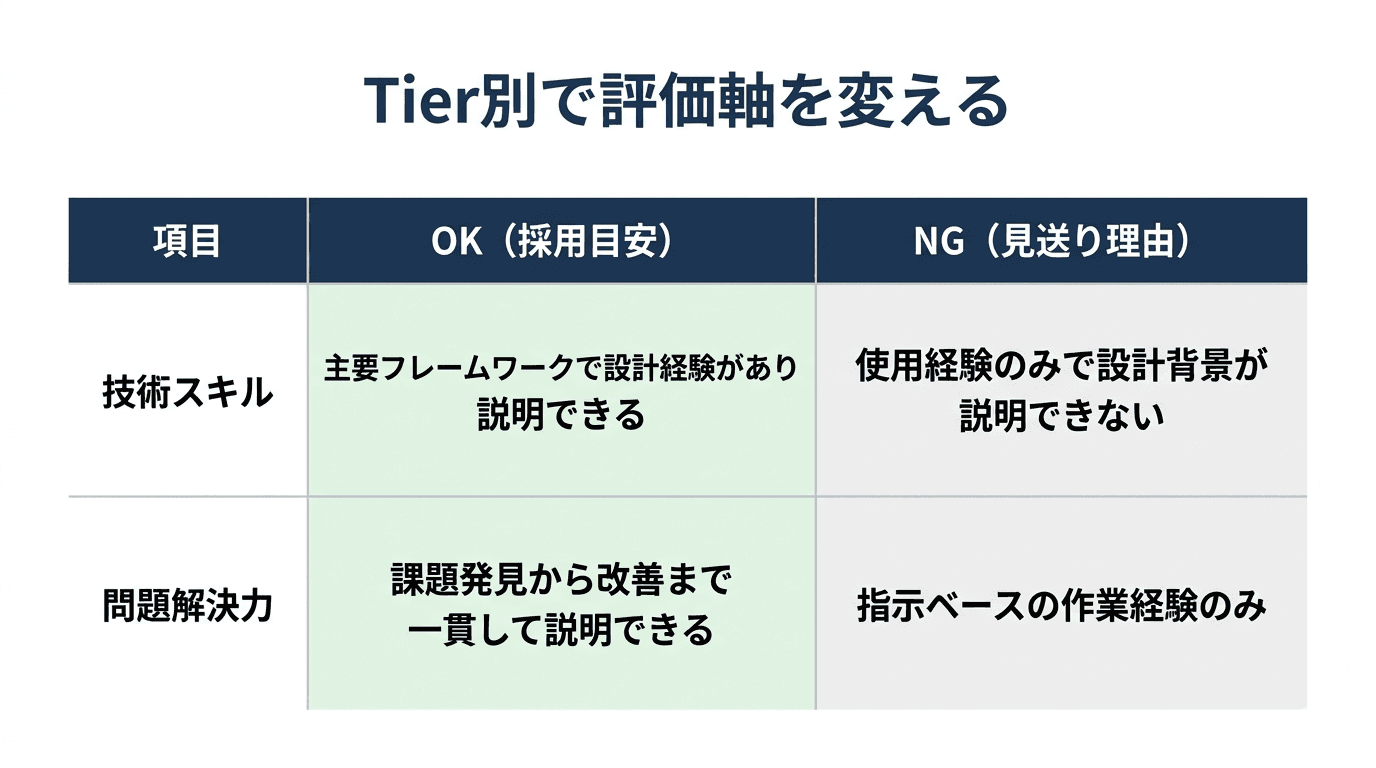
Change criteria by Tier
Tier1 and Tier2 have different evaluation assumptions, so using one standard creates mismatch.
Tier1 is highly competitive and high-potential but may have limited practical experience, so prioritize reproducibility. Tier2 has wider variation, so accuracy improves by emphasizing depth and continuity of practical experience.
Design a concrete pass line for document screening
Criteria alone will not align decisions; operations remain unstable unless you define a pass line.
For example, set clear conditions such as: “Pass only if the candidate has at least two reproducible technical skills and handled key phases in a recent project.” This reduces reviewer-by-reviewer variance.
In short, the prerequisite for effective document screening is not just deciding “what to evaluate,” but defining “where to pass.”
Related articles

Global tech firms compete fiercely for Indian talent not just for demographics, but for a unique education system and intense competition. This article analyzes Tier 1 universities and the latest hiring market data.
Practical improvement methods
Designed standards only work when embedded in operations.
Most important is linking CVs with the hiring process so improvement can be measured.
Linking CVs and Tests
If resume screening and technical tests are separate, evaluation consistency breaks.
For example, if a candidate passes a CV review for “backend design experience,” the test must also assess design ability; otherwise criteria become misaligned.
In practice, always set tasks tied to skills confirmed in the CV and verify reproducibility to prevent gaps between documents and real performance.
Monitoring Pass Rates
Resume screening should be managed by numbers, not intuition.
By breaking down “resume pass rate,” “first interview pass rate,” and “test pass rate,” you can see where accuracy drops.
When the resume pass rate is too high, later test pass rates often fall sharply, hurting overall hiring efficiency.
So regularly review pass rates at each stage and fine-tune criteria to build a repeatable hiring process.
Summary
In India hiring, document screening is not just filtering; it is a key step that determines overall hiring accuracy. Results depend on whether CV reading and evaluation criteria are designed in a structured way.
The three essentials are: assess by breaking down skills and consistency, switch criteria between Tier1 and Tier2, and clearly define the pass line.
Only with these in place can you judge job fit at the document stage.
However, building this internally requires understanding India-specific resume formats and technical evaluation know-how, and relying on individual experience cannot ensure consistency.
Hiring accuracy changes greatly depending on whether you can screen down to differences in university level and practical applicability of tech stacks.
If you have direct ties with Indian universities, can compare talent pools across Tier1 to Tier3, and can design screening based on technical understanding, CV-stage judgment accuracy improves significantly.
Also, if you can run everything end-to-end from selection design to VISA support, post-hire risk is easier to reduce.
If your company is unsure about criteria design or operations, one option is to bring in external expertise and review the structure.
Improving document screening accuracy ultimately raises overall hiring efficiency and success rates.
[Source]
・India Skills Report 2024
https://wheebox.com/india-skills-report/

Latest Articles

Stay up-to-date
Related articles

Why AI Agent PoCs Fail and Enterprise Design Essentials

Is FDE Viable for Japanese Firms? SES Differences & Setup

India New Graduate Starting Salary and Annual Income 2026 | CTC Structure and Offer Design

Stricter Visa Rules for Dispatched Engineers in Japan (2026)