Prevent Indian offer dropouts | Why accepted offers are withdrawn and what to do

Hiring Indian graduates and mid-career talent helps secure top performers, but many withdraw after accepting offers, disrupting project plans. The root issue is a flawed process that treats offer acceptance as a final decision. This article outlines why post-acceptance withdrawals happen, how candidate psychology shifts, and practical hiring process and operational actions to prevent them.
Contents
※Please be noted that this blog is translated automatically by AI
Withdrawals after acceptance
In India hiring, treating offer acceptance as a final decision will fail.
The market itself works on the premise that comparison continues even after acceptance.
Offer acceptance is not the end of decision-making
Many Japanese companies see acceptance as the candidate’s final decision. But for Indian talent, it is only provisional, and parallel interviews and offer comparisons continue.
In practice, after receiving an offer, candidates often move to final interviews elsewhere and, after getting better pay or growth opportunities, decline within 3 days to 1 week. Companies often lack follow-up plans at that stage, so they cannot recover the decision.
So after acceptance, this is not a "finalized phase" but the later stage of a "competition phase."
A market built on multiple offers
In India, especially among Tier 1 and Tier 2 university talent, holding multiple offers at once is common, and even after accepting one company, waiting for other offers is seen as rational.
Meanwhile, Japanese firms are often slower in hiring and less flexible in offer terms than global firms, creating a flow toward companies with clearer conditions and role definitions.
This gap is judged not only by salary but by whether the environment raises market value, so poor design can easily reverse decisions even after acceptance.


When candidate mindset changes
Offer declines after acceptance are usually not due to unstable intent, but to a rational re-evaluation process.
Especially between acceptance and joining, decision criteria can change greatly.
Three factors that shift preferences
Candidate preferences are not fixed; after accepting, they are re-evaluated on three axes: "salary," "growth opportunities," and "market value."
For example, a candidate who first accepted for the stability and work environment of a Japanese company may later receive offers from startups or foreign firms and switch priorities to short-term pay growth or broader technical experience.
This is not weak commitment but rational decision-making with more information, so companies can mainly act through "information sharing" and "relationship building."
Re-evaluating salary and market value
After acceptance, candidates re-compare offered pay with market levels; if seen as relatively low, decline risk rises sharply.
Especially in the Tier 1 segment, overseas and remote companies often present higher offers, making Japanese-company terms look relatively weaker; without clear explanations to close this gap or show growth opportunities, decisions can easily reverse.
In short, salary is seen not only as pay but as a proxy for future market value, so companies must design not just the amount but also the rationale behind it.
Common traits of failed firms
Companies with frequent post-acceptance withdrawals share clear patterns.
None are designed around the candidate’s decision process, so they end up losing in competition.
Gap in post-acceptance follow-up
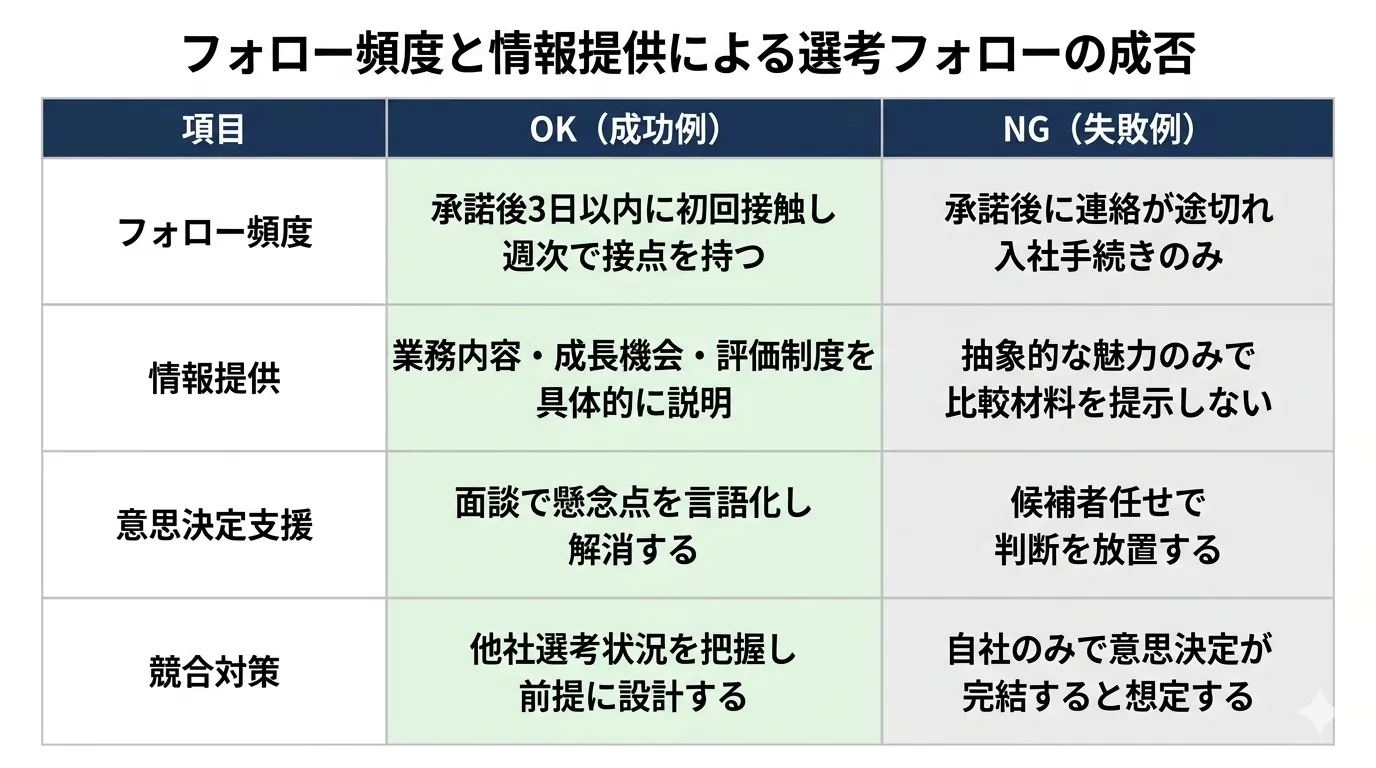
When company contact stops after offer acceptance and the next message is only onboarding paperwork, the candidate’s decision almost always wavers.
For example, if there is no contact for over a week, candidates keep taking interviews and offers from other firms, become more attracted to companies with clearer terms and growth paths, and eventually decline.
During this period, Japanese companies may think “they already accepted, so it’s fine,” but candidates keep comparing options, so this contact gap directly leads to losing out.
Insufficient decision-process design
Many companies design the hiring process but not the “post-acceptance decision-lock process,” leaving the final choice to the candidate.
As a result, evaluation criteria and value messaging are inconsistent, interviewers communicate different points, and candidates enter comparison mode with a vague understanding of the company.
In this state, it is inevitable candidates move to competitors that present clear terms and support decisions; this is not just a hiring issue but a design issue.
If it is unclear where screening or follow-up is failing, the same withdrawals will repeat unless the whole hiring process is broken down and redesigned.
Why competing offers win
Most post-acceptance withdrawals are not candidate whim; they are rational losses when compared with competing offers.
Especially against global firms and startups, differences in offer design directly drive decisions.
Gap in terms vs. global companies
Global firms and fast-growing Indian companies present not only pay but also clear details on role, tech stack, and career path, so candidates can picture growth after joining.
Japanese companies, by contrast, often decide work after placement or give only abstract explanations, making future market value hard to see from a candidate view.
As a result, candidates may choose firms with clearer growth opportunities even at slightly lower pay, and decision gaps arise that salary alone cannot explain.
Different competition by talent tier
Tier 1 talent is contested by global and overseas firms, and compared on both salary and technical environment, so it is hard for Japanese companies to win alone.
Tier 2 talent has wider skill variation, but with proper screening, companies can secure high-potential candidates, so competition is relatively softer.
In short, target tier changes both the competitive landscape and required hiring design; using one uniform approach without this premise leads to post-acceptance withdrawals.
Related articles

In hiring Indian engineers, it is risky to judge university tiers only by academic scores. This article uses local data to explain Tier 1 (led by IIT), the talent-rich reality of Tiers 2/3, and which talent segments Japanese companies should target and how they view careers.
Hiring design to prevent declines
To prevent post-acceptance withdrawal, stronger follow-up alone is not enough; you must create conditions where the decision will not be reversed.
For that, post-acceptance touchpoint design and decision lock-in are critical.
Practical design for post-acceptance follow-up
The first 72 hours after acceptance are most important; without touchpoints in this window, candidates gain time to compare other companies.
So, right after acceptance, set meetings with engineers and managers to share actual work, technical issues, and team structure, and fix a clear image of joining.
Also keep weekly touchpoints and have candidates verbalize remaining concerns and comparison points, to reduce decision wavering.
Interview design to lock in decisions
Rather than simple follow-up interviews, design them so candidates clearly verbalize their reasons for deciding.
For example, ask why they chose your company, identify concerns and comparison axes from their answer, and create a state where your advantages can be reconfirmed against other offers.
This process clarifies the basis of their decision and makes them less likely to waver when new offers arrive.
Post-offer process breakdown management
To prevent dropouts after offer acceptance, strengthen follow-up and break down the full pre-joining process for risk control.
In overseas hiring, timeline gaps especially affect decisions.
Risk control until joining
The longer the period from acceptance to joining, the more chances candidates have to compare other offers, so attrition risk must be managed at each phase.
For example, if documents are submitted two weeks after acceptance and there is then no contact for a month, candidates may keep interviewing elsewhere and withdraw after getting better terms.
So it is key to stage onboarding info, team introductions, and deeper job understanding to sustain relationships and expectations.
Handling VISA and timeline gaps
Because VISA/COE procedures can take months, plans must assume candidate decisions may change during this period.
If progress is unclear for long, candidates feel uneasy and tend to revisit other offers, so regular updates and clear next steps are essential.
Even when delays occur, being able to explain the reason and impact helps keep commitment.
Summary
In India hiring, offer dropouts after acceptance are not just communication gaps. They reflect a hiring design that fails to lock decisions, causing delayed joining, higher re-hiring cost, lower team productivity, and project slowdowns.
To succeed, treat post-acceptance as a competition phase. Reassess candidate intent and market value (including pay), and build touchpoint design plus decision support.
Also essential are a tier-based hiring strategy, first action within 72 hours after acceptance, weekly follow-ups, and clear articulation of decision reasons.
However, if this is designed and run only in-house, criteria often become person-dependent and candidate psychology is easy to misread, making consistent accuracy hard.
Especially when covering global competition, salary benchmarking, and VISA/COE process control, hiring becomes advanced design work, not just HR operations.
Phinx, drawing on hiring and organization-building experience in global companies such as Rakuten and Mercari, leverages university networks from Tier 1 to Tier 3 and provides end-to-end support: technical screening, VISA/COE handling, and post-join onboarding.
If you face issues like "We cannot identify why candidates decline after acceptance" or "Our follow-up design is intuitive and not repeatable," bringing in external expertise is one option when redesigning the hiring process from the structure level.
[Source]
India Skills Report
https://wheebox.com/india-skills-report/

Latest Articles

Stay up-to-date
Related articles

Why AI Agent PoCs Fail and Enterprise Design Essentials

Is FDE Viable for Japanese Firms? SES Differences & Setup

India New Graduate Starting Salary and Annual Income 2026 | CTC Structure and Offer Design

Stricter Visa Rules for Dispatched Engineers in Japan (2026)