Why Indian talent quits quietly and the fatal flaws in 1-on-1 design

Hiring Indian talent offers strong ambition and expertise, but projects can stall when hidden dissatisfaction leads to sudden resignations. This article explains why dissatisfaction is hard to detect, the cultural factors behind it, and why 1-on-1s often fail in Japanese firms, then gives practical design and decision criteria to prevent turnover.
Contents
※Please be noted that this blog is translated automatically by AI
Hidden dissatisfaction leads to turnover
Indian talent turnover is often seen as "sudden" even though warning signs existed in advance and were missed.
In reality, hidden dissatisfaction kept building; it was just not structurally visible.
Traits of unspoken dissatisfaction
The key is that dissatisfaction is not simply "unsaid" but "accumulates in an unspoken form."
For example, even when effort is clearly insufficient for task difficulty, the person keeps saying "no problem," while output quality gradually declines.
Companies often judge this as a skill gap, but often the cause is dissatisfaction with workload or mismatched expectations; when this is never verbalized and only reflected in evaluation, the relationship worsens.
Why it appears as sudden turnover
An engineer hired with high marks after the final interview may resign three months after assignment, saying only, "I chose another opportunity."
Managers often had not recognized issues until just before this, but in fact 1-on-1 talks were shallow and failed to capture dissatisfaction or expectation gaps.
In short, dissatisfaction does not arise suddenly; it builds unobserved and surfaces as resignation when it reaches its limit.


Why don't Indian workers complain?
Behind unspoken dissatisfaction are cultural factors and career decision structures, not personal traits.
The Japanese-company style of "frank 1-on-1 talks" does not work when that premise is not shared.
Avoidance Behavior Shaped by Culture
First, Indian talent tends to avoid direct denial or criticism in hierarchical relationships, especially toward managers with evaluation authority, to avoid damaging the relationship.
So even when dissatisfied, they may say "no problem" or "it's fine" to avoid conflict, while internally starting to consider other options, including changing jobs.
If this is read as "no dissatisfaction," the gap from reality widens and can lead to sudden resignation.
Differences in Orientation and Career Decisions
Another key point is that dissatisfaction is handled differently depending on orientation.
Indian talent often prioritizes market value and growth opportunities; if pay, position, or tech stack falls short, many resolve it through "job change" rather than negotiation.
For example, when offered higher pay or advanced projects, many decide quickly instead of voicing dissatisfaction and waiting for improvement, and this speed creates a perception gap with Japanese firms.
Why 1-on-1s don't work in Japanese companies
Invisible dissatisfaction often stems not from individual traits, but from poor company dialogue design. In many Japanese firms, 1on1s are structurally hard to make effective.
Even when held formally, they often fail to capture real information.
The Reality of Hollow 1on1s
In many workplaces, 1on1s lean toward progress checks or small talk, while key issues—frustrations and expectation gaps—are left untouched.
For example, even with weekly 1on1s, talks stay on task status and immediate problems, without probing career goals or fairness of evaluations.
As a result, things look fine on the surface while dissatisfaction keeps building.
When Evaluation and Dialogue Are Mixed
If 1on1s are tied to evaluation, honest talk becomes difficult.
When speaking with a boss who controls ratings, employees may see frank concerns as risky and intentionally stay positive.
In this situation, companies keep assuming employees are satisfied and often miss warning signs until just before resignation.
Related articles

The success of hiring Indian talent is determined not only by acquisition but also by "retention and contribution." This text explains the characteristics of teams and specific organizational design that bridge the gap between high-context Japanese organizations and thinking traits to maximize their performance.
Mistakes companies fail to spot
When dissatisfaction stays invisible, companies make decisions without noticing gaps between evaluations and reality, and this leads to turnover.
The key issue is that warning signs exist but are not used as decision criteria.
An evaluation process that misses warning signs
In many workplaces, evaluation is based only on output results, and signs of dissatisfaction or overload are excluded.
For example, even as review rejections increase, managers label it a "skill gap" and assign more work, which raises load and lowers performance.
Although this should prompt suspicion of workload or expectation mismatch, limited evaluation axes lead to the wrong response.
A structure where issues surface only right before resignation
Sometimes an engineer central to a project announces resignation just before release.
Only then are complaints shared, such as "the workload was excessive" and "I felt no growth," but decisions are already finalized, so retention fails.
In short, unless companies capture signs in real time, dissatisfaction is recognized only as turnover.
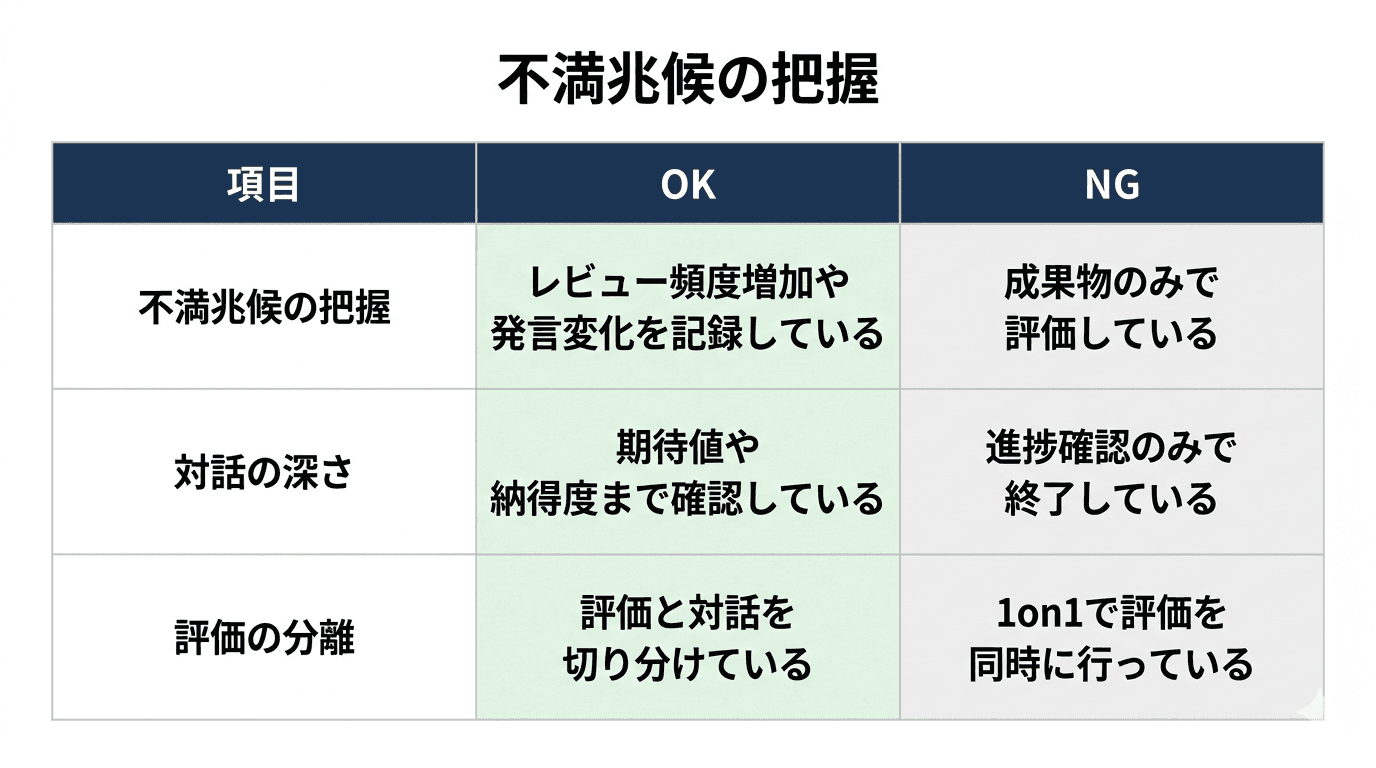
If it is unclear at which step signs are missed, break down the process from hiring to post-assignment evaluation and identify where information capture stops.
1-on-1 Design to Prevent Turnover
To make dissatisfaction visible, redesign 1on1s from "relationship building" into a "system for gathering information."
Results depend less on format or frequency and more on what the conversation is designed to draw out.
Design principles to surface dissatisfaction
First, avoid directly asking about dissatisfaction.
Questions like "Do you have any complaints?" rarely get honest answers; instead, ask about gaps from expectations and decision criteria.
For example: "Do you feel your current work increases your market value?" and "If you received another offer, what would you compare?" These reveal orientation and sources of dissatisfaction indirectly.
By eliciting career decision criteria, you can structurally capture hidden dissatisfaction.
Practical frequency and question design
Next, separate frequency and roles.
Monthly 1on1s detached from evaluation are too slow, so short weekly check-ins work better to observe small changes continuously.
For example, track shifts in satisfaction since last time and changes in work priorities to detect accumulating dissatisfaction early.
Also, fully separating these talks from evaluation interviews lowers speaking risk and increases honest responses.
Practical improvement steps
Even if you understand 1-on-1 design, it becomes formalistic again if it is not embedded in operations.
The key is to clarify who checks what and when, and run it in a repeatable way.
Steps to redesign 1-on-1s
First, break down current 1-on-1s and separate roles if "progress checks," "evaluation," and "career dialogue" are mixed.
Next, instead of directly asking complaints, standardize questions on career orientation and market value across all managers.
For example, define questions like "Which skills does your current work improve?" and "What is your advantage versus other companies?" to prevent inconsistency in information gathered by manager.
If questions are not clearly verbalized at this stage, the same mismatch will repeat.
Mechanisms to prevent operational drift
Next, you need a system to treat collected information as organizational data, not keep it with individuals.
For example, briefly record signs of orientation or dissatisfaction found in 1-on-1s and share them weekly among managers, enabling decisions not dependent on one person.
In one case, managers shared signs that a specific engineer was speaking less and giving abstract answers, adjusted work early, and prevented resignation.
In this way, designing individual dialogue to feed organizational decisions creates a state that truly works.
Summary
Turnover among Indian talent is not an individual issue. It is an organizational issue caused by a structure where dissatisfaction stays hidden and by 1-on-1 designs that fail to capture it.
So the key is not asking "Are you satisfied?" but designing a system that reveals "Under what conditions would they decide to leave?"
There are three main success factors.
First, gather signals indirectly—through career orientation and perceived market value—rather than asking complaints directly. Second, separate evaluation from dialogue to lower speaking risk. Third, treat 1-on-1 information as organizational, not personal.
Without these, dissatisfaction stays hidden and is noticed only as resignation.
However, building this in-house requires understanding India-specific career orientation and market structure, then translating that into question design and evaluation criteria, which is hard for individual teams alone.
Especially when a system can grasp orientation from university networks and screening, then connect it consistently to post-hire 1-on-1 design, repeated mismatches are greatly reduced.
If you can identify candidate orientation in advance through direct partnerships with universities including the Indian Institutes of Technology, and organize everything end-to-end—from technical screening to post-hire dialogue design and visa support—the split between hiring and retention is less likely.
If in-house design is difficult, using external expertise that can structure these elements is one option.
[Source]
India Skills Report 2024
https://wheebox.com/india-skills-report/

Latest Articles

Stay up-to-date
Related articles

Why AI Agent PoCs Fail and Enterprise Design Essentials

Is FDE Viable for Japanese Firms? SES Differences & Setup

India New Graduate Starting Salary and Annual Income 2026 | CTC Structure and Offer Design

Stricter Visa Rules for Dispatched Engineers in Japan (2026)