Labor Law Guide to Successful Hiring of Indian Talent

Hiring talent in India helps secure strong engineers, but misunderstandings of labor law often cause firing disputes or invalid contracts, and hiring may be halted. This article clarifies key regulation-contract links Japanese firms often miss, and explains practical criteria and actions to prevent trouble.
Contents
※Please be noted that this blog is translated automatically by AI
Why Indian labor laws make hiring harder
Understanding labor law is essential for hiring in India, but many Japanese firms misread the framework and face issues after onboarding.
Especially when the assumption of "operating the same way as in Japan" fails, organizational management can stall even before contracts or evaluations.
State-by-state legal differences
First, India’s labor system is shaped not only by central law but strongly by state law, so applicable rules vary by work location even within one company.
For example, Karnataka and Maharashtra differ in working hours, shop regulations, and leave systems; if headquarters applies one uniform work rule, it can immediately create legal violations.
So the premise that "one system for India works at all sites" does not hold, and location-based system design is needed from the hiring stage.
Applicability changes by employment type
In addition, laws and regulations differ by employment type—permanent, contract, or dispatch—so hiring design itself is affected.
Even if someone is hired as a contract employee, if actual work is judged as full-time employment, they may be treated as permanent staff, adding dismissal restrictions and welfare obligations.
As a result, even when contract type is chosen to cut costs, correction orders later often lead to labor costs higher than expected.
Related articles

For Indian recruitment, check skills, Japanese level, visa status, COE, referral route, and contract type together.


Common misconceptions Japanese companies fall into
The issue with Indian labor law is not complexity, but Japanese companies’ assumptions.
Especially companies that believe contracts can control everything tend to create bigger gaps with legal rules, leading directly to trouble.
Misbelief that contracts can control everything
Many companies think, "If it is written in the employment contract, it can be enforced," but in India labor law overrides contracts, so this assumption fails.
For example, even if overtime pay is included in fixed salary by contract, if state rules require separate payment, that clause is invalid and unpaid amounts can be claimed.
In short, contracts are not freely designed; they are valid only within legal limits, so the idea of "adjusting by contract" itself must be reconsidered.
Misunderstanding of probation and dismissal
Another common misunderstanding is that employees can be freely dismissed during probation.
In reality, under certain conditions, valid grounds and procedures are required, and especially when deemed long-term employment, simple dismissal may not be allowed even during probation.
As a result, a company may notify dismissal for poor performance, but the employee may file an unfair dismissal claim, and resolution can take several months or more.
Workplace issues from labor law misunderstandings
Misunderstanding labor law is not just a system issue; it directly affects post-hire operations.
Errors in dismissal or pay decisions can quickly escalate into troubles that halt the whole organization.
Dismissal disputes and litigation risk
There are real cases where a low-performing engineer was told of immediate termination during probation, but then filed with the labor bureau, triggering the company’s duty to explain.
If the company has no evaluation records or improvement guidance history, it cannot prove the dismissal was valid, increasing the chance of reinstatement or compensation claims.
In short, dismissal is not just a "decision" but a "proof process"; it must be designed on the premise that it cannot be executed without an evaluation system and records.
Turnover caused by payroll and benefits violations
In payroll design, if minimum wage and statutory benefits are not understood correctly, violations can occur unintentionally.
For example, an offer may follow market rates, but if state minimum wages or systems such as the Provident Fund are not considered, employees may find take-home pay lower than expected after joining and leave soon after.
This is not merely a pay issue; it leads to the view that "the company does not understand the law," which then harms future hiring.
If it is unclear at which step legal understanding is missing, break down the hiring design itself and organize decision criteria for contracts, evaluation, and pay.
Overlooked key regulations
In Indian labor law, Japanese firms often overlook day-to-day areas like pay, working hours, and leave.
Hiring can still proceed even with unclear understanding, so issues surface after onboarding.
Minimum Wage and State Standards
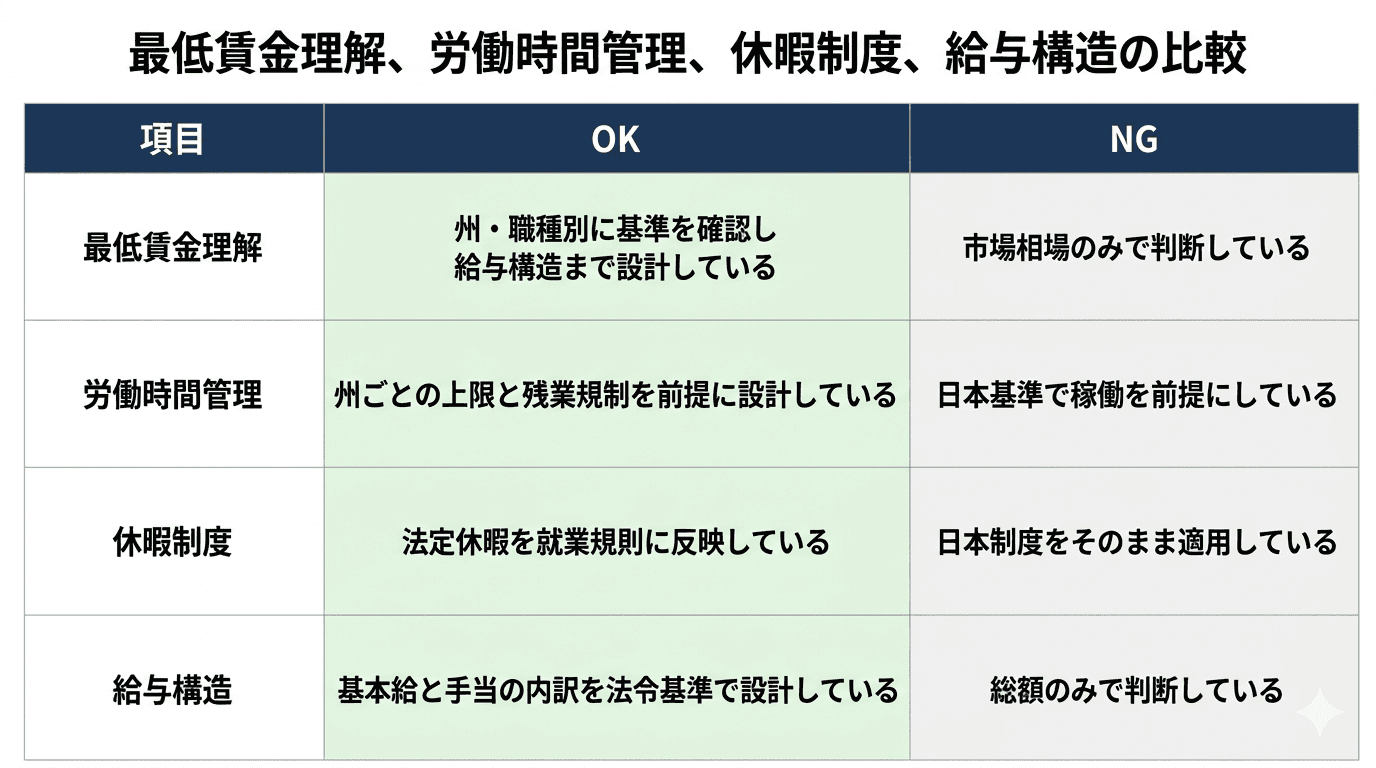
Minimum wages are not nationwide; they are set in detail by each state, and also differ by job type and skill level.
So the view that "engineers are paid market rates, so it's fine" is not valid; you must check case by case whether the relevant state and job category minimum is met.
Also, depending on the breakdown of base pay and allowances, it can be treated as a violation even if total pay exceeds the standard, so payroll design should be judged by structure, not total amount.
Working Hours and Leave Rules
Rules on working hours and leave also vary by state, and limits on overtime and treatment of weekly holidays are strictly controlled.
For example, if a project is designed around long hours to match Japan HQ standards, it may violate local law and require correction through employee reports or audits.
As a result, staffing may need adjustment during execution, causing delays and extra costs, and affecting operations after hiring.
Contracts and Regulations
The most misunderstood point in hiring in India is the priority between contracts and legal rules.
Many assume proper contracts can avoid risk, but in practice that premise often fails.
Law takes priority over contracts
In India, labor laws are mandatory, so even if a company and employee agree on contract terms, they are invalid if they violate the law.
For example, even if both sides agree to shorten the resignation notice period, if applicable law or state rules require a longer period, that contract term will not apply and the company will face extra obligations.
In short, contracts are not a risk-avoidance tool by themselves; they work only when compliant with law, so legal regulation must always be the starting point.
Pitfalls of global contracts
Another issue is applying a global template contract created by the Japan headquarters directly in India.
In practice, there are cases where an employment contract drafted to Japanese standards was offered to an Indian engineer, and a local law firm flagged multiple clauses as invalid or potentially non-compliant, forcing re-contracting.
In such cases, hiring schedules are delayed, trust from candidates drops, and the risk of offer rejection ultimately rises.
Risks of Violations
Labor law violations are not solved by simple correction; they have long-term effects on both hiring and operations.
In India especially, employee protection is strong, and poor employer awareness quickly becomes risk.
Penalties and administrative action
When violations are found, companies may face not only fines and corrective orders but also labor bureau investigations.
For example, if minimum wage or benefits noncompliance is identified, back payments may be required, creating unexpected lump-sum costs.
If correction is delayed, additional penalties may apply, leading to losses far above hiring costs.
Employer brand damage and rehiring difficulty
More serious is the rise in hiring difficulty when violations spread in the candidate market.
In practice, labor-condition issues can spread on social media and review sites, causing multiple offer declines and making later talent-pool building difficult.
In India, competition with foreign firms is intense, and candidates value not only pay but also compliance and security, so once trust is lost, recovery takes a long time.
Practical criteria
Results in complying with Indian labor law depend not on whether you understand it, but on the level at which you can design for it.
So, before hiring, you must clarify criteria and eliminate person-dependent operations.
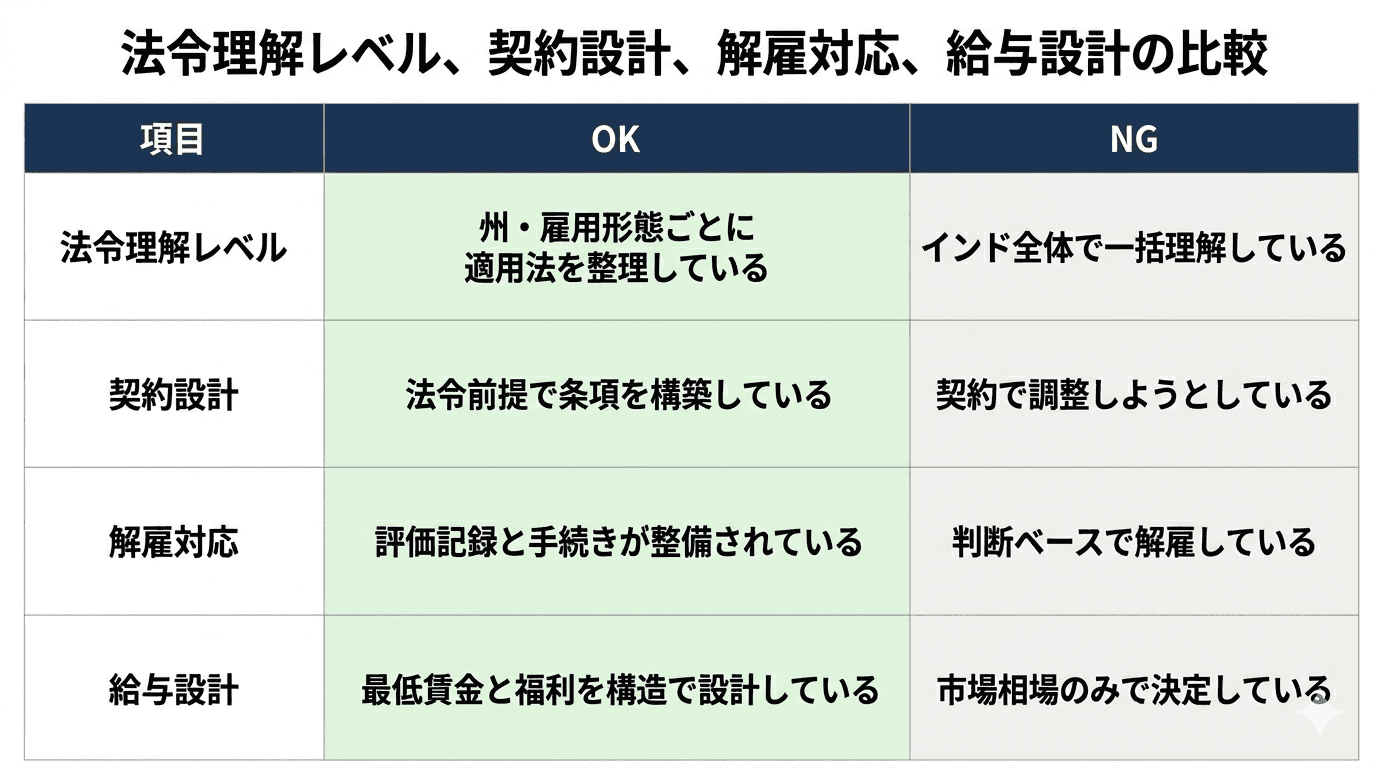
Compliance Level: OK/NG
First, treat legal compliance not as a checklist but as decision criteria.
For example, for minimum wage, just saying "checked" is not enough; it must be designed by state, job type, and pay structure.
Also for termination, it is not enough to think "it's fine because of probation"; only when evaluation records and an improvement process remain can it be called practical level.
Pre-hiring Checks
In practice, how deeply you break down and verify items before hiring greatly affects later trouble rates.
Specifically, the standard is whether you can define in advance four points: state law of work location, applicable law by employment type, pay structure, and termination process.
If hiring proceeds while these stay vague, post-hire system revisions become necessary, directly affecting employee trust and project progress.
Labor Law-Compliant Design
Labor law compliance must be built into the hiring process, not handled case by case, to ensure consistency.
In India especially, rules should not shift before and after hiring; a consistent design is required from the start.
How to Build It Into Hiring
First, labor law compliance should be built in from talent pool creation, not right before offering.
For example, when targeting Tier 1 talent, pay ranges and benefits are usually designed above legal standards, so issues are less likely. But when hiring broadly from Tier 2, pay structures vary more, and accuracy on minimum wage and benefits becomes critical.
Therefore, unless target segment and pay design are defined together, the risk of post-hire policy adjustments increases.
How to Use Local Partners
On the other hand, trying to cover everything in-house makes it hard to handle state-by-state legal and operational differences, and decisions become person-dependent.
In practice, some companies that designed systems without local expertise were later cited for multiple violations, had to fully revise policies, and even paused hiring temporarily.
So a practical choice is to build a structure that can judge across legal, hiring, and compensation design, or use local partners to remove risks during the design stage.
Summary
Labor law compliance in hiring in India must be treated not just as legal knowledge but as a core hiring design issue.
Because misunderstanding laws does not stop at individual issues like dismissal disputes or payroll mismatches; it can directly cause project delays and employer brand damage, lowering company-wide productivity.
The key to success is whether hiring is designed with regulations as a premise.
Specifically, it is critical to organize applicable laws by state, design systems starting from law rather than contracts, and set practical criteria covering evaluation records and salary structures.
If these remain unclear, operational distortions will appear after hiring, and repeatable hiring will not be possible.
At the same time, there are limits to handling all this internally.
Continuously tracking differences in state regulations and real operations while consistently designing hiring, contracts, and labor management is difficult, and this area is prone to person-dependence and judgment errors.
Phinx, based on hiring and organizational build experience at global organizations such as Rakuten and Mercari, leverages a university network from Tier1 to Tier3, including the Indian Institutes of Technology (IIT), and provides end-to-end support from screening grounded in technical understanding to VISA/COE handling and onboarding design.
Rather than simple recruitment, it supports hiring design itself with legal compliance in mind, preventing post-hire troubles.
If you face issues such as unclear evaluation criteria causing concern about dismissal risk, or difficulty organizing the relationship between contract design and regulations, please consult Phinx.

Latest Articles

Stay up-to-date
Related articles

Why AI Agent PoCs Fail and Enterprise Design Essentials

Is FDE Viable for Japanese Firms? SES Differences & Setup

India New Graduate Starting Salary and Annual Income 2026 | CTC Structure and Offer Design

Stricter Visa Rules for Dispatched Engineers in Japan (2026)